
MSU Preschool With Play-Based Curriculum to Add Third Location
A group of three year olds burst out of a classroom in a Michigan State University Child Development Laboratory preschool, ready to burn energy on the playground before they are reminded by their teacher to suit up on the chilly March day: snow pants, jackets, hats.
Little voices fill the hall as the kids suit up: “I can do hard things,” one asserts. “Where are my boots?” another stresses. Their teacher flutters her attention from one student to the next. “Do you want to do it yourself?” she asks one child. “What is our first step?” she asks a frustrated youngster.
The Child Development Laboratory has been providing specialized early childhood care and education for nearly 100 years. There are currently laboratory locations in Haslett and East Lansing, and one more will come to Lansing’s east side in the coming months, providing much needed preschool slots in an area with few options.
The preschool is unique because the lead teachers are also professors at Michigan State University who teach courses in human development and family studies. Other teachers often hold bachelor’s or even master’s degrees. The schools are assisted by Michigan State University students getting valuable hands-on experience early in their careers.
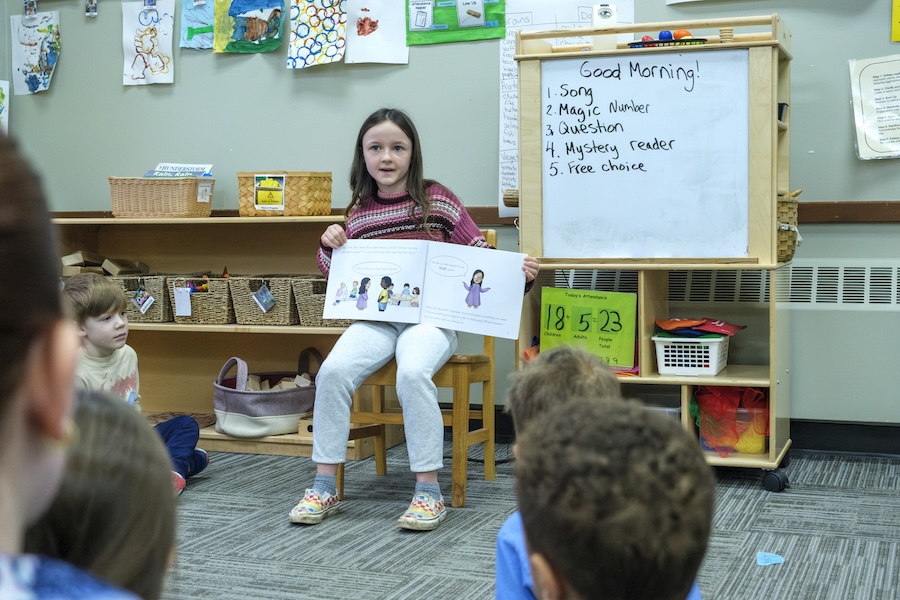
The Child Development Laboratory educators are tasked with utilizing a play-based approach to help nurture children’s development in six key areas: aesthetic, affective, cognitive, language/communication, physical and social.
“The environment of an early childhood classroom is different than an elementary classroom,” said Jessica Landgraf, assistant director for the Child Development Laboratory. “What we’re teaching here is helping to prepare them to be successful in those classrooms.”
Aesthetic development focuses on the arts such as drawing, music and movement. Affective development is the ability to understand and recognize emotions, and talk about how things feel. Cognitive development focuses on early math and science skills. Language/communication development focuses on pre-literacy skills like having discussions with peers. Physical development focuses on fine and gross motor skills like zipping up a jacket and running. Social development focuses on interactions with other kids.
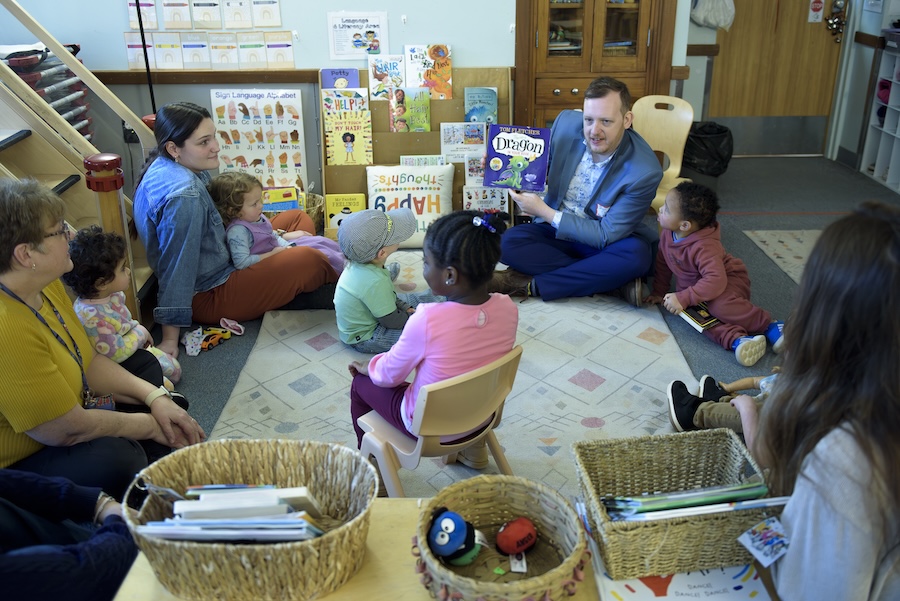
90% of brain development occurs by age five, making the first few years of a child’s life critical. Experiences in preschool set the tone for developing higher level abilities like motivation, problem solving and social skills later on in life.
“Infants and toddlers were just fascinating to me, I loved working with them… for me it’s intellectually stimulating because there’s so much to observe and there’s so much to try to figure out,” Landgraf said.
Since every child is different, there is no specific timeline to have children meet milestones, the goal is simply to have the kids ready for kindergarten.
The preschool utilizes a play-based approach to education through exploration of materials and conversations, which can include teachers posing open-ended questions for the children to encourage curiosity.
For example, instead of having a child count objects pictured on a piece of paper, a teacher would give them tangible objects to tally off. This not only helps kids learn to count, but can make it easier to pick up more advanced concepts like addition and subtraction later on.
“The fact that they can actually move those things [objects] and explore those things … that is going to stick in their brain and solidify much faster than if you’re only giving them pencil [and] paper, if you’re only telling them about it,” Landgraf said.
The Child Development Laboratories are also generating new information on early childhood behavior and education through research. For example, the centers have supported research into how children understand emotions and early literacy development.
There are currently two Child Development Laboratories, one in East Lansing that accepts infants through four years and serves around 90 to 100 students. There is also a Haslett location that accepts three and four year olds.
There is a third location that will soon open for infants to four year olds in Lansing, bringing a preschool to an area that is considered a child care desert.
“There aren’t enough available child care spaces for the number of children in the area, so it’s an area that lacks child care where there needs to be child care,” Landgraf said.