
As Outrage Grows Over Arrest Video, Critics Point to Broader Concerns With East Lansing Police
After a video surfaced over the weekend of an East Lansing Police Officer repeatedly punching a 20-year-old Black woman with her arms behind her back, many in the community are demanding answers for what they say is another incident of unwarranted use of force from ELPD against a person of color.
In response to the nearly 14-minute video where an officer is seen punching the woman, Myana Collins, as she lays facedown on the ground, East Lansing released a statement Monday saying that the video “does not capture the entire incident.” The city urges anyone with information or video footage from the incident to contact ELPD.
Collins sustained numerous injuries to her arms, legs, back and head, shown in images published online by Collins’ mother Shannon.
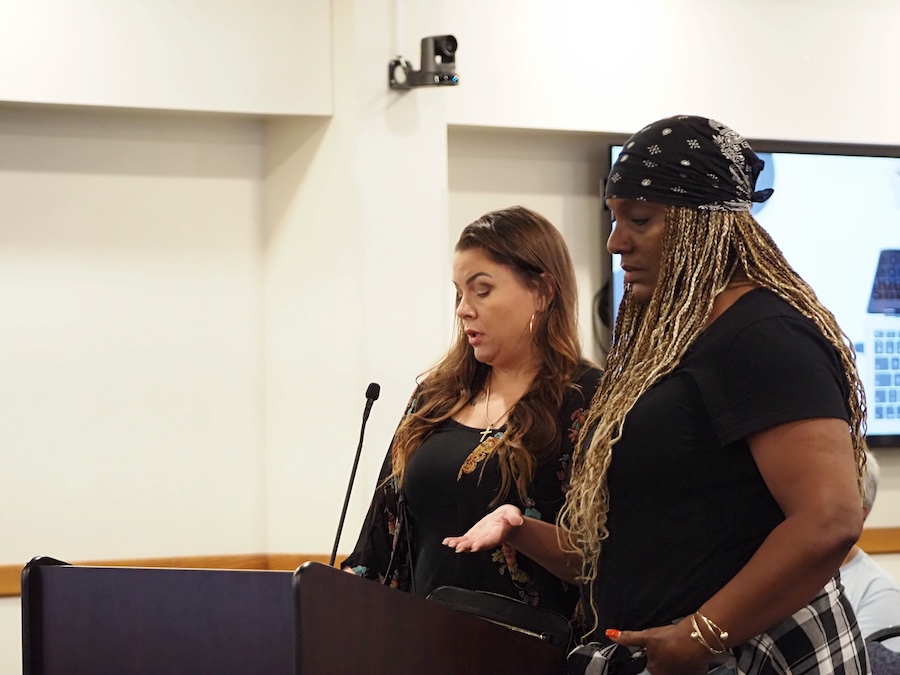
Some time after police arrested Collins, she was taken to the hospital for a scan of her head, Shannon told members of the East Lansing Independent Police Oversight Commission, or ELIPOC, during their Wednesday meeting where public comment was solely focused on the incident.
“We have all painfully watched the video footage. We watched Myana handcuffed and restrained by multiple officers, being punched while she lay on the ground, screaming, terrified,” Shannon said. “We want to know why she was arrested. Why that level of force was used against a restrained young Black woman … No family should have to watch footage like this … she was not charged. She was released. We don’t know why this happened. We want answers and we want truth and transparency.”
The city has not given a reason why officers arrested Collins outside of Harper’s Restaurant and Brew Pub around 1:30 a.m. Sunday morning.
East Lansing Info emailed all five members of the City Council and Interim City Manager Annette Irwin seeking comment. Irwin referred ELi to the city’s statement. The only member of the City Council who responded was Councilmember Kerry Ebersole Singh, who wrote in a statement that she is “deeply upset” by the video and that the incident requires a full and transparent review.
“To Ms. Collins and to every resident of color who saw that video and felt afraid: I hear you, I’m listening, and I am committed to addressing your concerns through action, not just words,” Singh wrote in her statement.
When Taylor Drozdowski, who recorded the video that has gained attention, first saw Collins the night of the incident, she said Collins was sitting with her head between her knees, so visibly drunk she was breathing heavily on the ledge of the planters near the bar line outside of Harper’s.
“I beat myself up every single day since this happened because I should have been the one to call an ambulance,” Drozdowski said. “I was clear minded. I hadn’t drunk anything and I’m a mother. I should have called that ambulance.”
Drozdowski, a Macomb County resident, said she was in town so she could go to Harper’s with her friends and because she is trying to do content creation, she started recording outside the bar.
Drozdowski said as she went to take a video of the crowd outside of Harper’s she captured the police’s interaction with Collins by “the grace of God.”
Immediately the situation was made chaotic by the officers, Drozdowski said, as the officers scared Collins as she was at the front door of the bar which caused her to fall to the ground where police deployed a taser on her at close range.
Collins was not resisting arrest and was lying with her arms handcuffed behind her back when the officer began punching her, Drozdowski said.
In the video, Collins is heard screaming “please help me” and “they’re being racist” for nearly four minutes before the officer begins striking her.
“She kept screaming, he got frustrated [and] punch[ed] her to get her to shut up,” Drozdowski said. “They could have killed her … That baby girl was hunched over, she was so drunk that she was she couldn’t even breathe … All those knees on her back … She was terrified. I was so afraid that at any moment, a gun would be pulled.”
The scene was pure chaos, Drozdowski said, adding that she and her friends exited Harper’s because it made her uncomfortable how many people were inside that were clearly underage.
“I’m almost 100% certain that [Harper’s] would have a lot less chaos if they didn’t invite so many children into their establishment,” Drozdowski said.
Watching a 20-year-old Black woman scream for her life on the ground as an officer pounds on her back was a difficult scene to watch on video, but not a surprising one, said Ernest Conerly who serves as the chair of the city’s police oversight commission.
The East Lansing Police Department has a culture problem from its top leaders to its youngest officers, Conerly said, pointing at several incidents in the last year where the department’s use of force against young people of color has been called into question. One of these incidents includes the arrest and pepper spraying of two Black men around this time last year where the city said the pair was being criminally charged with fighting, only for security footage to reveal one of the men had been attempting to prevent any conflict.
East Lansing police are impatient and unconcerned with providing clear instructions before enacting violence towards individuals of color, Conerly said. As each incident of violence by police passes by without accountability, officers learn there is no recourse for their actions and no responsibility to treat human beings with dignity.
“There’s no rationale to treat any human being that way. I don’t care what they have done, if they are unarmed, not actively engaged in any sort of violence or destruction or anything, there’s no rationale to treat anybody like that whether it’s man or woman, young or old, there’s no rationale to treat anyone like that,” Conerly said. “If a man can get that angry, if a police officer can get that angry and that frustrated that they strike a human being in a way that that officer was striking her, they don’t need to wear a badge. If anything, they need mental health counseling.”
It’s ironic that an incident involving a woman with her hands tied behind her back is now before the city’s police oversight commission, which has its hands tied behind its back, ELIPOC member Chris Root told ELi.
Changes to the ordinance governing ELIPOC made last year largely declawed the already limited authority the commission had to address citizen concerns over local law enforcement’s actions. Amongst the relegations, commissioners are barred from commenting during meetings about complaints made against the police department until after they are resolved and commissioners may not say police employees names during meetings.
An analysis by ELi showed that ELPD officers used force more than 50% more often in 2025 compared to the year prior. As the city continues to face backlash about its police department’s use of force, particularly against individuals of color, another concern is being brought to light that Root says shows police policy is headed in the wrong direction.
In late July, at the inquiry of the policy committee of ELIPOC, ELPD sent revisions it is considering to its use of force policy which includes removing a mention about preserving sanctity of human life in regards to use of force.
The policy currently reads:
“The Department recognizes and respects the sanctity of each human life and prioritizes preserving human life and safety for all. In vesting officers with the lawful authority to use force to protect the public welfare, it is the policy of the Department that officers shall only use an objectively reasonable amount of force to effectively bring an incident under control while protecting the lives of Department personnel and others”
The revision ELPD is proposing reads:
“The East Lansing Police Department will use only the amount of force which is objectively reasonable and necessary under the circumstances in response to resistance and /or attack, up to, and including, the use of deadly force, to effect a lawful arrest and/or to lawfully perform a duty. ELPD officers are authorized to use reasonable levels of force to protect themselves, other officers, or other persons, against attack, or threat of attack, by persons or animals.”
Police officers are charged to protect and serve, Root said, and ‘protect’ extends to their own ability to make it through their shift and go home at night. But there should be a profound and clearly stated commitment that law enforcement’s primary objective is to, whenever possible, preserve the life of everyone.