

Draft Report Finds Black People More Likely to Face Severe Force From ELPD Officers
In 2025, East Lansing Police Department officers were much more likely to use severe force against Black people than white people, even when controlling for factors like resisting arrest, according to a 25-page draft analysis authored by Adrian College professor Cedrick Heraux.
The city’s Police Oversight Commission hired Heraux to complete the report by analyzing written narratives and raw data describing incidents where ELPD officers used force while on the job. Incidents captured in the data range from minor encounters where an officer grabs a person’s shoulder to keep them from walking away to more serious uses of force like an officer pointing their handgun at someone or pepper spraying them.
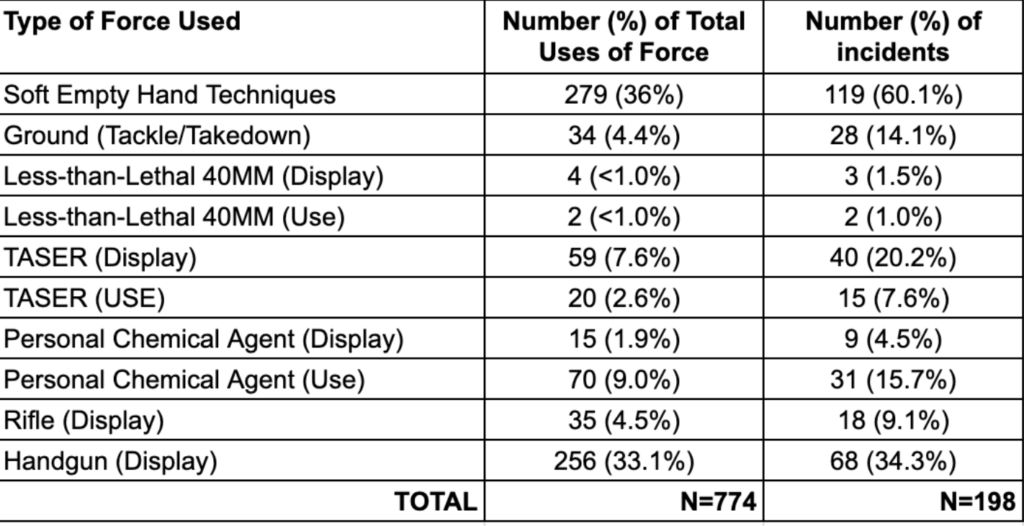
The draft report confirms earlier reporting by East Lansing Info that there was a more than 50% spike in the number of incidents force was used in 2025 compared to 2024 and a widening racial gap. ELPD officers used force during 198 incidents against 274 individuals in 2025, up from 131 incidents where 171 people were subjected to force in 2024.
About 54% of those subjected to force were Black and 31% were white, according to the report. This was a big shift from 2024, when about 46% of the individuals who force was used against were Black and 49% were white.
The draft report comes amid a series of controversies involving ELPD officers over the past year that have drawn sharp criticism from the Lansing NAACP and other racial equity advocates. The Lansing NAACP branch has called for the resignation or removal of ELPD Chief Jennifer Brown, who was in her first year leading the department in 2025.
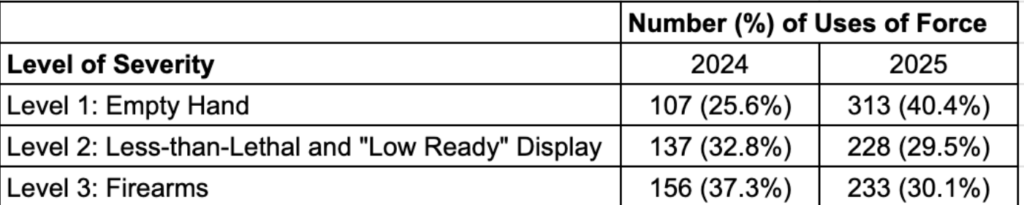
At Wednesday’s Police Oversight Commission meeting, Heraux presented his report on ELPD use of force, highlighting a racial gap that exists even when factors like resisting arrest and combative behavior are factored in. In addition to Black and other non-white people being more likely to have force used against them, these groups were more likely to be subjected to a higher degree of force. Heraux categorized the levels of force used by officers into three categories:
- Level 1: Empty-hand techniques, ranging from an officer placing a hand on a subject’s arm to tackles and strikes.
- Level 2: Less-than-lethal weapons, such as pepper spray or tasers.
- Level 3: The display or use of firearms.
“When you take into consideration all the different behaviors and categories, Black subjects are 173% more likely to have more severe force be used against them,” Heraux said at Wednesday’s meeting. “For subjects in the ‘all other race category’ that is 265% … when we hold those things constant, race still matters.”
The report found that while there were increases across all three levels of severity, the category capturing the least severe incidents saw the largest growth.
The report also found that officers often used force when responding to incidents that can be categorized as “large fights” involving multiple people, with about 36% of incidents fitting in this category.
Officers are much more likely to use severe levels of force if they believe they are encountering a person who is armed, the report says.
This finding prompted questions from Police Oversight Commissioner Simon Perazza at Wednesday’s meeting. Perazza said he is concerned about bias playing a role in who police perceive to be armed.
“I’m seeing this idea that if you’re armed you’re dangerous and in this country that’s crazy,” Perazza said. “We’re all dangerous, we’re all armed, so why are they [Black men] getting singled out?”
Heraux noted that officers did not explain why they believed a suspect to be armed in narrative reports. However, he said that police are given broad discretion to conduct stops on people they believe are carrying weapons, even though it’s legal to carry guns in Michigan.
More than 40% of those who force was used against were not arrested and charges were not sought against, the report says.
Further, Heraux noted that out of 274 total people who were subjected to police force, 48 individuals were charged only with resisting and obstructing arrest. However, the use of force data supplied by police stated that four of those individuals did not resist arrest.
“I’m not sure how that happened,” Heraux said, adding that these cases may have been data entry errors. He explained that passive resistance can be as simple as failing to walk over when ordered.
“These four individuals apparently didn’t even meet that minimum threshold, but they have been charged.”
The data also showed that white officers use higher levels of force than Black officers when encountering similar subjects. Heraux highlighted a critical staffing issue: the department has many new officers and veteran officers, but a gap exists where there are few mid-career officers with two to five years of experience at the ELPD. At Wednesday’s meeting, Heraux said this can lead to less experienced officers training new officers.
Moving forward, Heraux provided the Police Oversight Commission with three primary policy recommendations: The ELPD needs to collect clearer data, the increase of level one force should be analyzed and policy language that emphasizes the importance of preserving human life should be protected.
Heraux noted that the lack of consistent data collection has been a persistent problem, pointing out that tracking was inconsistent across both 2024 and 2025. He explained that there have been multiple iterations of use of force narratives, with written reports sometimes being less detailed. He emphasized that establishing clear, consistent data is vital to identifying and understanding trends.
As for analyzing force, he recommended the commission learn why empty-hand force spiked and determine if it is a result of training. Additionally, he added that the department should utilize research and evidence-based, free training opportunities that are widely available.
Earlier this year, the police department shared proposed revisions to its use of force policy at the request of the Police Oversight Commission policy committee. Notably, the revised policy removes all mentions of preserving the sanctity of human life in the ELPD’s use of force policy. Heraux defended keeping the phrase because it humanizes people police interact with.
“[It’s] not just about the use of lethal force, sanctity of life as a policy decision … is really about approaching encounters with individuals as human beings rather than a subject or suspect,” Heraux said. “That is a point worth fighting for.”