
After Having Enforcement Capabilities Restored, ELPD Issued Four Tickets For Loud Exhaust This Year
The East Lansing Police Department has issued four citations for loud exhaust this year after the City Council amended an ordinance in January to allow officers to ticket drivers of excessively noisy vehicles.
In 2024, the City Council passed an ordinance prohibiting the ELPD from conducting traffic stops based solely on certain minor, non-safety-related violations, a practice often referred to as pretextual stops. Supporters said the ordinance was intended to reduce bias in policing by limiting stops that rely heavily on officers’ discretion.
At the time, the most controversial inclusion in the ordinance was loud exhaust, as residents had complained about cars with modified mufflers interrupting public events, evoking anxiety and disrupting sleep.
After the council was told that state law requires a decibel reading to enforce laws against modified mufflers and police cannot pick up decibel readings on moving vehicles, the ordinance was put in place. Former City Manager Robert Belleman later told ELi that East Lansing police had only issued one citation for loud exhaust since 2020.
In January 2026, the council amended the ordinance to exclude loud exhaust, as police said the ordinance was preventing officers from issuing tickets. ELPD Chief Jennifer Brown said police would focus on pulling over cars with modified exhaust systems and initially issue warnings to educate drivers about the law.
Some community members pushed back against the change, arguing that allowing police to stop drivers for loud exhaust without an objective way to measure noise levels could invite biased enforcement and make citations difficult to uphold in court.
On Monday, the ELPD responded to a records request from East Lansing Info by providing citations issued for loud exhaust this year. Seven incidents were documented – four where citations were given for loud exhaust and three other incidents where a driver was cited for a different infraction and warned for having loud exhaust.
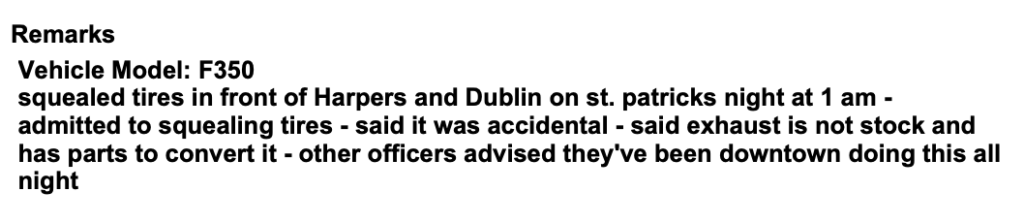
The infractions typically took place late at night, with six occurring between 11 p.m. and 1:30 a.m. The violations were mostly recorded near downtown, with four taking place on Albert Avenue, two on Grand River Avenue and one on Michigan Avenue.
When the council reinstated enforcement of the loud exhaust provision, Brown said it could be applied to motorcycles. However, the citations obtained by ELi show that only cars have been cited.
Mayor Erik Altmann, who was a lead proponent for enforcing loud exhaust violations, said he knew state law would make it difficult to enforce a noise ordinance on cars. But he said his impression is that he’s observed fewer excessively loud cars.
“I think there’s more ways than one that an ordinance can work,” he said, “because an ordinance communicates to the public what’s acceptable and not acceptable.”
Altmann compared the loud exhaust regulation to the city’s fireworks ordinance.
When the City Council put heavier restrictions on fireworks in 2012, it significantly helped to curb usage. The fireworks ordinance was also hard to enforce, but people stopped using them outside of allowed times because the rules were made clear, Altamnn said.
Altmann said he thinks the city should gather more feedback on if residents from different neighborhoods and people who are frequently downtown believe there have been fewer excessively loud cars this year.