

Council Roundup: East Lansing Turns Attention to Loud Cars, Hires a Communications Coach for its Police Chief at Busy Meeting
Amid backlash after an ELPD officer pepper sprayed two Black men downtown and Police Chief Jen Brown made a comment that has been broadly condemned as racist, the East Lansing City Council moved to hire a communications coach for the city’s police chief.
At Tuesday’s City Council meeting, council approved a package of contracts that aim to address “heightened community concern, particularly within communities of color.” Among those is a three-month contract for nearly $25,000 with Mario Morrow and Associates to provide one-on-one communications and media coaching to Brown, strategic communications planning, assistance with messaging and community engagement.
Additionally, council approved contracts to provide training for the police department on three different topics: Mental health and deescalation, cultural competency and implicit bias. Those contracts combine to total just over $50,000.
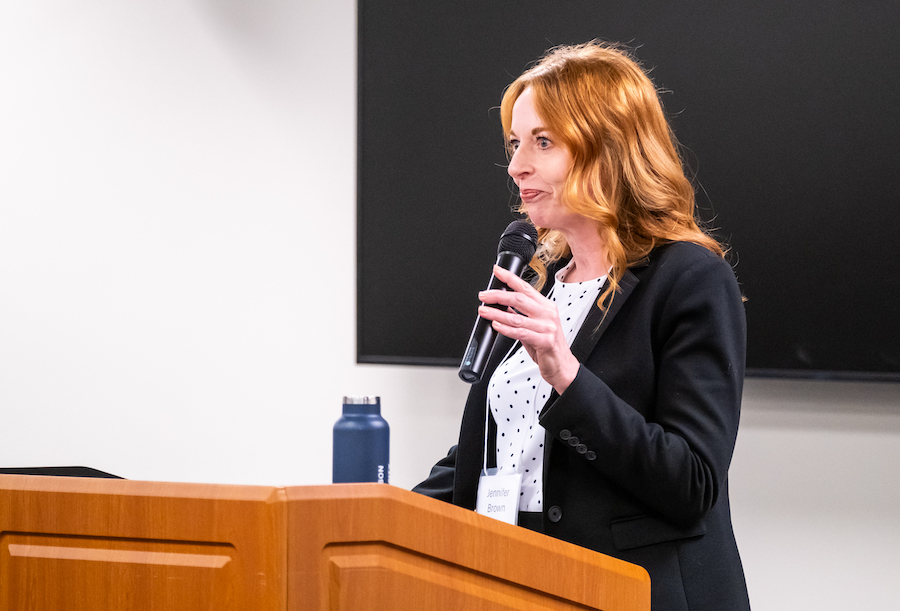
The meeting saw speakers during public comment who continued to demand Brown resign or be removed from her post, including some who held signs critical of the police chief. NAACP Lansing Branch President Harold Pope said the city’s proposed actions don’t go far enough, and the city needs to apologize to the two men pepper sprayed by ELPD who were named in a misleading press release about the incident.
“Publicly addressing this incident is not only the right thing to do, but is also necessary to begin healing the wounds caused by these actions,” he said.
The pepper spray incident and press release are now the subject of civil lawsuits filed in federal court. Next Tuesday, Dec. 16, council is set to meet in closed-session to discuss a settlement or trial strategy related to the litigation.
Council moves to expand ELPD’s road patrol, address loud cars.
The biggest topic of discussion at Tuesday’s meeting was a package of public safety recommendations crafted by a team of city and police employees. One recommendation – a potential ban on public camping and loitering in parking areas – was covered by ELi in a report earlier this week.
Another recommendation from the committee is to remove “loud exhaust” from a list of pretextual stops the East Lansing Police Department is barred from stopping cars for. Loud cars with modified mufflers that disrupt public events and trigger anxiety have been a common complaint at public meetings. Tuesday, council voted to further consider amending an ordinance that instructs ELPD to not pull drivers over for “loud exhaust.”
Last year, City Council adopted an ordinance to end pretextual stops in East Lansing as part of an effort to reduce bias in policing. At the time, many residents spoke out against including “loud exhaust” as a provision in the ordinance because of the prevalence of loud cars downtown.
The ordinance was adopted in a 4-1 vote after it was revealed that ELPD does not have the technology to pick up a decibel reading on moving objects, leading to questions about if a noise ordinance on cars is enforceable.

Council passed a first reading of the pretextual stops ordinance amendment Tuesday and will have to vote in favor of a second reading at a future meeting for an ordinance change to go into place.
Council also instructed the city manager to communicate with the city’s lobbyist about changes to state law regarding emissions and aftermarket changes to vehicles. Cars with mufflers modified to sound like gunshots have been a top complaint from residents at meetings.
While the committee only recommended amending the pretextual stops ordinance to remove loud exhaust, Councilmember Steve Whelan, who was elected last month after working as an ELPD officer for more than 25 years, said he thinks other parts of the ordinance should also be repealed.
Council should also consider removing tinted windows, registration plate lighting violations, cracked windshield, and cracked or broken tail lights from the ordinance, Whelan said.
Council also voted to amend this fiscal year’s budget to add two more officers to ELPD. The officers will primarily handle traffic enforcement.
The city will spend about $189,000 from its reserve funds to hire the two officers, but because the new positions will primarily enforce traffic laws, the revenue generated by issuing more tickets should offset that cost, City Manager Robert Belleman said.
“I’ve sat here, I don’t know for how many meetings, and how many hours listening to residents talk about noise, talk about speed, talk about [drivers] ignoring all of the traffic control devices,” Belleman said. “We don’t have enough officers on the force dedicated to traffic enforcement. I think the fact that you invest in amending the budget for the $189,000 to dedicate to two officers to do just that will be impactful.”
Additionally, council voted to have the city manager or a designee review placement of lighting and additional cameras downtown, another recommendation from the public safety committee.
East Lansing assembles a task force to address the city’s financial challenges.
With the city budgeted to run at a deficit this fiscal year, City Council appointed seven volunteers to serve on a committee that will conduct a thorough review of the city’s finances and make recommendations.
The committee approved by council will include: Ann Holmes, Timothy Irvin, Roberta Jameson, Robert Kleine, Dale Kruithoff, David Lancaster and Jill Rhode. Council voted to make Rhode, who served on a similar city task force about a decade ago, the committee’s chair.
Each of the members appointed to the team has experience in finance, pension or benefit management, and Kleine served as the state treasurer under former Michigan Gov. Jennifer Granholm.
The committee is scheduled to carry out its work over six months, though council can extend the timeline if it desires.
Councilmember Kerry Ebersole Singh requested that the committee deliver an interim report by April 30, which is weeks before council will approve a budget for the next fiscal year.
A cutline in this story was updated to correctly characterize what is included in the pretextual stops ordinance.