
East Lansing is Seeing More Extreme Rain Storms, a New Plan Prepares for a Wetter Future
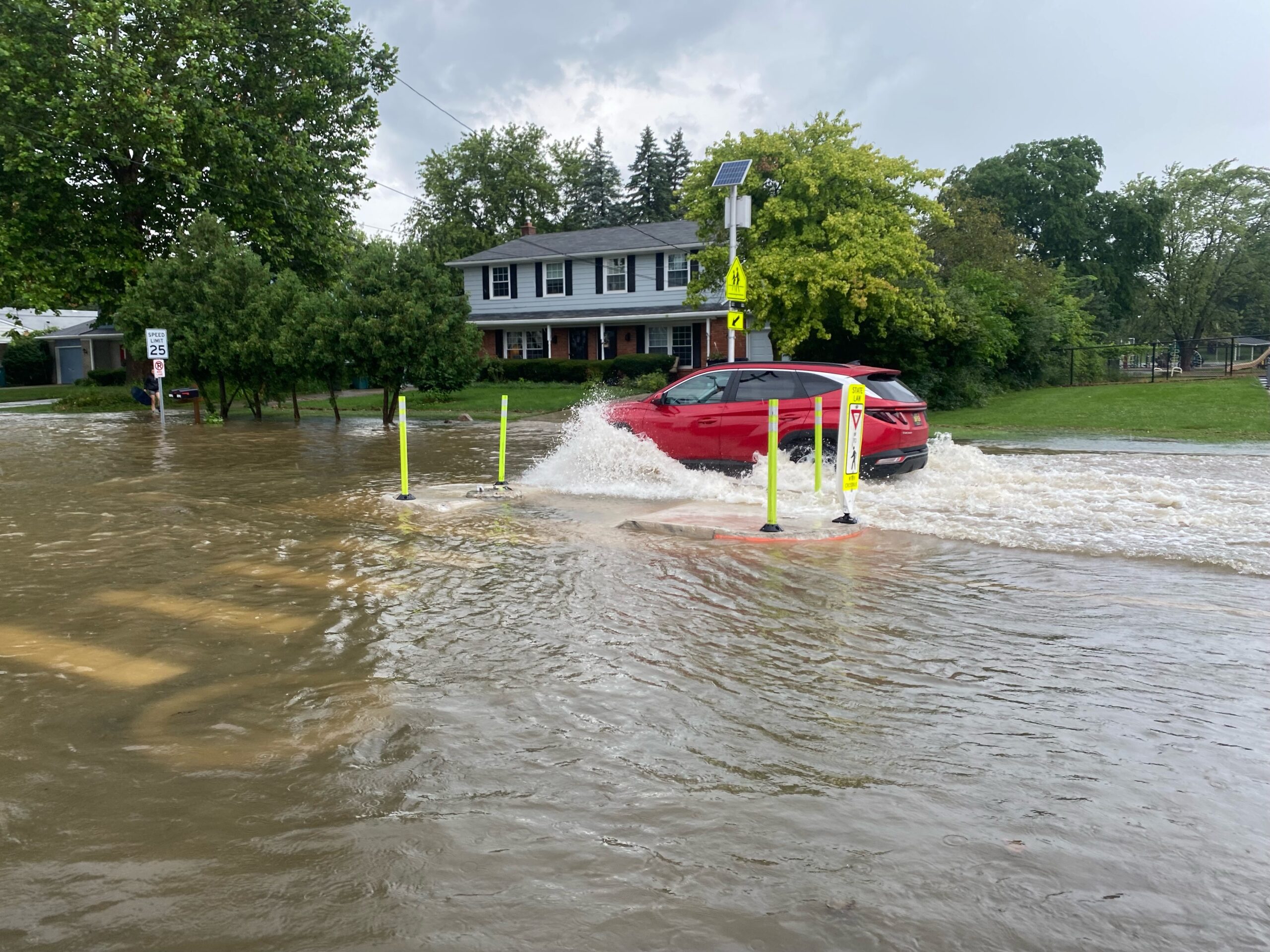
When major storms hit East Lansing, basements flood, streets become impassable and water backs up through a system that was not designed for today’s increasingly intense rainfall. Now, the city is moving forward with a plan aimed at identifying and addressing its biggest flooding problems.
East Lansing’s flooding problems are the result of a combination of factors, including the city’s natural landscape, aging infrastructure and extreme rainstorms that are becoming more and more common. The city’s Wet Weather Resiliency Plan that has been in the works for years intends to help officials identify which areas are most vulnerable and determine where investments could have the greatest impact.
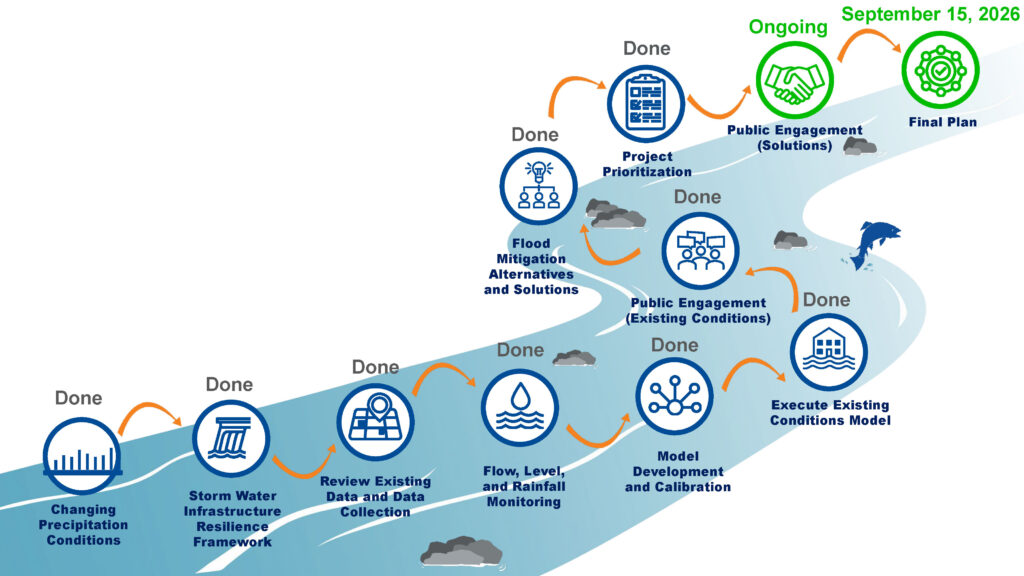
The Wet Weather Resiliency Plan, which was shaped through interviews with residents, advanced modeling and more, will be presented to the City Council at a meeting in September. At Wednesday’s Parks and Recreation Advisory Commission meeting, Environmental Sustainability and Resiliency Manager Cliff Walls shared some of the highlights.
Natural features in East Lansing make the city vulnerable to flooding. The city’s soil has poor infiltration compared to other areas, with Walls saying Grand Rapids was built on top of a sand dune, while East Lansing was built on a hockey puck.
“Just the ability to absorb and infiltrate [water] here is a bigger challenge,” Walls said at Wednesday’s meeting.
Additionally, while many view East Lansing as a flat city, there are plenty of hills and valleys that funnel water to certain areas that then flood.
“Water doesn’t care if it’s the Rocky Mountains or 2 inches, it’s going to find the bottom,” Walls said.
Natural features have long been a challenge for stormwater management in East Lansing, but widespread flooding is happening more often. Walls explained that climate change is making large rain events that happen in a short period of time more common. These events are overwhelming the city’s stormwater management system.
Storms are measured by how frequently they should happen. For example a 10-year storm should have a 10% chance of happening in any given year and a 100-year storm should have a 1% chance of happening in any year. As is evident in East Lansing, which since 2021 has had two 1,000-year storms, the model is out of date and cities need to upgrade infrastructure to handle heavier rainfall.
“We hear the term 100-year storm and 10-year storm and 1,000-year storm, and there’s a lot of misconceptions about what that means, but it’s clear intuitively that the numbers are off,” Walls said at Wednesday’s meeting. “What’s supposed to be a 100-year storm doesn’t mean that it happened this year, so it won’t happen for another 99 [years].”

It isn’t just the amount of rain the city is receiving, it is how quickly it is receiving it that is causing flooding. The city’s storm infrastructure is generally designed to handle 10-year, 24-hour storms, Walls said, but the rainfall that is causing flooding isn’t spread out over a day, it’s coming in a few hours or less.
Infrastructure upgrades need to meet a moving target, as extreme rain events are only expected to become more common, Walls said. The plan projected the size of storms that will be hitting the city in 80 years, as the same infrastructure will remain the ground in many places. The model had projections for if the “global community sort of gets its act together on emissions” and if it does not, Walls said, anticipating the latter.
The worst-case-scenario projections anticipate a 20% increase in the volume of stormwater, Walls said. This is on top of the 30% increase that has already occurred since the middle of the 20th century.
However, there is no simple engineering solution to the city’s problems, as Mayor Erik Altmann previously guessed issues would cost “hundreds of millions” of dollars to fix, and floated a stormwater utility as a means to pay for improvements.
Without a sweeping solution to the issues, the Wet Weather Resiliency Plan mapped out the areas in the city that have experienced the most issues. The map and input from community members and police and fire officials will help the city prioritize what projects are completed first.
A high priority project, for example, would be a key roadway that experiences 10 inches of surface flooding during large storms, as ambulances shouldn’t drive through more than 6 inches of water, Walls said.
Walls explained that many of the issues are due to water backing up in the storm system underground. That means that while street flooding occurs in one area, the actual problem could be miles away.
For example, there is often street flooding on Abbot Road, near the Hannah Community Center during big storms, Walls said. However, the cause of the flooding is a bottleneck at the Charles Street and Grand River Avenue intersection that is overwhelming the system and causing backups near the Hannah center.
“That’s the problem that we all see [Abbot flooding], but the fix is a mile away,” Walls said.
“Just because the work isn’t happening in front of your house, it doesn’t mean that you’re not going to benefit from it,” he said.
To determine what fixes are needed to solve the city’s biggest issues, the Wet Weather Resiliency Plan included advanced hydraulic modeling that shows how water moves through the city’s system in different scenarios.
“You can plug in, like I mentioned a 10-year storm, a 100-year storm and see what the outcomes would be,” Walls said.
Walls said he is particularly excited about this part of the plan, as the modeling has been done in large cities like Denver, New York City and Houston, but is extremely rare in cities East Lansing’s size.
Engineer explains why flooding issues are so challenging for municipalities to address.
Aging infrastructure that struggles to contain large storms is a common problem across Michigan, Erica Morgan, a project engineer for OHM Advisors, told East Lansing Info in a July interview.
Morgan, who operates in OHM’s water resources group, has worked on some of the largest stormwater systems in the state. She said there are engineering fixes to flooding, but these projects can be expensive and mean long construction periods.

This summer, a large stretch of East Lansing’s busiest street, Grand River Avenue, was blocked off while engineers worked on a $45 million project to transition part of the city’s combined sewer system to a separated system. The months of construction have caused traffic headaches and crippled some businesses located along the blocked off stretch.
But separating sewer systems can be a critical step towards improving stormwater management, Morgan explained.
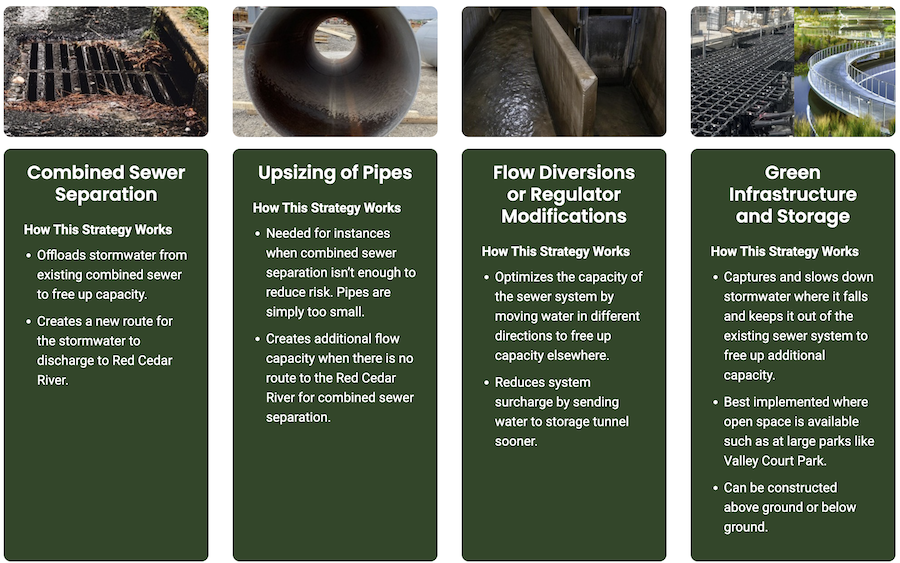
The combined system, which was standard when East Lansing’s sewer was built in the 1950s, carries both stormwater and wastewater from homes and businesses in the same pipes to be treated at the city’s wastewater recovery facility before it is discharged into the Red Cedar River, a city press release explains. When the system is separated, stormwater can be discharged directly into the river, while wastewater travels in different pipes to be treated.
Separating wastewater and stormwater systems can prevent sewage from overflowing into waterways such as rivers during large storms, Morgan explained.
Morgan said the neighborhoods that experience the most basement flooding are likely affected by several factors, including low-lying homes with less elevation between the sewer system and the house, and homes located downstream in the system are more likely to flood.
She said cities can take several steps to address flooding besides separating sewer systems, including building retention basins that can temporarily store and even treat water and diverting stormwater to green spaces during large storms.
“Let’s divert some of that storm water to a green space before it gets into the system,” Morgan said. “It kind of delays that really high peak flow.”
It often takes years for cities to address issues, as they must properly study solutions and find adequate funding, Morgan added.
Hydraulic modeling, like East Lansing has done, can help with more than planning for bigger and bigger storms, Morgan said. Understanding how water is flowing through pipes can also help guide growth within cities, as new homes and businesses can also add water to the system.
At Wednesday’s Parks and Recreation meeting, Walls said he expects to present a final draft of the Wet Weather Resiliency Plan to the City Council at its Sept. 15 meeting. The city is still accepting feedback on the plan through a virtual open house.