

East Lansing Parks Department Posts Healthy Surplus, but Challenges Await
The East Lansing Parks and Recreation Department closed out fiscal year 2026 with a substantial surplus, adding over $286,000 back into its reserve accounts instead of depleting $54,000 in savings as it was originally budgeted to.
The department successfully weathered a year of transitions, navigating a director’s retirement, a steep drop in program fee revenue and the departure of the All-of-Us Express Children’s Theatre. However, an unexpected grant offset those challenges, leaving the department with a healthy rainy-day fund cushion. With fiscal year 2027, or FY 27, beginning at the start of July, the department faces a tighter budget this fiscal year after city leaders cut $400,000 from the parks budget.
This reduction drew sharp criticism from members of the volunteer Parks and Recreation Advisory Commission. Commissioners previously expressed frustration with the cut, noting they were blindsided with the late recommendation by then-City Manager Robert Belleman after spending months drafting a budget recommendation.
“Overall we are now adding to the fund balance $286,342 … and puts us at about $1.4 million fund balance as of June 30,” said Justin Drwencke, the director of the Parks, Recreation, and Arts Department during the parks commission’s meeting on Wednesday, noting that the surplus gives the city room to consider new community investments.
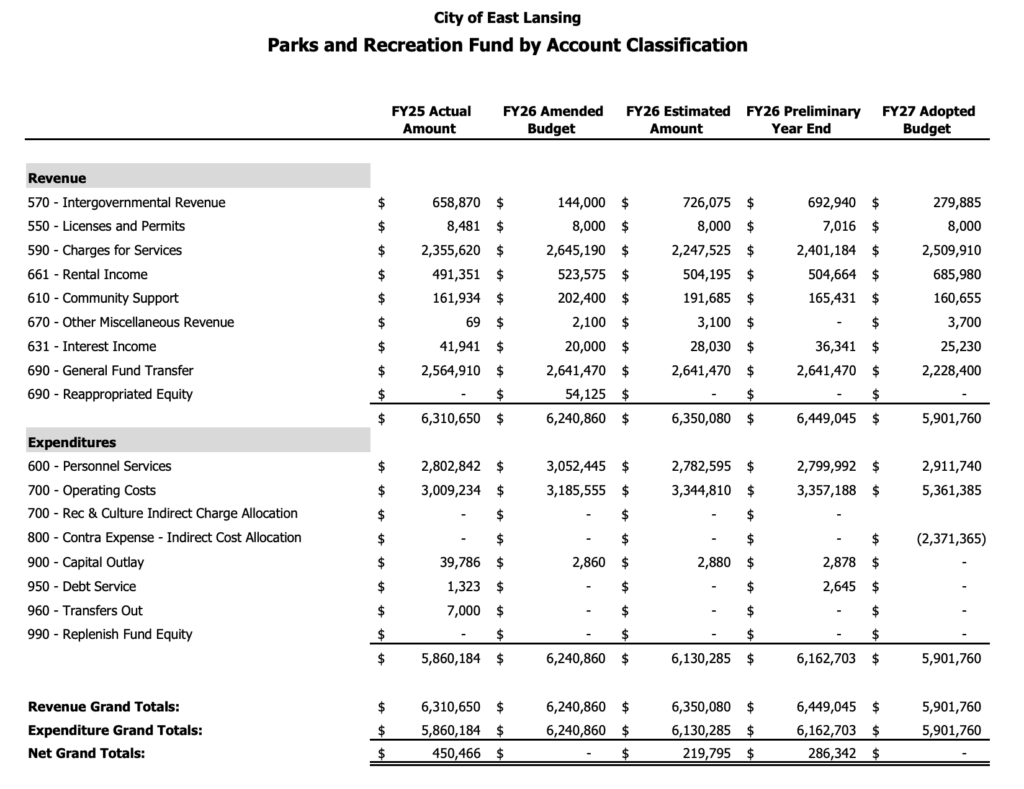
The financial life jacket was given primarily by a $695,280 state Out-of-School Time Grant awarded through the Michigan Department of Lifelong Education, Advancement, and Potential. The funding supported the city’s before- and after-school programs, supplying $676,995 for School Age Care alone. Drwencke added that a portion of the grant money was used to reimburse families for program costs.
While the grant was a lifeline, the parks department faces challenges to keep its day-to-day budget balanced. The department collected $244,000 less revenue from program fees than it expected to during FY 26, which suggests lower enrollment, while physical operating costs came in $171,633 over budget.
The department ultimately covered those operational expenses by saving more than $252,000 in total personnel services across all divisions compared to initial projections, which Drwencke noted was largely due to the vacancy left by former Director Cathy DeShambo’s retirement.
To bridge the gap left by the city’s cuts to the department’s FY 27 budget, Drwencke and city staff restructured the department’s budget by implementing fee increases across almost every division to prevent any single fee seeing too big of an increase.
“I feel very confident in the numbers we put together for FY 27,” Drwencke said. “As programs change and evolve, the amount of space that they need changes or the amount of time programs need changes. It fluctuates a little bit each year, but I don’t think it will fluctuate substantially.”