

East Lansing Police to Deploy Flock Camera, a “Phenomenal” but Controversial Law Enforcement Tool
East Lansing has purchased a Flock camera, a powerful law enforcement tool that has spurred privacy concerns in communities around the country.
Each time a vehicle drives by a Flock camera, the device snaps a photo, gathering information like the license plate number and a description of the vehicle, and noting the date and time it passed by. This information is stored in Flock’s database, data the camera owner can choose to share with other entities.
Groups like the ACLU believe collecting data on every car that drives by is an invasion of privacy, when the vast majority of drivers have done nothing wrong. Artificial intelligence has enhanced search capabilities, allowing law enforcement to look for vehicles based on appearance, even allowing for unique features like bumper stickers to be flagged.
Worries about Flock go back years, but instances of local law enforcement departments sharing data with U.S. Immigration and Customs Enforcement, or ICE, to aid in President Donald Trump’s mass deportation efforts have only ramped up the level of concern.
Flock cameras are a “phenomenal” law enforcement tool but police departments should have carefully thought out policies about how devices will be used, Michigan State University Criminal Justice professor David Carter explained to East Lansing Info.
The camera can help to find stolen cars or vehicles attached to people with warrants. They can also help solve crimes, Carter said. For example, a homicide could take place at a residence and law enforcement could check data from a nearby Flock camera and find that a suspicious vehicle was nearby around the time of the incident.
East Lansing’s Flock camera is a mobile trailer camera, East Lansing City Manager Robert Belleman told ELi. The camera will primarily be stationed on busy roads like Michigan Avenue, Grand River Avenue and Saginaw Street.
East Lansing police plan to use the camera to enforce traffic laws. Belleman said the camera will be placed on a busy roadway, and a cadet will monitor the feed live and look for excessively loud cars or cars that are speeding, alerting road patrol if there is a violator.
Carter said placing the camera on a busy roadway is the right approach and Flock cameras can be used to monitor traffic, but he hasn’t heard of other departments using the technology this way. He said Flock cameras are “information collection cameras” and using them primarily to enforce traffic laws would be a significant underutilization of the technology.
“Monitoring traffic cameras and street light cameras would provide better, broader views and be less expensive than a Flock — the Flock camera is specifically designed as a License Plate Reader and contracted for that use,” Carter wrote in a follow-up email to ELi.
Privacy concerns hang over Flock.
Controversy has followed Flock into many of the communities that have chosen to use the technology, and often for good reason, Carter said, as many communities use so many of the cameras it’s “overkill.”
There are towns of 5,000 or 6,000 people that have more than a dozen license plate reader cameras set up. East Lansing’s investment in a Flock camera is worthwhile, Carter said, and he may even purchase a second camera if he ran the city. Beyond that, privacy concerns could be warranted.
“I have often told law enforcement when they start getting these, you need to be conservative,” Carter said. “Because there’s going to be a backlash, a privacy backlash, and most departments have not been [conservative].”
When communities install many license plate readers along busy roadways and at intersections, they can be used to track the movement of individual vehicles, explained Florian Schaub, an associate professor in the University of Michigan School of Information.
“That information is pretty intrusive and can be used for all kinds of things,” Schaub said. “It puts people under suspicion and surveillance without any kind of concrete evidence that they did any kind of wrongdoing.”
Anti-Flock advocates warn the rise of license plate readers provides infrastructure for mass surveillance and that police employees have ignored department policies and even state laws when sharing information. The ACLU argues the expanded use of license plate readers is especially concerning given the United States’ history of surveilling groups connected to civil rights, anti-war and labor movements.
Flock cameras and other license plate readers are not just common with police departments, but with private businesses and community associations. For example, Tommy’s Car Wash in Lansing uses a license plate reader for subscriptions, Carter said.
Data collected by privately owned cameras may also be shared with outside agencies, Carter said, and Belleman confirmed the 7-Eleven downtown off of Albert Avenue has a Flock camera that shares data with ELPD.
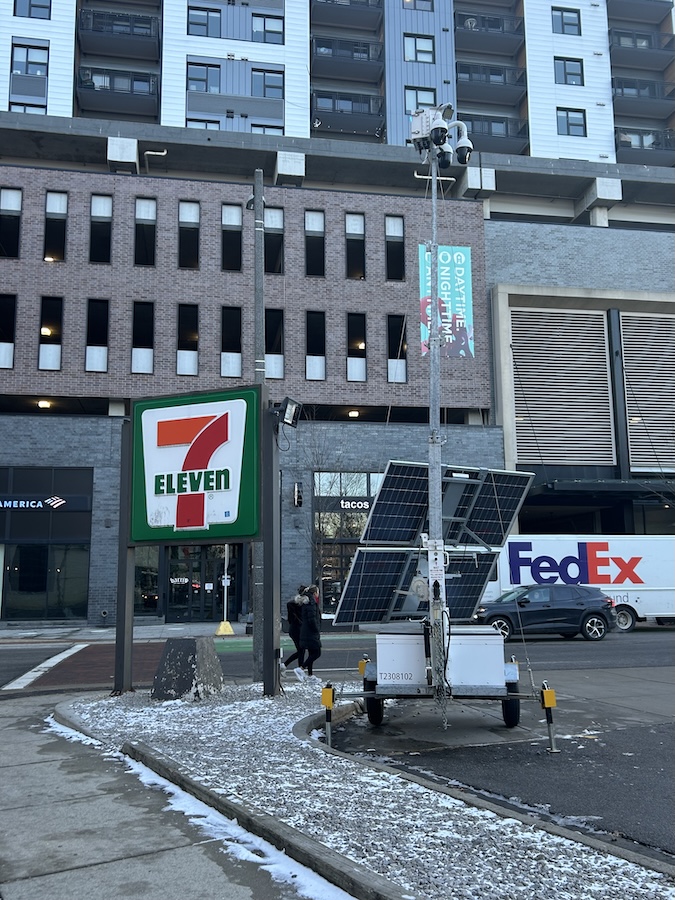
Police departments should have comprehensive policies about how Flock cameras will be used, Carter said.
It’s important for departments to put a limit on how long data collected by Flock cameras will be retained. Thirty days is a standard amount of time for departments to keep data, Carter said. He added that police departments should be clear about what agencies they will share data with.
In a March 3 interview with ELi, Belleman said ELPD’s policy for the Flock camera is still being developed, but the plan is to only share data with adjacent municipalities like Lansing, Michigan State University and possibly Meridian Township.
The camera will not be deployed until the policy is created, Belleman said.
Carter also recommends robust communication around the camera’s use. He said ELPD should make a public information announcement about the camera being deployed, and hold conversations with community and neighborhood groups about what license plate readers are.
Communication should be ongoing, Carter said, recommending police departments provide regular updates about how many records are collected by the Flock camera and when records are purged from the Flock database.
Carter said police departments should be responsive to concerns as they emerge.
“We [police] have an obligation to address community issues and community concerns,” he said. “If your community doesn’t want it, then you shouldn’t have it.”
While Flock cameras can be a tool to solve specific crimes, Schaub said they are not a replacement for community policing.
“If you want to make communities safer, you actually have to work with the communities, you’ve got to identify what the problems are, you’ve got to provide support and infrastructure,” he said. “Just slapping cameras on intersections is not going to really solve the problems that make communities unsafe.”
Dustin DuFort Petty contributed to this reporting.