

East Lansing Planning Commission Discusses Fee-in-Lieu Plan for Affordable Housing Goals
It’s expensive to build housing and high construction costs are limiting the amount of affordable housing in East Lansing, especially downtown.
The East Lansing Planning Commission discussed the dilemma at its meeting Wednesday night during a public hearing about requirements for new apartments added downtown. Right now, the city requires 25% of units in new apartments be moderately priced, owner-occupied or meet some other standard to help diversify the area’s housing stock.
Since the 25% rule was put into place about a decade ago, just one project has met the requirement – The Landmark by requiring 25% of units be used for senior housing – and developers have said the requirement is prohibitively expensive.
Right now, two developers are proposing large apartment buildings downtown and each has said the diverse housing requirement is a roadblock to their project. Developers proposing a 13-story apartment where the Bailey Street parking lot sits now have said they would need a tax break to meet the requirement. Developers proposing a 15-story apartment where the Student Book Store is currently have asked the city to develop a system where they can pay a fee instead of meeting the requirement.
At a meeting on Wednesday, the East Lansing Planning Commission heard Principal Planner Landon Bartley explain different pathways the city could take to make developing in the city’s downtown palatable, while helping the city meet its housing goals. In addition to the city potentially lowering the requirement from 25% – a possibility raised by some members of City Council – Bartley explained how a fee-in-lieu program would work and his recommendations for allowing developers to transfer diverse housing units outside of the downtown area.
Other cities with fee-in-lieu programs collect millions from developers.
Under a fee-in-lieu program, developers that build projects downtown could pay a fee instead of meeting the diverse housing requirement. The city could use that money to create a fund to carry out its housing goals.
A fee-in-lieu would not be cheap. Bartley said the city could charge developers between $87 per square foot and $170 per square foot. The amount charged is meant to close the “affordability gap,” or the gap between what families making 50-80% of the area median income can afford and what the market price of housing is. The approach is similar to what Ann Arbor does now.
To demonstrate how much developers would pay for a fee-in-lieu, Bartley showed how much it would have cost developers that opened three large apartment complexes in recent years.

While the program could collect millions of dollars from developers, other cities that host Big 10 universities offer fee-in-lieu programs that charge a similar amount, or even more. City staff calculated what a fe-in-lieu would cost The Hub, The Abbot and The Landmark if it had the same diverse housing requirement and fee-in-lieu structure as Bloomington, Indiana; Columbus, Ohio; State College, Pennsylvania; Iowa City, Iowa; and Evanston, Illinois.
Most of the communities measured have a lower requirement for the amount of diverse housing that must be provided, so developers need to pay the fee on fewer units.




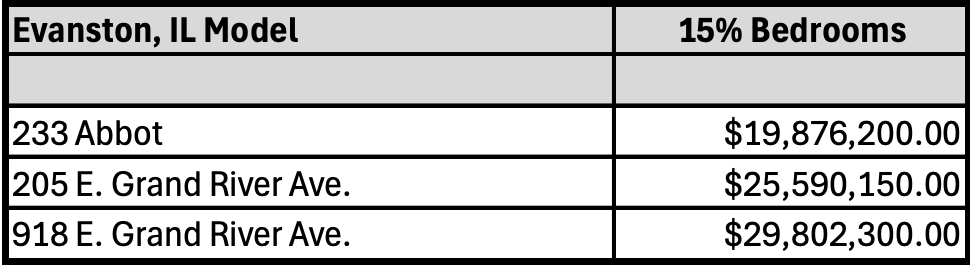
Community and Economic Development Specialist Heather Pope said staff is reaching out to these communities to find out more about how they reached the amounts for their fee-in-lieu charges.
“We feel like we’re in the right range, seeing what these other communities are charging,” Pope said at Wednesday’s meeting.
Commissioner Ryan Putz said the city will need to have a carefully developed plan for how money collected by a fee-in-lieu program would be used.
Pope explained Ann Arbor has a city commission that recommends uses for the money collected by its fee-in-lieu program. She said the fund would be used to promote affordable housing.
“Affordable housing can mean everything from providing supportive housing services to those who are at risk of being evicted, providing funds to support development,” Pope said. “The Ingham County Housing Trust Fund has a substantial amount of money, so maybe we can partner with them on projects because affordable housing is just not in East Lansing, it’s [needed] Ingham County-wide.”
Planning Commission Chair Joseph Sullivan said that “at a minimum” the diverse housing requirement should be bumped down to 10%. He said if policy goals change later on, the requirement can be moved back up.
Transferring diverse housing units outside of downtown could make the requirement more affordable for developers.
A second adjustment the city could make is allowing developers to transfer required diverse housing units to projects outside of the downtown area.
City staff recommends that developers be required to build the units at a 1.2 to 1 ratio from what is required downtown, because it is cheaper to build housing outside of the downtown area.
“I see it being appropriate to have some difference, some change, because we still want to encourage diverse housing to be downtown,” Bartley said.
The agenda packet for the Planning Commission meeting suggests the city could also change the ratio depending on how far from downtown the housing is. For example, if the units are transferred within a quarter mile of the downtown district, the ratio would be 1.1 to 1, but if it is transferred a quarter mile to a half mile away, the ratio would be 1.2 to 1.
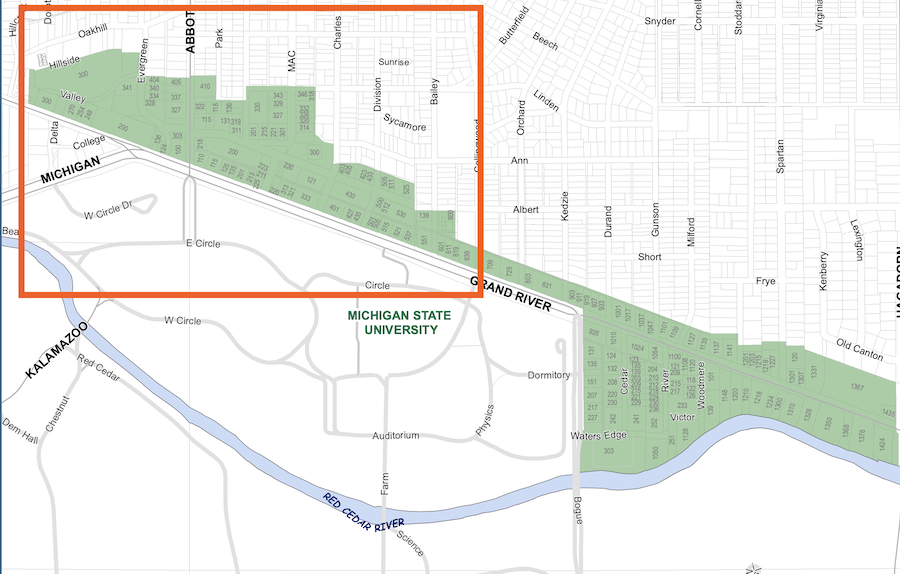
The recommendation prepared by staff would allow the housing units to be transferred to business districts, and the city’s East Village district that is located on the south end of Grand River, between Hagadorn Road and Bogue Street.
Bartley said he likes the idea of incentivizing building housing on the upper floors of business district buildings.
“We may end up with upper story vacant space if the office market has trouble, that could be fairly easily converted into residential [space], which could be used to help support these diverse housing requirements,” Bartley said.
Bartley added that developers have recommended the city consider allowing the housing units to be transferred into other zoning districts, including some areas close to downtown and Michigan State University’s campus.
Planning Commission Chair Joseph Sullivan said he’s never been convinced the diversified housing units need to be placed in the core downtown area, and suggested units should be transferable to areas along transit corridors.
“Is that where young professionals, potentially families, really want to live is in the core of a college downtown?” he asked. “Or are there other areas just outside of downtown that give access to good amenities?”
The discussion about changing the city’s policies is just starting to heat up.
If changes to the diverse housing requirement are made, those changes are still likely months away, Bartley said. The topic will come back to the Planning Commission at its next meeting on April 8, and proposed changes will then be considered by the City Council later on. If changes to the city’s policies are made, Bartley said he doesn’t expect the decision to be made until June or July.
Whatever changes the city does make should be flexible so adjustments can be made in future years, Putz said at Wednesday’s meeting.
“Whatever we select for our AMI percentage, whatever we select for our credit transfer ratio, and I would say even, what districts maybe should be included in that transfer range, we should have some sort of mechanism in place to review that on an annual basis for a set amount of time,” he said. “We may not get it 100% right the first time, that’s OK, but if we don’t give [ourselves] an opportunity to review and revise, it will hurt way more down the road to make changes to it.”