

Nonprofit Seeks to Establish East Lansing Healthcare Committee in City Charter
With over 20 years of experience as a family physician, Dr. Todd Otten has witnessed patients in some of their most vulnerable moments: debating whether to buy essential medication or use that money for groceries. It is a systemic dilemma shared by millions of Americans facing mounting barriers to accessible healthcare.
Now, Otten is advocating in favor of a grassroots movement in Michigan that is attempting to push local governments to step in to address barriers to healthcare. A petition drive to establish an East Lansing healthcare committee that analyzes local access to healthcare and provides recommendations to local, state and federal officials has collected enough signatures to be placed on the Nov. 3 general election ballot.
The effort is led by Community Action Michigan, a nonprofit organization that seeks to increase access to healthcare. The organization coordinated petition drives across six Michigan municipalities – including East Lansing – to require the cities to establish local healthcare committees. The East Lansing initiative collected enough signatures, but still needs to have ballot language approved by the City Council and undergo a state review before it is officially placed on the ballot.
The effort to establish the committees was motivated by Medicaid cuts put in place by the federal government last year, according to Community Action Michigan’s website.
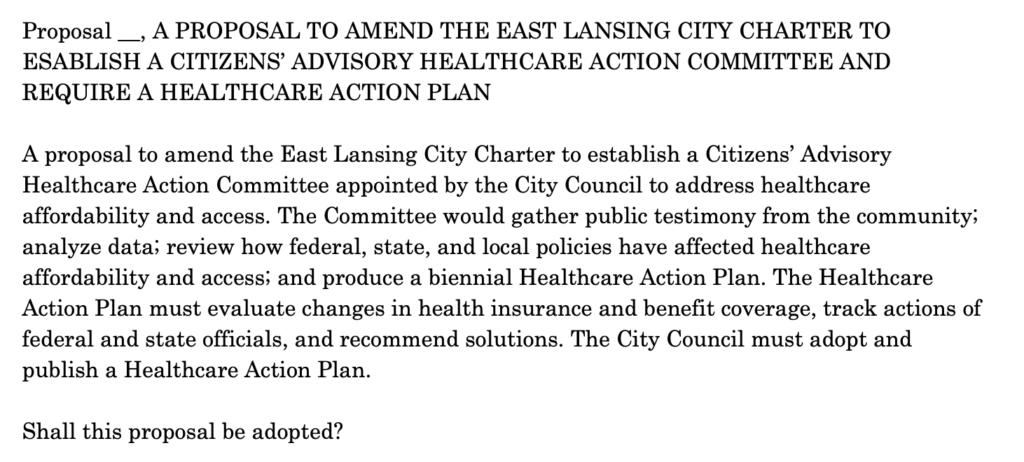
If the initiative is eventually approved, the city will create a committee to gather public testimony, analyze data, and review how state and federal actions affect access to healthcare and affordability. Every two years, the committee will create a report on its findings and recommendations.
The information gathered and recommendations made by the committee would be passed on to local, state and federal policymakers, with the goal of identifying and removing barriers to healthcare.
The committee would be made up of seven volunteer members, who would be appointed by the City Council. The Council would prioritize appointing community members with relevant experience, like healthcare workers and uninsured community members.
Otten, who practices out of Lansing, became an advocate for the charter amendment because he has seen inaccessible healthcare prevent many people from receiving treatments they need.
“Patients are suffering, it’s really just a result of greed on many, many levels,” Otten said.
Otten said he spent years working in the fee-for-service world. There, his patients experienced daily frustrations with rising prescription drug costs and delayed diagnoses.
“I’ve seen patients who have died because they haven’t had access to care,” Otten said. “And not just once, not just a few times, but in my career hundreds of times. When I was in the fee-for-service world a couple years ago, it was daily.”
Otten hopes local action can help make healthcare accessible on a large scale.
“We need activity like this where local communities have said ‘enough is enough,’” Otten said. “We want representation from local stakeholders telling our leaders that what’s happening is not acceptable.”
At the July 21 City Council meeting, the council deferred voting on proposed ballot language for the initiative, as City Clerk Emily Gordon said there were concerns about compliance with regulations related to the proposal and city attorneys were reviewing the matter. In a follow up call with East Lansing Info on Wednesday, Gordon said the compliance concerns have been addressed and she expects the City Council to vote on ballot language at a special meeting on Aug. 10.
Besides East Lansing, Community Action Michigan succeeded in gathering enough signatures to place similar charter amendments on the ballot in five other communities: Lansing, Battle Creek, Benton Harbor, Portage and Kalamazoo.
Canvassing took between four and six weeks. The responses from residents were “extremely positive and almost overwhelming,” said Mark Fisher, a spokesperson for Community Action Michigan. Fisher added that voters shared their own personal stories about their struggles to access and afford care.
“It [healthcare] has reached a crisis state in our country,” Fisher said. “We really felt that at the doors in all the communities we canvassed.”
The effort is well funded. According to a campaign finance report filed on July 27, Community Action Michigan has received $1.4 million in contributions since April 27, and spent more than $860,000. The donations came from three organizations: Global Impact Social Welfare Fund contributed $250,000, CityScope, Inc. contributed $650,000, and American Opportunity Action contributed $500,000.
Global Impact Social Welfare Fund and American Opportunity Action both target public policy issues such as healthcare. Both are registered as 501(c)(4) social welfare nonprofit organizations, meaning financial contributions are not publicly disclosed and donors remain anonymous. Social welfare nonprofits must exclusively “further the common good and general welfare of the people of the community,” according to the IRS.
CityScope, Inc. has little online presence. In an email to ELi, Executive Director Sean Nicholson provided this statement: “CityScope is thrilled to support local campaigns where citizens are taking real action to improve their lives. We’re inspired by the truly impressive community efforts across Michigan to create local action plans to deal with the problems created by Washington — and we’re proud to support Community Action Michigan.”
This November, East Lansing voters and five other Michigan communities will have the opportunity to move the needle on local healthcare solutions, Otten said, adding that this is just one of several needed actions.
“I think there are solutions that we don’t know what they are just yet,” Otten said. “But the reality is we got roughly 30 million people in this country who are uninsured and end up in the emergency department half the time. Ultimately, we are all paying for that in one capacity or another.”