
Thousands of Weekly Searches Tap Into ELPD’s Flock Data. Few Come From Local Police.
As concerns about Flock Safety’s cameras continue to grow locally and nationwide, a single camera in East Lansing tells a big story about how Flock data is shared broadly across Michigan police agencies.
An investigation by East Lansing Info reveals that the East Lansing Police Department allowed external law enforcement agencies to tap into East Lansing’s Flock data for tens of thousands of searches during a 30-day stretch in July and August. The searches range from neighboring jurisdictions to departments hundreds of miles away like the Gogebic County Sheriff’s Office, located in the westernmost county in Michigan’s Upper Peninsula.
Experts say the search logs raise serious questions about how local police departments are able to safeguard their own equipment from misuse by external agencies.
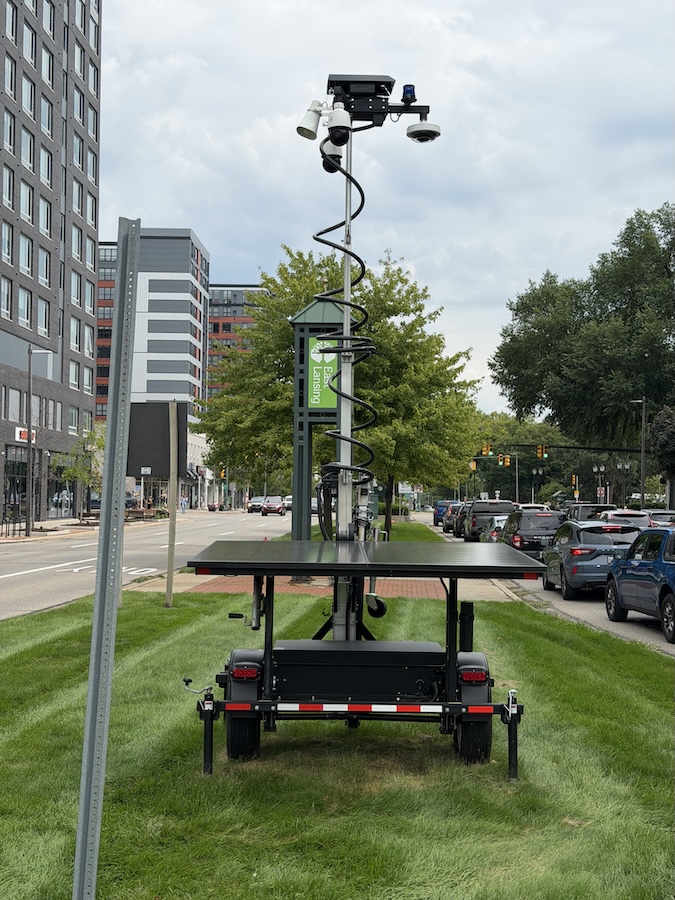
Earlier this year, East Lansing police deployed the city’s first Flock camera, an AI-powered device known as a license plate reader, or LPR. The large mobile trailer camera has been stationed on medians on busy roadways since the spring, recording the license plate numbers of passing vehicles, along with descriptors of vehicles, such as their color, make and even bumper stickers.
This information, and the time that each car passed, is stored in a database that is searchable to departments that ELPD grants access to.
Police defend LPRs as powerful crime-fighting tools, saying the technology can flag vehicles associated with people wanted on warrants and help recover stolen cars.
Critics say the cameras present a major privacy concern, as they collect data on every passing vehicle, the vast majority of which belong to people who are not committing a crime. No warrant is needed, and the data is retained for a default of seven days, whether or not there is an ongoing investigation. Departments can opt to retain data for longer or shorter periods – ELPD’s policy says the department and Flock Safety can retain data for up to 30 days.
Organizations like the American Civil Liberties Union, or ACLU, have said the cameras can be used to track movement, as they can show the date and time individual cars passed by. The more cameras, the clearer the picture of where a vehicle was at any given time.
Additionally, some agencies have shared Flock data with Immigration and Customs Enforcement to help carry out President Donald Trump’s mass deportation campaign. The data has also been misused by individual law enforcement officials, who have utilized it to stalk ex-partners and romantic rivals.
The more than 1,700-page search log shows that agencies with access to East Lansing’s data conducted tens of thousands of searches between July 25 and Aug. 24. During the same time period, a different log shows the ELPD conducted fewer than 200 searches of the database.

Dozens of law enforcement agencies searched ELPD’s data, including departments in the Metro-Detroit area, several sheriff’s offices and, most often, Michigan State Police. Even the conservation-focused Michigan Department of Natural Resources tapped into the city’s Flock data.
East Lansing is also allowed broad access to a network of cameras around the state. An audit of the searches made by ELPD officers shows ELPD searched between one and 855 networks, with most searches including more than 800 networks. The array of data Michigan State Police, or MSP, was given access to is even larger. Many search hits from MSP employees tap more than 6,000 networks.
As concerns about LPRs grow, cities nationwide have moved to end their contracts with companies like Flock. Last week, the Lansing City Council voted to ask the city to end its Flock contract, though it’s unclear if police and city leaders will heed that request.
Police agencies defend the use of LPRs and broad data sharing, saying the technology helps catch criminals.
In an email to ELi, MSP Public Information Officer Lt. DuWayne Robinson highlighted an incident where state police responded to a shooting in Saginaw. The incident was caught on a surveillance camera, which led police to suspect a 14-year-old of the crime. Using an LPR, police identified a transport vehicle driven by the boy’s father, which was then picked up by an LPR across the state in the Holland area. Police then arrested the suspect.
In his email, Robinson explained that when a police department purchases an LPR system, they can request permission to access other agencies’ data. Agencies can either approve or deny that request.
David Carter, a criminal justice professor at Michigan State University, further explained in an email to ELi that departments can give other agencies direct access to search their data, or they can keep the data internal and conduct searches on other agencies’ behalf when asked to. Typically, Carter said, departments give broad access.
“… it is normal for agencies to share the information broadly – it is easier, less costly from staffing perspective and agencies trust that others using the system are doing so based on lawful reasons,” he wrote, adding that local legislators could put restrictions on data sharing, but most do not.
Before the city deployed its Flock camera, former City Manager Robert Belleman told ELi that the city was developing a policy that would limit data sharing to nearby agencies like Lansing, Michigan State University and Meridian Township police. However, the city is sharing its data much more broadly, giving access to departments hundreds of miles away in some cases. While it’s likely that the ELPD only authorized sharing to agencies in Michigan, that’s still far beyond the localized scope Belleman said was planned.
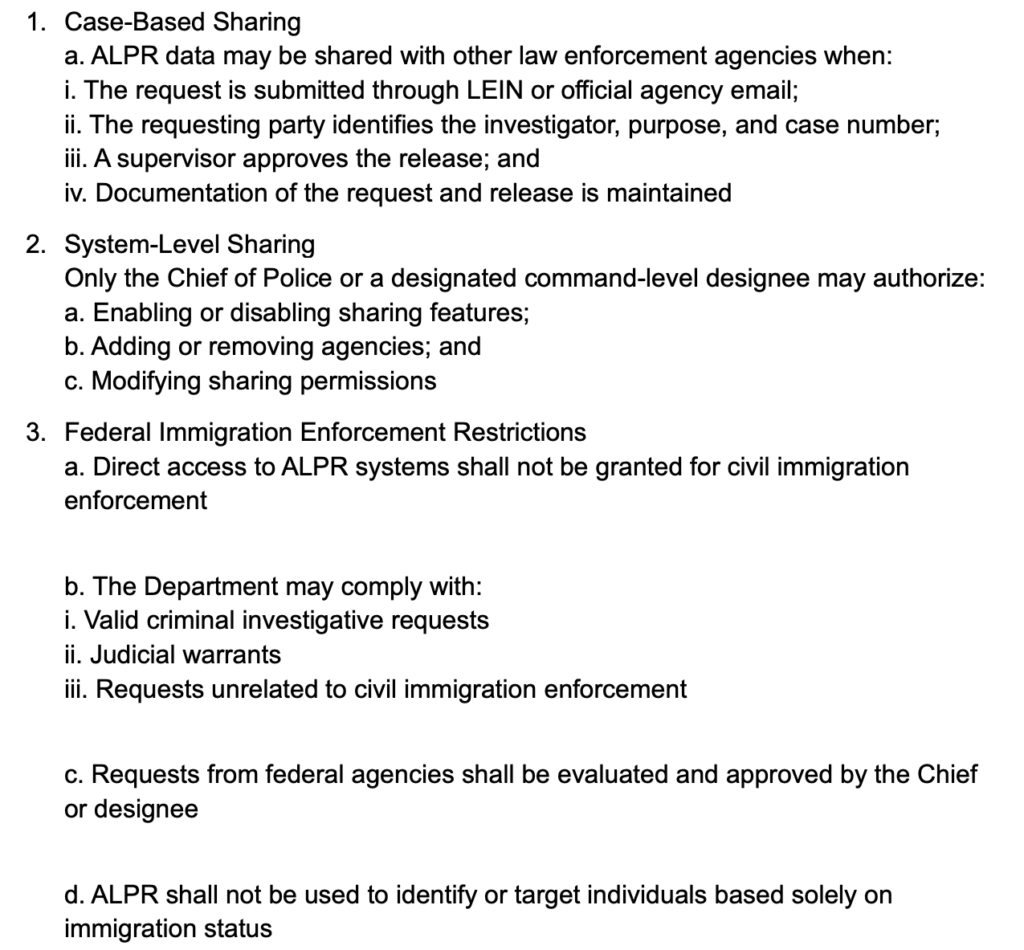
East Lansing’s usage of LPRs is governed by an eight-page policy ELPD Chief Jennifer Brown signed in April, around the time the city’s Flock camera was deployed. The policy includes provisions that restrict ELPD’s usage to legitimate law enforcement purposes, bans using the technology for civil immigration enforcement and outlines that officers may be fired and even prosecuted if they misuse the technology.
The policy provides provisions for both case-based data sharing and system-level sharing. The case-based sharing requires other agencies to provide information like a case number and reason for the search. Meanwhile, system sharing, which allows other agencies to freely access ELPD’s data, has few guidelines and can be approved by the chief of police or a command-level designee.
Gabrielle Dresner, a policy strategist with the ACLU of Michigan, told ELi there is no statewide regulation of LPRs, so they are managed by a patchwork of different local policies. Theoretically, she said, this could allow the dozens of other police departments that have access to East Lansing’s Flock data to use it in ways that are against the local policies.
And while each search requires an officer to state a reason for the search, thousands of external searches tap into ELPD’s data each week. The ELPD is not vetting each of these searches or the officer making them to ensure the system is being used appropriately.
“Once they elect to share that information … [vetting] is not done on a search by search basis,” Dresner said. “It’s basically open access to whoever they shared it with.”
City and police officials declined to comment when asked about the ELPD’s Flock data sharing.
Experts warn that License Plate Reader technology comes with many risks.
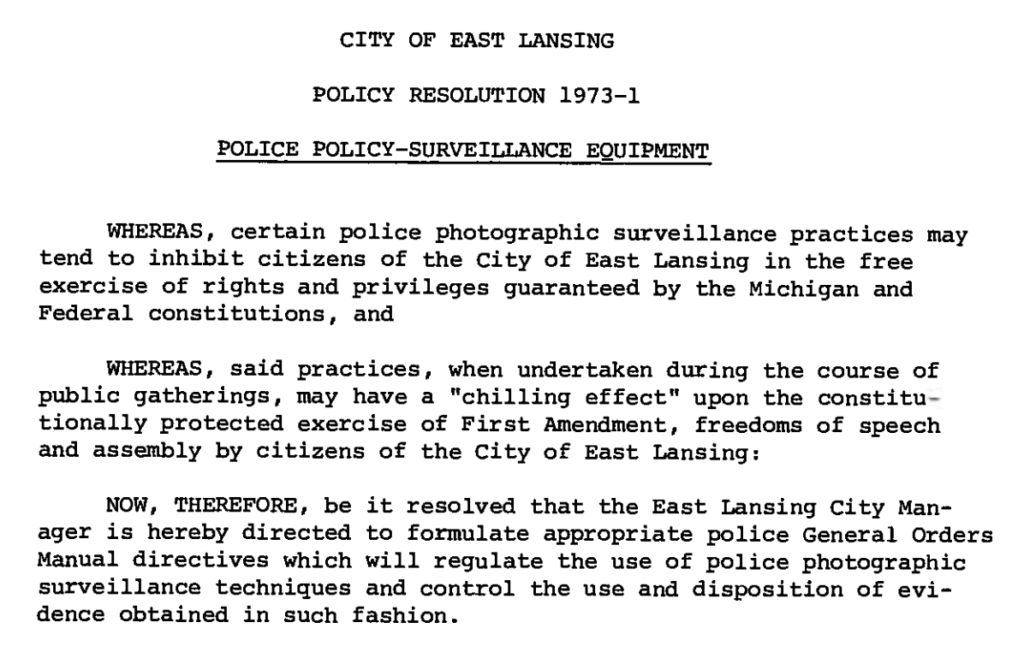
The advent of police surveillance technology has long sparked debates over its usage and its implications for rights to privacy, free expression and unreasonable search. East Lansing’s City Council even passed a resolution in 1973 out of these very concerns.
The resolution said surveillance can have a chilling effect on freedom of speech and directed the city manager to create policies to regulate the usage of “police photographic surveillance techniques” and the use and disposition of any evidence obtained.
Fifty-three years later, the city is now grappling with many of the same concerns.
Concerns about Flock cameras and other LPRs stem from incidents where individual officers have misused cameras to broader concerns about building infrastructure that can be used for mass surveillance.
Dresner told ELi that Flock’s expansion is one piece of a bigger trend of increasingly expansive mass surveillance across the country.
“There’s an expected right to privacy even when moving among public spaces, which roadways are,” Dresner said. “The connectivity between all of the cameras and the nationwide lookup availability makes this information so that what would previously be unknowable is now knowable. This mass network of surveillance cameras, when combined, can track basically your every move in the public roadways.”
Florian Schaub, an associate professor in the University of Michigan School of Information specializing in privacy, echoed Dresner’s concerns. Everyone – whether they’re committing a crime or not – is recorded.
“What these surveillance technologies do is they … discretize everything you do, right?” he said. “It’s recorded, exactly how you did it, and it makes things permanent that are otherwise, you know, maybe small infractions that are really not a big thing in the larger scheme of things, but if someone wants to use them against you, they can.”
Schaub also worries about masses of data that is collected through agreements with local governments being held centrally by a private company.
“That [data], you know, of course, is subject to contracts they have with individual municipalities and police departments, but then, to what extent are they following those?” Schaub said. “Are they changing the terms of service? Are they looking for other ways to monetize the data they have? Are they allowing, maybe more or less access to this data than police departments are aware of or anticipate?”
But there are more than just big-picture concerns about the expansion of LPRs, instances where officers have misused the system have popped up around the country. An Indiana sheriff’s deputy was charged with a felony in August after searching his girlfriend’s license plate more than 2,000 times in eight months.
Officers have also searched Flock data on behalf of federal agents to aid deportation efforts, even in jurisdictions that forbid police from aiding in civil immigration enforcement.
Redactions to the log of ELPD searches makes it hard to tell if there should be any concerns about misuse from East Lansing officers, Dresner said. Officers document a reason for their search when they access the Flock database, which sometimes provides insight to how the cameras are being used. However, the city redacted this portion of the log.
The log shows ELPD officers searched the Flock database fewer than 200 times during the 30-day period audited, far less than many of the other agencies that utilize East Lansing’s network. ELPD’s searches came in sporadically – at one point an officer made more than 30 searches during a 12-minute period. From Aug. 1 through Aug. 6, ELPD officers made no searches at all.
Right now, East Lansing just has one Flock camera, but city officials were looking to expand their fleet in the recent past. In the preliminary Fiscal Year 2027 budget, the city’s grant writer included a Byrne State Crisis Intervention Program grant, asking the “State of Michigan for mobile Flock LPR cameras and trailer to assist with traffic enforcement.”
The city looked into this grant, but it was never submitted and was included erroneously in the report, according to an email sent by Capt. Adrian Ojerio, ELPD’s public information officer. Ojerio also told ELi in a separate email that “ELPD and the City are not seeking/open to expanding Flock.”
If departments must use LPRs, experts advise restraint
The East Lansing City Council approved the contract with Flock by voting in favor of “a budget Amendment for Traffic Safety Technology” on the consent agenda of an August 2025 meeting, holding no discussion about what technology was being purchased.
Experts say LPRs can be deployed responsibly, but there needs to be more oversight and transparency about how they are used.
The ACLU has created sample municipal policies for LPRs. The sample policy restricts data retention to 48 hours in most cases and sets much more rigid guidelines for data-sharing than exist in East Lansing’s policy, among other strict guidelines.
“There are models out there that are worth looking into, and if municipalities feel like they have to have license plate readers, then they should enact the policy that the ACLU National has published on their website,” Dresner said.
Schaub said that many municipalities have decided the costs to privacy and data protection are simply too high.
“There are lots of examples of cities and counties getting rid of their Flock cameras because they feel the privacy costs that are being introduced are too high, in particular because there’s not sufficient oversight of Flock,” Schaub said. “And so the question is what are reasonable protections and stopgaps to prevent abuse of this type of data.”
That makes it a balancing game, and one where many departments choose to lean towards more surveillance, not less.
For that reason, experts suggest restricting usage and requiring clear, in-depth explanations for why the system was accessed. While most departments, and Flock itself, require a “search reason,” officers tend to provide vague reasons.
“It’s a text field, right? Basically, if you look at the log data from these Flock cameras, the reasons say things like ‘police work.’ ‘Investigation,’ right? Like, it’s not particularly deep,” Schaub said.
All of this uncertainty, misuse and uncharted territory only adds to existing concerns about LPRs. And the dangers without regulation are extensive. That’s why many experts like Schaub say the best approach is restraint. At least until the problems are worked out — if they ever are. In the meantime, he recommends police departments pursue community-based solutions to crime.
“The question is what would be adequate protections for this type of data, and until we have fully figured that out, I think the better option is probably to not have these types of cameras that constantly generate surveillance data that can be then misused, and instead invest in underground police work that can more effectively work in communities to help prevent and investigate crimes,” he said.
The ACLU also thinks that the technology itself presents too many concerns, but the organization is more focused on specific rights to privacy and potential chilling effects. That’s why it advocates for restraint, and ideally, extremely limited use of these technologies.
“These cameras are infringing on people’s rights, and on top of that, there’s a long-standing understanding that when people are under the impression that they are or are being surveilled, they will act less freely, regardless of whether or not that activity is actually wrong or illegal,” Dresner said. “People are fearful when they are being surveilled, and so they act differently. So this mass surveillance that’s proliferating our streets really creates a chilling effect on people’s rights and their will to use and exercise their rights.”
ELi Managing Editor Lucas Day contributed to this reporting.