
East Lansing Officials Begin Laying Groundwork for Income Tax Renewal Campaign
East Lansing officials are gearing up for an income tax renewal vote before the tax expires in 2030.
The income tax has played a pivotal role in city finances since voters approved it for 12 years in 2018 to rescue the city from mounting pension debt. Former City Manager Robert Belleman previously told East Lansing Info the tax is necessary for the city to continue to operate as it has been. This sentiment was shared by city officials at Tuesday’s City Council meeting, who said the city needs to begin preparing for a renewal vote that could be held as soon as next year.
“2030 is a lot closer than it once felt,” Chief Financial Officer Audrey Kincade said at Tuesday night’s council meeting. “It’s not just ‘we should, we should, we should,’ we need to start.”
At Tuesday’s meeting, the council heard recommendations from the city’s Financial Health Review Committee, a group of volunteers that spent about six months doing a deep dive on local finances. The committee found that East Lansing’s finances are not dire, but there are risks – most notably the looming income tax renewal vote.
The income tax collects 1% of residents’ income and .5% from non-residents, and is pitched as a way to get Michigan State University employees who live outside of East Lansing to pay into the city’s coffers, as land on campus is largely tax exempt. The tax is paired with a five mill reduction to the property tax cap.
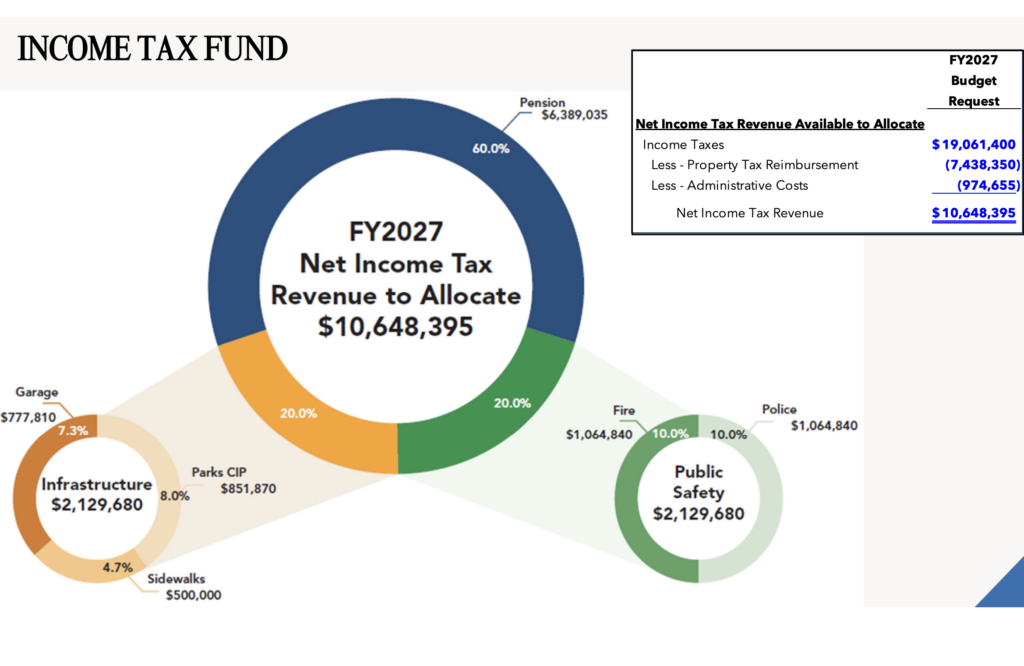
The tax now plays a critical role in buoying the city’s finances, as East Lansing has chipped away at its pension liabilities, added police officers and avoided staffing cuts that were discussed before the tax was approved. In the current fiscal year, the income tax is projected to net more than $10 million, a substantial amount for a city that operates with a roughly $50 million general fund.
The tax is structured so that after the general fund is reimbursed for administrative costs and the five mill property tax reduction, 60% of revenue goes to pension payments, 20% goes to public safety and 20% goes to infrastructure improvements. The structure of the tax could be amended when the tax goes up for a renewal vote, as the Financial Health Review Committee recommended the tax structure be broadened so 60% can go to all long-term liabilities, like retiree healthcare benefits.
The committee recommended extending the income tax for 10 years until 2040. If the renewal vote is successful, the committee recommends having another vote before 2040 to make the tax permanent.
At Tuesday’s meeting, members of the City Council discussed the need to pick an election for the renewal vote and map out a communication strategy.
While the income tax does not expire until 2030, the Financial Health Review Committee recommended the city put it back on the ballot between 2027 and 2029.
Currently, East Lansing is operating under the leadership of Interim City Manager Annette Irwin. With the next city manager unlikely to take over until February or March of next year, they could be stepping into the role during the renewal campaign.
“It will in any case have to be, maybe not the top priority, but probably the top priority for the incoming city manager to address this issue,” Mayor Erik Altmann said. “This will be their first big challenge.”
Irwin said she plans to begin “laying the groundwork” for the renewal campaign, so the next city manager inherits a plan already in progress.
Altmann said in 2018, there were a few communications approaches that helped usher the tax through.
He said then-City Manager George Lahanas gave many different presentations on the tax in settings that ranged from small groups in people’s living rooms to in front of larger audiences. Additionally, there was a campaign committee that included members of the City Council that advocated for the tax. East Lansing firefighters also went door-to-door to speak with residents and promote the tax.
Councilmember Mark Meadows said members of the council should take a leading role in advocating for the tax and suggested they begin preparing presentations about who pays the tax and what has been achieved since it was put in place. He said these presentations can be given to neighborhood associations to ask for residents’ thoughts and the reasons they would or would not support the tax’s renewal.
While city leaders see the tax as essential, it is far from a given that the tax will be renewed. An initial income tax proposal was rejected in 2017, before voters approved a revised version in 2018. At Tuesday’s meeting, Mayor Pro Tem Chuck Grigsby said from his time campaigning before the 2025 City Council election that he thinks the answer from residents would be a “hard no” on the tax renewal right now.
Further, experts who previously spoke with East Lansing Info said a series of controversies may have eroded public trust in city leaders and jeopardized the renewal vote. From unresolved allegations of police misconduct to an unconstitutional “disguised tax” embedded in utility bills to a failed 2025 proposal that would have raised property taxes and persistent tensions between city officials and volunteer commission members, outrage has been a fixture at city meetings.
“I wasn’t here during that first push for that [income tax vote],” Grigsby said. “But I’ve always thought, before I even got elected, that was going to be one of the most important things that we do … to gear up for that [renewal vote].”