
Analyzing East Lansing’s Election: Turnout Was High; Student Votes Helped Sink a Proposal to Move Council Elections
East Lansing voters were part of a national environment that broke heavily in favor of Democrats at Tuesday’s election, as Democrats flipped the U.S. House and Senate and seized control of both chambers in the Michigan legislature.
A closer look at the local results shows a high turnout in East Lansing and precincts on Michigan State University’s campus swung a vote against a proposal to switch City Council elections from odd- to even-numbered years.
There were more than 17,600 votes cast in East Lansing precincts, according to unofficial results from the Ingham and Clinton County clerks’ offices. This is an increase from the roughly 14,000 votes cast in the 2022 midterm election.
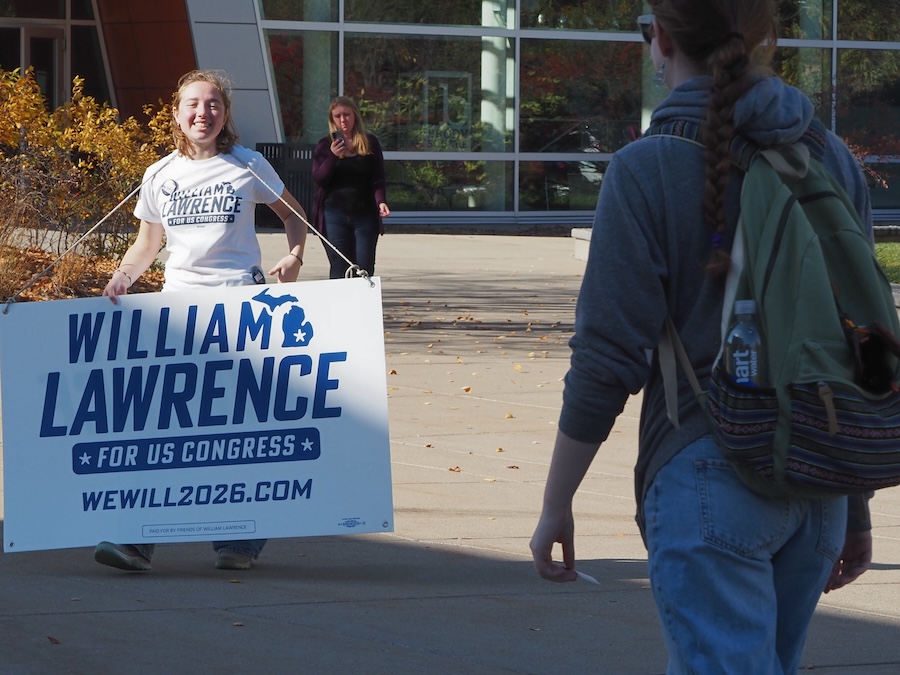
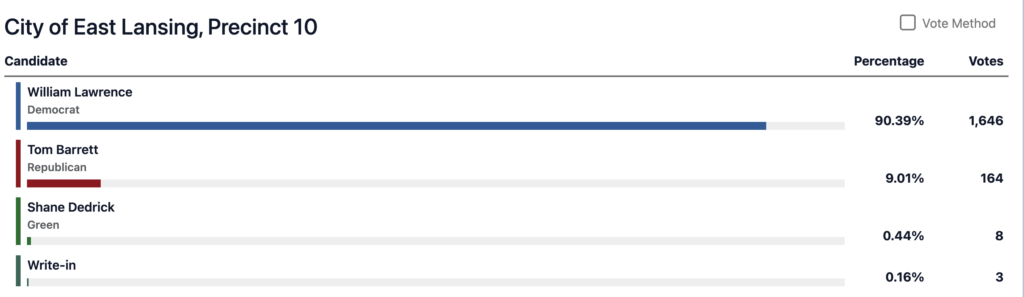
East Lansing voters continued their decadeslong support for Democrats, with gubernatorial candidate Jocelyn Benson, U.S. Senate candidate Abdul El-Sayed and U.S. House candidate William Lawrence each winning at least 68% of the vote in all 14 city precincts. In some precincts, Democrats received more than 90% of the vote. All three Democrats won their races, according to the Associated Press.
Democrats up and down East Lansing ballots won their races, including Rashida Harrison in Michigan’s 28th Senate District and incumbent State House Democrats Rep. Julie Brixie and Rep. Penelope Tsernoglou, who were reelected as Democrats gained control of both chambers of the Michigan legislature.
Megan Kathleen Cavanagh and Noah Hood, incumbent Michigan Supreme Court Justices who were backed by the Ingham County Democratic party and East Lansing voters, retained their seats.
Campus votes are instrumental in keeping City Council elections in odd-numbered years.
A proposal to amend the City Charter to switch City Council elections from odd- to even-numbered years was narrowly defeated, with 6,819 voters in favor and 7,197 against. Had the proposal passed, it would have aligned City Council elections with federal and state general elections, substantially increasing turnout, especially among Michigan State University students.
Precincts on MSU’s campus were critical in the vote against the charter amendment, as most off-campus East Lansing voters supported the amendment. The proposal was rejected by a margin of 378 votes and in the four campus precincts, 619 more voters opposed changing the election years than supported.
Sarah Reckhow, who helped organize the campaign in favor of the amendment, said she believes an explanatory caption the City Council added to the ballot question swayed the student vote.
The caption the council added is the first paragraph in the ballot text. The full text reads as follows:
“A citizen-initiated proposal to amend the City Charter to move all City elections to even years, which, if passed, would extend the terms of current officeholders by one year. Note that even if approved, the City Council must take action to finalize the move of City elections to even years.
“Shall the East Lansing City Charter be amended to require the City Council to move all elections held under the City Charter from odd-numbered years to even-numbered years?”
Reckhow, an MSU political science professor, said the caption may have led some voters to view the proposal primarily as a means to extend City Council members’ terms by a year, rather than as a change to the timing of local elections. She said some voters may have opposed the amendment because they did not want current council members to remain in office for another year.
“A lot of students don’t necessarily have a great impression of the East Lansing City Council,” Reckhow said in a call with East Lansing Info Wednesday. “A response to that can be ‘Wait, they’re going to be in office another year.’”
The caption was controversial when the City Council added it. Adam DeLay, a former City Council candidate who campaigned for the amendment, accused the council of trying to “poison pill” the vote at a meeting in August. At that meeting, Councilmember Mark Meadows argued the initial language left out important information by not stating that members’ terms would be extended.
Additionally, restrictions on campaigning in MSU dorms made it hard for proponents for the amendment to reach student voters, Reckhow said.
Despite the proposal failing, Reckhow said the campaign in favor spoke with many residents about why it’s important to participate in local elections and the role members of the City Council play. She said she hopes this helps to increase turnout at the 2027 City Council election.
Elsewhere on the ballot, four other city charter amendments were strongly supported by voters.
A proposal to create a committee that analyzes local access to healthcare and provide recommendations to local, state and federal officials was favored by more than 70% of East Lansing voters. A proposal to create a healthcare committee in Lansing was passed by voters as well.
Three other charter amendments that originated from a city committee that recommended changes to the charter were approved by voters with strong margins. These amendments largely allow more flexibility for city officials to delegate certain tasks.
The election was marked by high turnout.
Leading up to Tuesday’s election, City Clerk Emily Gordon told ELi she was preparing for a “presidential level” turnout. The preparation turned out to be worthwhile.
While the midterm election didn’t quite reach 2024 presidential turnout, where nearly 19,000 votes were cast, more than 17,600 East Lansing voters turned in their ballots.
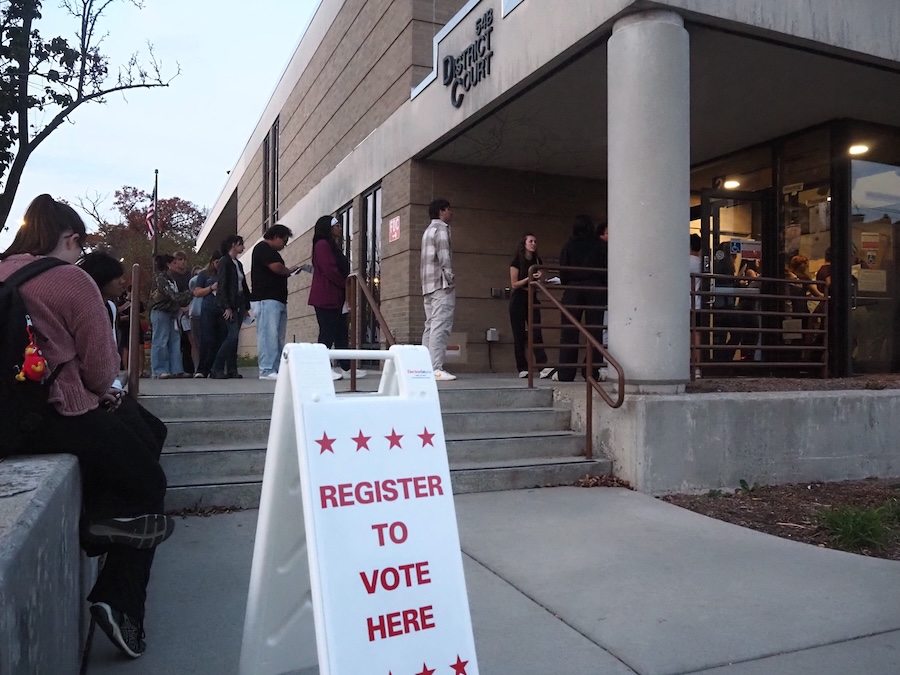
High turnout in East Lansing was widely reported after the 2022 midterm election, when students waited in line for hours to register and vote. Still, there was a roughly 25% increase in turnout for this year’s midterm election in East Lansing compared to four years ago.
While there were no lines similar to the polls at Brody Hall in 2022, which wrapped around halls throughout the building, there were a few voting locations that saw significant waits.
During major elections, many MSU students still need to register to vote or update their registration on Election Day. These voters are funneled to a couple of locations called Election Day Vote Centers because registration is not done at regular polling places.
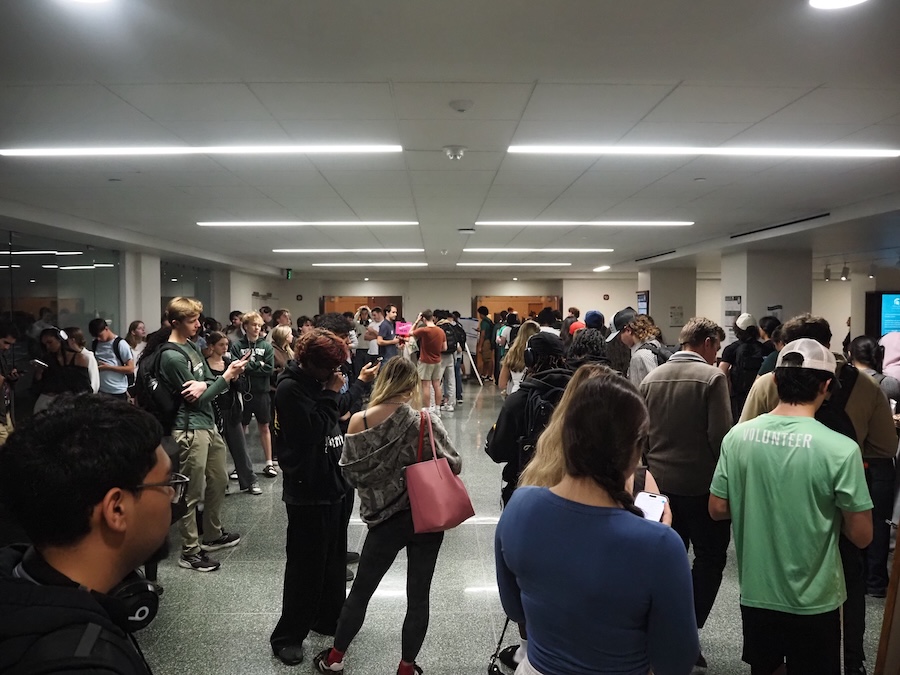
This year’s Election Day Vote Centers were located at City Hall and WKAR’s Studio A in MSU’s Communications Arts and Sciences building. Students who had finished voting at City Hall a little after 5 p.m. estimated they waited in line for about 40 minutes. At about 6 p.m., students at the Communication Arts and Sciences building told ELi it took about an hour to cast a ballot.
There was also a long line at the MSU Union, as students in line at about 7 p.m. said they had waited for more than an hour to vote. ELi did not observe any similar long wait times at other regular polling places.
We’re still waiting to hear who won a seat on the school board.
There were only three on-ballot candidates in a race for four seats on the East Lansing Board of Education. The on-ballot candidates – Abbie Tykocki, Tali Faris-Hylen and Delia Fernandez-Jones – each easily claimed a seat.
The winner among three write-in candidates seeking the final seat is unclear. Scott Farver, Timothy Schmitt and Abigail Wright-Geddes each ran as official write-in candidates, and results show that hundreds of write-in votes were cast in the election. However, the results on the county clerk’s website do not distinguish who these write-in votes are for.
ELi reached out to Clerk Gordon asking if a fourth school board trustee has been elected. She responded in an email Wednesday afternoon, writing that more will be known about this race starting Thursday.