
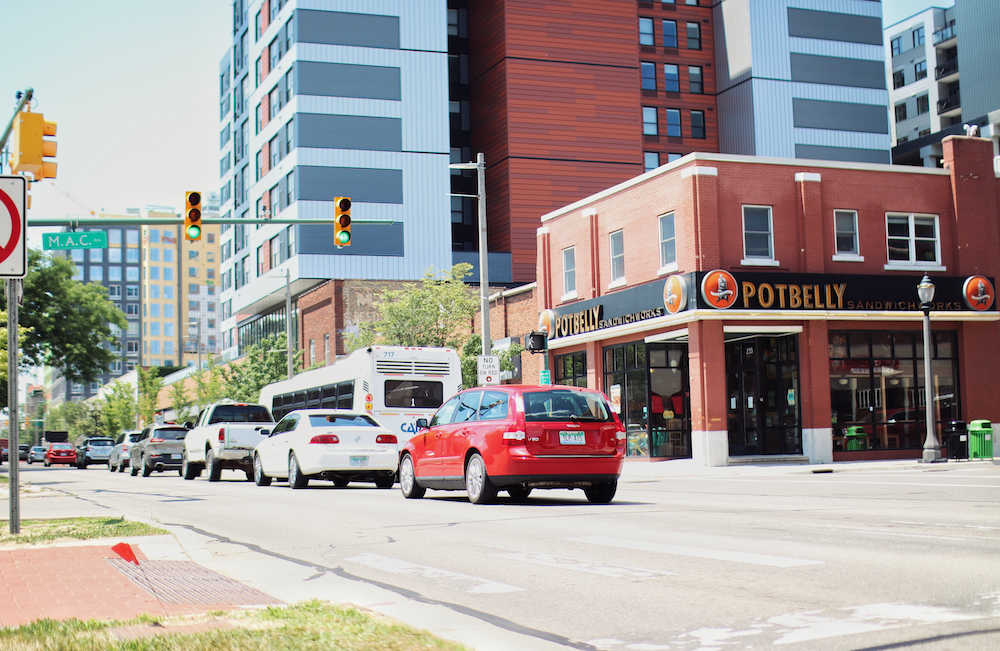
East Lansing Considers Local Control of Saginaw Street, Grand River Avenue
Multiple crashes involving pedestrians, including an incident in which an 86-year-old was struck by a cement truck, have prompted the East Lansing Transportation Commission to consider whether the city should take over management and maintenance of two major roads that bisect the community.
At its Nov. 2 meeting, the Transportation Commission invited representatives from Kalamazoo, Meridian Township and Ann Arbor to share their experiences working with the Michigan Department of Transportation. Each municipality has successfully taken control of a road previously managed by the state.
The two roads under consideration in East Lansing are Saginaw Street and Grand River Avenue.
Commission member Noah Vander Galien, who invited the representatives to the meeting, said three or four crashes involving pedestrians occurred near the intersection of Saginaw Street and Abbot Road over a six-week period.
Those incidents, combined with frequent requests from community members urging the commission to take action, have prompted discussions about whether the city should assume control of the roads.
If the city does take control of the roads, it would be able to adjust the speed limits and change the signal timings at some intersections. However, the city would also need to pay for road repairs.
“I think that that’s the biggest sticking point as far as the city’s concerned; that’s a big expense that right now we don’t have to pay,” Vander Galien said.
Currently, Vander Galien said, the city can contact the Michigan Department of Transportation, or MDOT, when a state-managed road needs repairs.
Speaking for himself and not on behalf of the commission, Vander Galien said he believes a truly vibrant downtown is difficult to achieve without changes to Grand River Avenue.
“We’re getting close to the age where there’s driverless cars, and people have electric cars, and everything else, and the problems are only getting worse,” he said. “There are only more delivery drivers downtown, there are only more deliver-like big trucks that just block a lane on Grand River that in order to have a truly like vibrant economic center of the town, I think that something needs to change about how traffic moves through it.”
Vander Galien said the presentations from Kalamazoo and Ann Arbor demonstrated how flexible MDOT can be when working with municipalities.
Erin Chelotti, manager of MDOT’s Lansing Transportation Service Center, helped coordinate a transfer of state-managed roads with the city of Lansing. She spoke with East Lansing Info about how such agreements work.
Chelotti explained that the state and municipality start with a conversation about if the transfer makes sense. If discussions advance, entities would then develop a memorandum of understanding identifying the condition the road should be in before ownership is transferred.
In Lansing’s case, the city and state exchanged responsibility for different roads. The state received Michigan Avenue from East Lansing to the freeway, while Lansing took control of a portion of the Capitol Loop previously managed by MDOT.
The exchange took nearly two years, Chelotti said, because both parties had to agree on the condition of the roads before the transfer could be completed.
“In that situation,” she said, “we actually both gained continuity in our networks versus losing continuity, so it really made a lot of sense for us to make that transfer. It helped both of us out.”
Vander Galien emphasized that the Transportation Commission is not yet ready to recommend that the city take over either road. However, he expects discussions to continue.
“I think that it’s important to encourage people to come to Transportation Commission meetings or City Council meetings and express their opinions about the matter,” he said.