
A Week of Extreme Heat Fueled East Lansing’s July 3 Storm
As people prepared to celebrate America’s 250th birthday, a week of intense heat in the 90s culminated into a severe storm system on July 3.
In East Lansing, the local fire department responded to 28 storm-related incidents. In an email to East Lansing Info, Interim Fire Chief John Newman noted that the incidents involved damage to power lines, power poles, fallen trees, structural damage and a damaged vehicle. Fortunately, no injuries were reported in East Lansing.
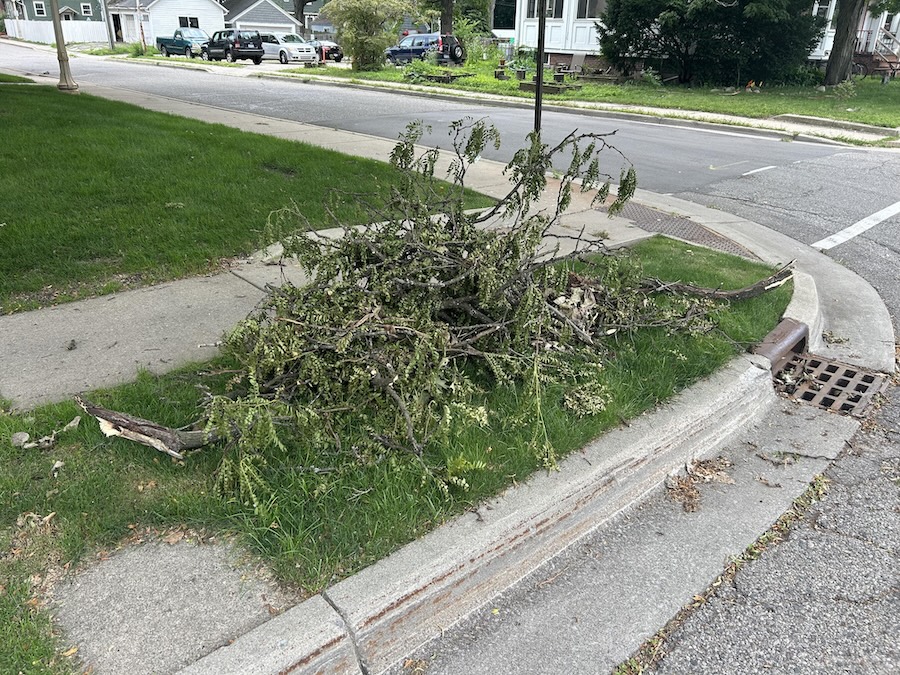
Residents are still picking up in the aftermath. The city is offering special collection of storm debris through Friday morning.
National Weather Service Grand Rapids Meteorologist Scott Thomas explained that the hot, humid air fueled a squall line as it tracked from Illinois into southwest Michigan before crossing into the southeastern side of the mitten state. The severe storm brought 60 to 75 mile per hour winds to the Greater Lansing area, with Kalamazoo reporting gusts near 80 mph.
A squall line is a group of thunderstorms arranged in a line that can span hundreds of miles. These types of storms bring high winds and heavy rain.
“As the heat comes back next week, I definitely could see some storms, but it is difficult this far out to pin down whether or not they would be severe,” Thomas said, adding that periods of stormy weather could continue alongside soaring temperatures.
Local emergency officials expressed relief that the damage was not worse.
“We’ve had those squall lines come through much, much worse in the past, so we’re thankful it wasn’t as bad as it could’ve been,” said Rob Dale, Ingham County deputy emergency manager.
Dale noted that while trees struck houses in Lansing and Meridian Township, there was no significant structural damage.
When municipal first responders exhaust their resources, they rely on the Ingham County Office of Emergency Management for county-wide disaster coordination.
“We’re kind of like the Amazon of disasters,” Dale said. “So if the locals can’t get something they need, I don’t want them to have to look for it, I want them to come to me.”
As for restoring power, Dale said utility companies such as the Lansing Board of Water & Light and Consumers Energy typically use a prioritization list and follow up with the office of emergency management to determine restoration priorities.
The time it takes to restore power after a storm varies depending on where outages occurred. Dale explained that the main lines, which typically have secondary routes to reroute power, are usually the first to be repaired since thousands of people rely on them, as opposed to individual homes which often face the longest repair time.
While some East Lansing businesses closed early for the holiday, others went into lockdown. Manager Selena Schmalback at Haraz Coffee House in downtown East Lansing heard about the storm when an employee called her frightened after hearing reports of falling trees.
Schmalback immediately ordered the door locked since it flings open during extreme winds, and directed staff and customers to the basement away from the cafe’s floor-to-ceiling windows.
“It’s definitely more scary when it feels like the wind is pushing on the windows and the winds are so strong,” Schmalback said. “There’s so much stuff in East Lansing, anything can hit the windows at any time. That’s the scary part.”
Area residents can sign up to receive real-time updates through the Ingham County Emergency Alert Program here.