
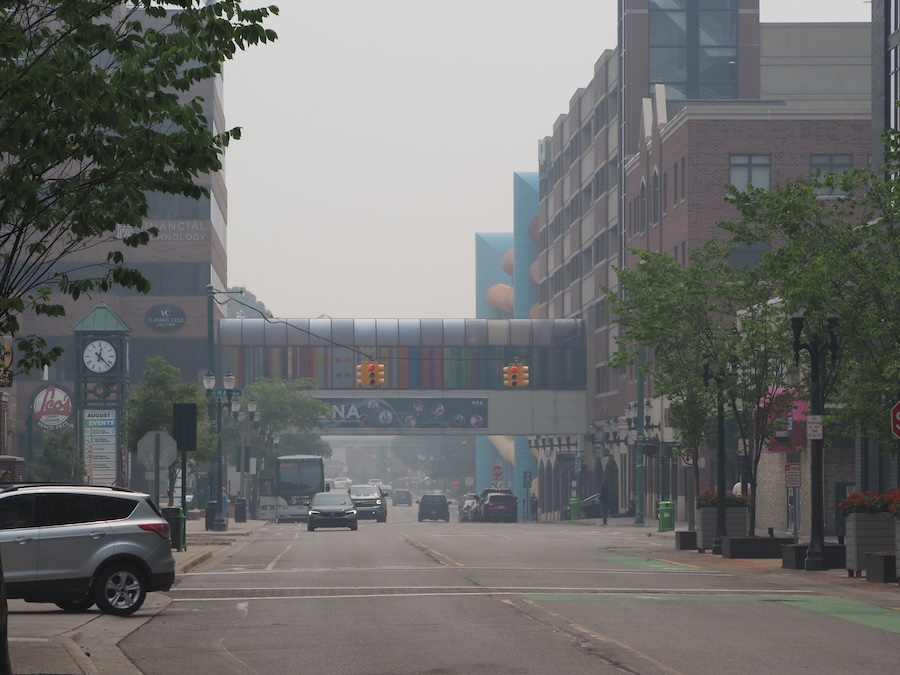
Camps Close, Patios Empty as Wildfire Smoke Engulfs East Lansing
Smoke drifting from wildfires north of Lake Superior is giving Michigan some of the world’s worst air quality on Thursday, enveloping East Lansing and other communities in a haze that has brought health concerns and closed outdoor spaces.
Winds on Wednesday and Thursday blew smoke from around 250 miles of scattered forest fires in Northern Minnesota and Canada south, bringing the haze to East Lansing and other communities across Michigan, explained Cort Scholten, a meteorologist with the Grand Rapids National Weather Service station.
The poor air quality is expected to linger throughout Thursday and into Friday morning, Scholten said, with hope that winds Friday afternoon provide relief.
“We think as we get winds from the southwest tomorrow afternoon, that could bring in a little bit cleaner air late in the day, but we’re not sure exactly when,” he said in a phone call with East Lansing Info Thursday afternoon.
Dr. Michael Masnyj, a pulmonologist at University of Michigan Health-Sparrow, said people are breathing air that is terribly polluted. He recommends spending as much time indoors as possible and wearing a mask when outside.

People with conditions that affect breathing like asthma, emphysema and COPD are at particular risk, as well as older people and young children, Masnyj said.
Poor air quality can bring a variety of symptoms like coughing, sinus pressure, headaches and dry eyes, Masnyj said.
More severe symptoms include feeling lightheaded, chest pressure, hyperventilating and seeing spots. Masnyj said people should seek medical care if these symptoms last more than 15 minutes.
Issues with air quality are happening at the same time Michigan is experiencing high summer temperatures, with many recent instances of East Lansing and Greater Lansing organizations alerting the public of health risks associated with extreme temperatures.
Air quality and high temperatures can create compounding health risks for individuals, Michigan Department of Health and Human Services Public Health Physician Dr. Annette Gilmer told ELi.
Both are stressors on the body. Extreme heat can take a toll on anybody, causing heat stroke and heat exertion. The burden of heavy smoke and the toxic materials it hosts can also threaten a person’s cardiovascular health, Gilmer said.
“It is a bodywide impact here. So it’s not just people who have asthma who have to worry. In fact, the people who have heart problems and cardiovascular problems in general also need to be very, very conscientious,” Gilmer said.
There’s a lot of confusion and concern over what people should be doing and how long the air conditions may remain hazardous, but the expectation from the state health department is that Thursday and Friday there will still be smoke and conditions could improve over the weekend, Gilmer said. Residents should check with public health resources like the state health department to monitor air quality.
The state is in a good position to disseminate important information about health and safety as individuals navigate the next couple days of heat and smoke, having learned a lot from the COVID-19 pandemic, Gilmer said.
In a press release on Thursday, the Michigan Department of Health and Human Services urged precautions like keeping doors and windows shut, closing the outdoor air intake on air conditioning units and using an air cleaner.
Carrie Sampson, communications director for the City of East Lansing, said the poor air quality impacted city operations. Employees were offered N95 masks, instructed to limit time outdoors and take frequent breaks in air conditioning.
Department of Public Works employees with underlying respiratory issues were reassigned to inside jobs on Thursday, she said. Additionally, the Aquatic Center and softball and soccer complexes were closed and a field trip for a school-aged childcare program was canceled.
Elsewhere, summer camps and daycares sequestered children inside or sent them home early.
Parents and guardians of campers at the Michigan Athletic Club at 2900 Hannah Blvd were advised just before noon today that campers should be picked up immediately. Kalani Davis, head camp counselor, said “current air quality conditions and direction advising against strenuous exercise” led to the closure and the club will remain closed until conditions improve.
Peoples Church Preschool at 200 W. Grand River Ave. kept students and staff inside Thursday due to “dangerous air quality” and told parents via text they would monitor conditions throughout the rest of the week if conditions persist.
The Lansing Lugnuts, Lansing’s minor league baseball team, posted on Facebook that team officials are monitoring the air quality ahead of Friday’s scheduled game against the Fort Wayne Tincaps. The team still plans to play the game, but fans are advised to follow updates on social media, as a decision won’t be made until closer to game time.
Staff at Michigan State University were informed via email that Infrastructure Planning and Facilities would close outside air dampers on HVAC systems to prevent smoke from filtering into offices and classrooms.
Mike Krueger, owner of The Peanut Barrel and Crunchy’s, said his restaurants will not seat customers on the patio Thursday to protect staff from working outside in the dangerous air quality.
The East Lansing Public Library is offering free masks for people to pick up. In a Facebook post, the library encouraged people who need a break from the outdoor air or heat to stop by for a rest in its air conditioned building.
Seniors are especially susceptible to the diminished air quality.
Alesha Williams, director of the city’s Prime Time Seniors program, said outdoor programs were moved inside but no activities were canceled. She advised seniors to follow guidelines that include wearing a N95 or KN95 mask if they go outside, even if it’s just walking to or from a car.
Mowing the lawn or gardening should be postponed, Williams told ELi in a text message.

Taking the dog for a walk, even for a short period of time, isn’t the best idea right now, State Veterinarian Nora Wineland said in a news release Thursday.
The release says that running or walking with pets is usually beneficial, but when the air quality is diminished it’s best to keep pets indoors when possible and to keep windows closed while running an air purifier.
“Animals react to poor air conditions much like humans do, and certain groups —such as birds, young or older animals, and those with heart or respiratory issues —face higher risks during air quality alerts,” Wineland said in the news release. “MDARD urges owners to monitor their animals for signs of coughing, wheezing, trouble breathing, watery eyes, low energy, changes in how they sound, reduced appetite and reduced thirst. If you see anything concerning, contact your veterinarian.”
As local and statewide organizations are ringing the alarm for vulnerable populations while the air quality is poor, organizations that work with unhoused people like Punks with Lunch Lansing say unhoused individuals face increased risks of exposure. Punks With Lunch is asking for KN95/N95 mask donations for distribution.
Treating the unhoused population as “out of sight, out of mind” is not an option during extreme weather events and air quality threats, Director of Public Policy at the Michigan Coalition Against Homelessness Nick Cook said.
In recent years there’s been growing awareness from the public about the risks for the unhoused community during code blue winter weather advisories, but there’s not as much awareness about the need to address the harm severe heat has on unhoused individuals, Cook said.
There’s really no getting away from the harmful impacts of the air quality for the unhoused population as heating and cooling centers only operate during the day, Cook said, and individuals have to navigate the consequences of inhaling contaminants all night long.
Breathing in hazardous air can be especially harmful for unhoused people, who are more likely to have serious health conditions, according to the Centers for Disease Control and Prevention.
“The unhoused population, many of them have chronic illnesses, but then they also just don’t have the basic shelter that they need to survive. So when you have these extreme weather events and the air quality the way it is, it’s just going to make a bad situation that much worse,” Cook said. “I’m thinking about a stage 4 cancer patient that lives in one of the encampments in Lansing. I can’t imagine what she’s going through with this hot weather and with the air quality the way it is.”