
East Lansing Plans ‘Data Week’ Ahead of Proposed Data Center Regulations
East Lansing plans to host a Data Week this October that will feature a series of data center, data science and AI-related events, according to East Lansing Principal Planner Landon Bartley.
The series is planned to take place from Oct. 19-23 and while events are still being developed, Bartley noted that programs will occur throughout the city and Michigan State University. The week may feature one final community meeting before staff presents draft ordinance language on data center regulation to the City Council. Bartley is hopeful the ordinance will be introduced at the Nov. 17 City Council meeting.
The tentative schedule for Data Week includes a presentation on data centers’ environmental impacts at the Commission on the Environment, or COE, meeting on Monday, Oct. 19. On the same day, the Center for Ethically and Socially Responsible Leadership at MSU is planning to host a related lunch-and-learn session.
The Quello Center at MSU, which aims to elevate discourse on communication, information and media policy, expressed interest in hosting an event on Tuesday, Oct. 20. Wednesday, Oct. 21 will feature a data science and AI summit at The Graduate, hosted by the MSU Research Foundation. Thursday, Oct. 22 could include two events: a cybersecurity class at the East Lansing Public Library and a tentative community meeting at the Hannah Community Center that evening.
“I expect a couple more orgs/events to still join on, but so far that’s the plan for Data Week. I’m hopeful that we can find a good speaker for COE that Monday,” Bartley said in an email to East Lansing Info.
A data center workgroup, made up of representatives from numerous departments, including public works and planning, was tasked with proposing ordinance language to regulate data centers in East Lansing. After meeting bi-weekly for months, the group produced a final report detailing their research into what data centers are, their environmental impacts, how other municipalities regulate them and specific policy recommendations.
In August, the East Lansing City Council extended a six-month data center moratorium by another six months, at the request of staff who wanted to meet with experts before making recommendations. The moratorium is now set to end in March 2027.
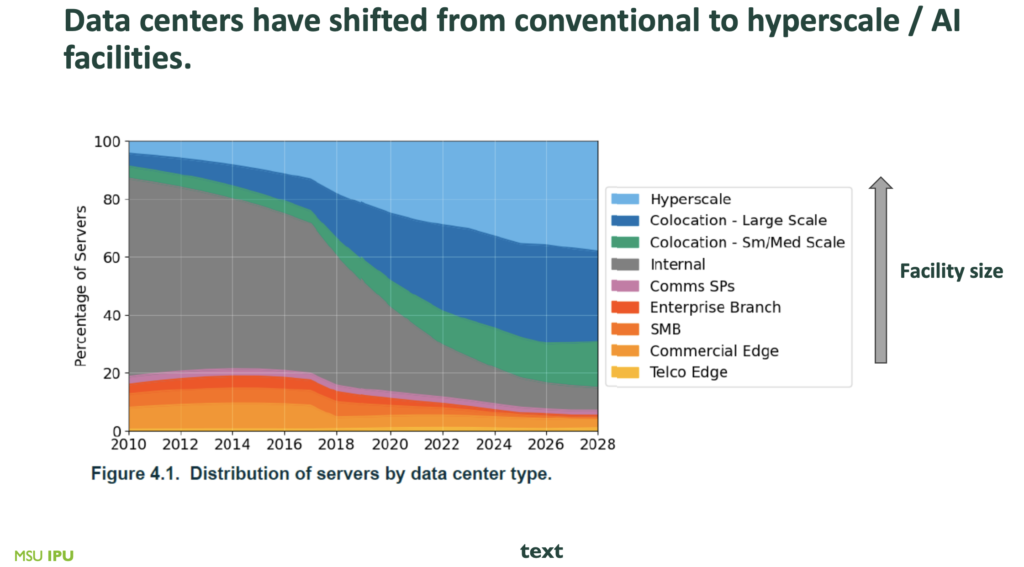
Bartley noted that staff discussed drafted ordinance language with MSU professors Erik Nordman in the Department of Agricultural, Food, and Resource Economics, and Jean Hardy, in the Department of Media and Information. Their feedback was generally positive, and they highlighted some inconsistencies and suggested differentiating between the various scales of data centers. They also advised on necessary requirements, such as clean energy sourcing, which are needed to receive statewide sales and use tax incentives.
While the two professors provided valuable insight, staff are still in the process of reaching out to additional experts for further technical analysis.
Staff previously presented a preliminary report in August, noting a few constraints specific to the City of East Lansing, particularly the fact that there are very few areas where a data center could legally be built under current zoning rules.
Currently, the city has two industrial zones covering about eight parcels where a data center could potentially be constructed. Bartley has previously noted this limited space, saying land would likely need to be rezoned for a data center to be built in East Lansing, which would provide an additional opportunity for public review of any proposed project. Examining whether the existing industrial zones are appropriate for data center development is one of six proposed policies by the workgroup.
Another proposed policy is a requirement to obtain a special-use permit and hold a public hearing before a data center is approved, rather than approving facilities “by right.” This means approval must come from a board, commission, or City Council following public input, instead of receiving automatic approval from city staff if a project meets basic rules. This would give the community a formal opportunity to weigh-in on data center proposals.
Additional policy recommendations include mandating green building practices, such as closed-loop cooling systems. Unlike traditional facilities that evaporate millions of gallons of water to stay cool, a closed-loop system preserves water by reusing it. The system pumps water directly through the computer chips to absorb heat, routes it to massive fans that blow the heat away, and then cycles that exact same water back inside. Because virtually no water is exposed to the air, a single fill-up can last for years.
The workgroup is interested in minimizing water usage and waste, and Bartley noted they are interested in mandating closed-loop cooling systems.