
East Lansing Seniors Pen Their Life Stories
A local memoir-writing class is helping East Lansing seniors turn their memories into books, an exercise that has uncovered long-buried family secrets and given participants a way to preserve their own histories for future generations.
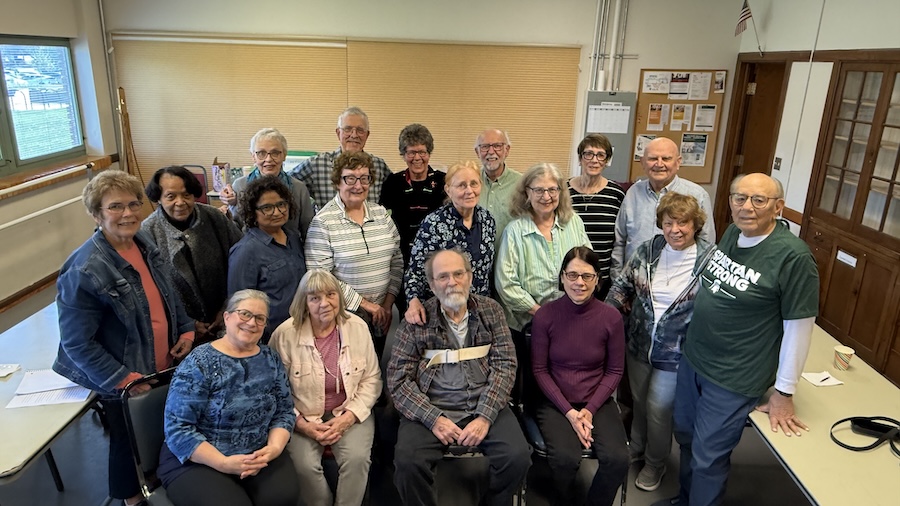
Nancy Seubert has taught Life Stories: Writing Your Own Memoir for 30 years in various venues, bringing the course to the East Lansing Prime Time Seniors Program in 2011. It runs twice a year for eight weeks, challenging participants to take pen to paper and revisit moments from their past with the goal of writing a memoir. Some students decide to go further and publish their books.
Karen Petersmarck, 80, always wanted to know more about her father’s upbringing, but she only started getting answers after he passed. While doing research for the memoir class, she secured her father’s military file and finally understood why he refused to talk about his past.
“I have to say there’s been a lot of healing just looking at my dad’s records,” Petersmarck said. “Finding out this terrible thing he never ever, ever talked about. It really gave me compassion for both of my parents because they had their own challenges.”
The class typically has 18 people. While many students return to take the course multiple times, beginners are often in the dark. To help them find their footing, Seubert meets with new writers before the first session to provide a writing toolkit filled with tips and prompts.
Students write a story each week. During class, they have five minutes to read their piece out loud, followed by two minutes of feedback from their peers. Because of the rotation schedule, Seubert noted that each student gets to read six times over the eight-week course.
Seubert highlighted the value of receiving feedback from peers, and clarified her main role is to keep everyone’s inner critic at bay. She accomplishes this by intentionally focusing on each writer’s individual strengths and pointing out aspects the writer did well. This format allows for other writers to hear what their peers and try in their own writing, a process she describes as osmosis learning. At times, a story will even spark other students’ memories.
“By doing that I keep it away from critique and instead go for what is the writing strength,” Seubert said. “We all have writing strengths no matter what … writing your memoir is not therapy, but there’s therapeutic activity that happens while you’re doing it, and especially when you’re doing it with a larger group.”
Seubert said she believes that writing a memoir is highly beneficial, offering the freedom to write about difficult moments or learn about people from different backgrounds.
Learning about others’ life experiences and connecting with them is something Petersmarck values tremendously.
“I’m a good writer but there are a couple women in the class that just dazzle me,” Petersmarck said. “People have had such different lives. I’m a white girl from suburbia and [those] women have grown up in different countries, become immigrants, just culturally different backgrounds, it’s the most amazing learning experience.”
Similar to Petersmarck, Jim Detjen, 78, also did not know much about his father, and his decision to take Seubert’s class stemmed partly from the lack of knowledge about family history. His father emigrated from Germany in 1926 during a time of economic chaos following World War I, just a few years before the onset of the Great Depression began in 1929.
“He lived through this period of great uncertainty and economic collapse,” Detjen said. “I think those memories were painful, particularly in Germany, he never would talk about it … there’s an awful lot I don’t know about my dad’s [life] growing up in Germany.”
Detjen got a glimpse of his dad’s life in Germany when his father was served turnips during a family meal and refused to eat them, explaining that he had survived solely on the vegetable during the economic collapse.
He wanted to record his own experiences so his children and extended family would grow up knowing their roots. Currently, he is in the process of publishing a book titled “Bashful to Bold – A baby boomer’s stories of growing up in the Hudson Valley.”
It’s a collection of 30 out of 130 stories he wrote in Seubert’s class. These vignettes delve into his life in the 1950s and ‘60s, covering his birth in New York City, a move to a rural community in upstate New York, his time in undergrad and graduate school, and landing his first journalism job at the Poughkeepsie Journal.
He added that because of the abundance of stories he wrote, he plans to publish two more books. One will focus on his career as an award-winning environmental journalist, where he covered topics like the space program and a nuclear reactor meltdown on Pennsylvania’s Three Mile Island. The third book will be a culmination of his travel experiences, including the time he lived in China with his wife and children, and study abroad courses he led as a Michigan State University professor.
Because some of Seubert’s students have taken the class for years and accumulated a vast collection of materials, she encouraged them to publish their stories.
Dawn Fleming wrote, illustrated and published a book about her childhood up until the age of 9.
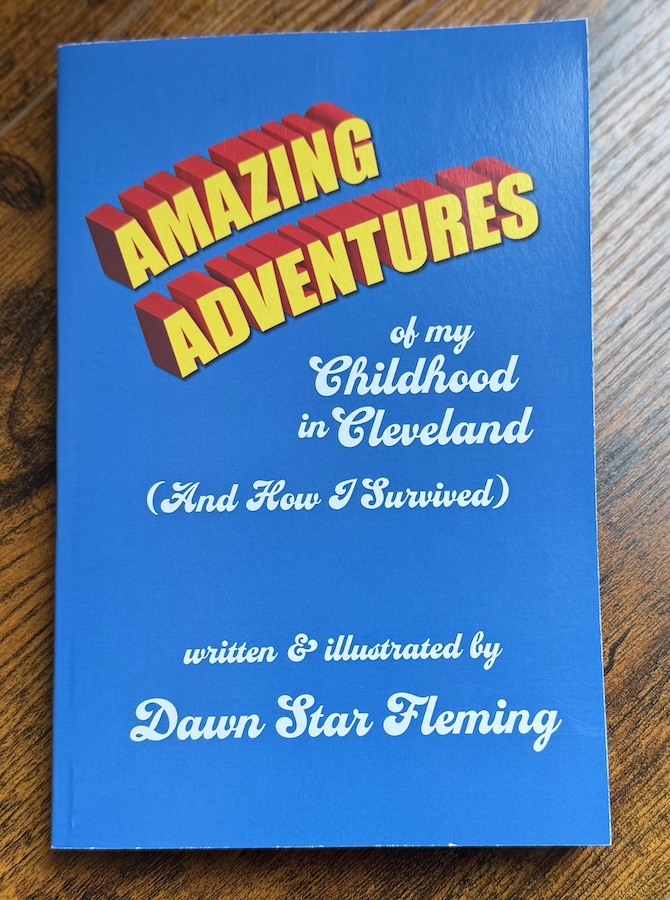
Titled “Amazing Adventures of My Childhood in Cleveland (And How I Survived),” Fleming’s memoir follows her upbringing chronologically and geographically, charting the multiple moves she made as a child. To help inspire her students to take the next step, Seubert invited Julie Taylor, the publishing services coordinator at Michigan State University Libraries, to lead two publishing workshops. She hoped the sessions would motivate the class to not just write, but print their work and publish it.
“Without her [Taylor] there’s no way I could’ve ever published that book, you know, if I would’ve tried to do it myself,” Fleming said.
Supporting people in documenting their lives and publishing those stories, regardless of intention to sell, is personal for Taylor because her mother had a heart attack and passed away at 58.
“Her whole history, all of her stories were just suddenly not available to us in her voice,” Taylor said, adding that she urged her father to write a memoir following the death. “For me to have the treasure of my dad’s book now, that gives me personal motivation to help people share their stories.”
Taylor explained that the library has “on-demand” printing, meaning that someone can walk in with a document they would like to print and by the time they walk out, they have a copy in their hands. Some authors will print a few copies to share with their families, while others will print many copies to sell on Amazon or in bookstores.
“That moment when I take the book off the press and hand it to them and just see this awe,” Taylor said. “[It’s] this magical moment when it’s no longer intangible, it’s a physical object they can hold … anybody can do this, and it’s important to do it … to write down your stories, even if you only have an audience of one.”