
ELPS M-Step Scores Better Than State Average, Lag Behind Okemos, Haslett
East Lansing students took the Michigan Student Test of Educational Progress (M-STEP) this spring, and the results are in: East Lansing had more students score proficient or better than the state average, but scores lagged behind neighboring districts Haslett and Okemos.
The M-STEP assesses students in grades 3–8 in English language arts, math, science and social studies, measuring their proficiency against state standards. Each student is placed in one of four categories per subject: advanced, proficient, partially proficient or not proficient.
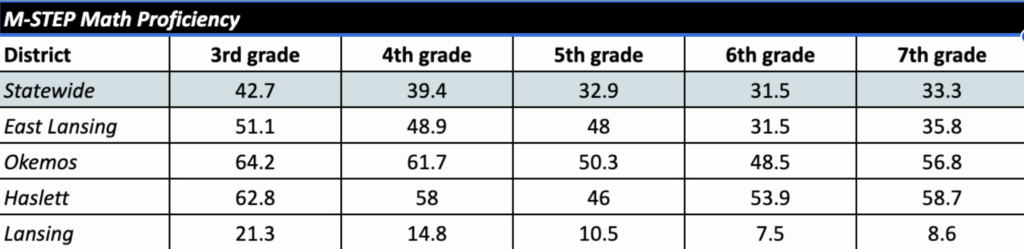
In nearly every grade and subject, East Lansing students exceeded the statewide average. The exception came in sixth-grade math, where East Lansing students matched the state average of 31.5% proficient.
Compared to 2024, the picture is mixed. Third graders dropped 10 percentage points in English language arts proficiency, while fifth graders gained 10. There were 7% fewer third-grade students who scored proficient in math, but social studies jumped 18.
Compared to neighboring districts, however, the gaps are more apparent. East Lansing outperformed Lansing schools, but generally lagged behind Haslett and Okemos.

Okemos students bested East Lansing at every grade level in every subject, with the largest gaps in middle school. Sixth- and seventh-grade East Lansing students trailed Okemos by 19 and 16 points in English language arts. In math, those same grades fell 17 and 21 percentage points behind. By eighth grade, East Lansing lagged 18 points in science and 23 in social studies.
Haslett’s scores more closely resembled East Lansing’s in English language arts, but Haslett scored better in middle school math, science and social studies.

ELPS Superintendent Dori Leyko told ELi via email that a presentation will be given on the test scores soon.
“I and/or some of our building principals will be preparing and presenting student achievement and student, parent and staff perception data at an upcoming board meeting,” she wrote. She noted that Glenn Mitcham, the departing ELPS deputy superintendent, would normally play a role in that process, and she plans to begin interviews for his replacement soon.
“We’ll be sharing, we’ll be responding,” Leyko said. “We want to do it thoughtfully and with our new curriculum and instruction leadership involved.”
The data also revealed noticeable differences among East Lansing’s five elementary schools.
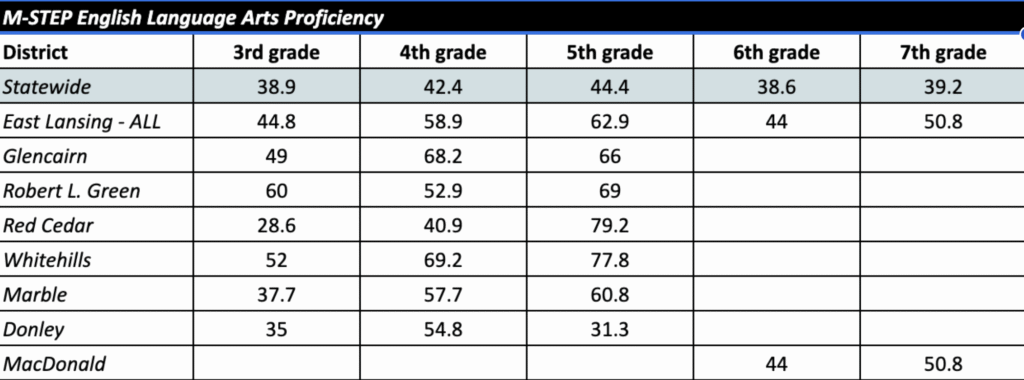
Red Cedar and Donley scored lowest in most English language arts categories, with Red Cedar reporting just 28.6% proficiency in third grade. Yet by fifth grade, Red Cedar led the district with 79.2% proficiency.
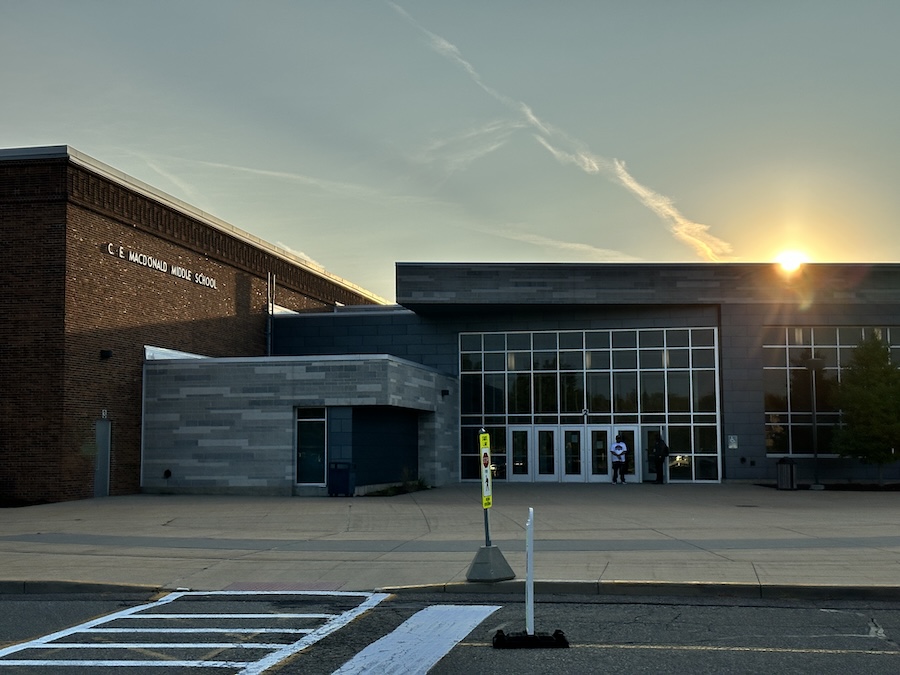
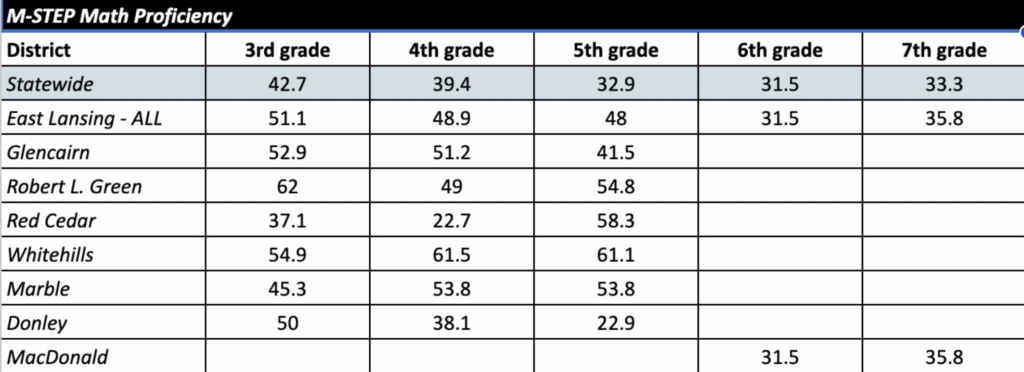
Whitehills set the pace in math, while Red Cedar again trailed in third and fourth grades before surging more than 30 points to 58.3% proficiency in fifth grade. At MacDonald Middle School, both tested grades hovered around state averages in the low to mid-30s.
Science scores varied: Donley’s fifth graders fell 13 points below the state average, while MacDonald’s eighth graders finished 10 points above it.

In social studies, just 25% of Red Cedar fifth graders scored proficient, while other Esat Lansing schools surpassed state averages.