
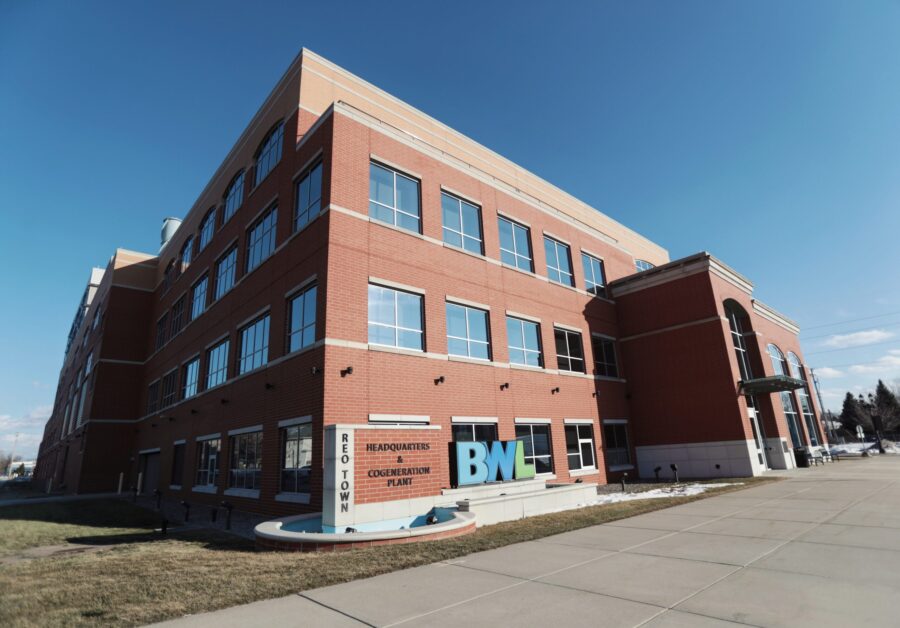
Many East Lansing Residents are Eligible to Receive Significant “Franchise Fee” Reimbursement Payments. How Many Will Submit a Claim?
East Lansing residents who paid for electricity through the Lansing Board of Water & Light in recent years are eligible to claim a portion of a $7.8 million settlement paid by the city for installing a “disguised tax” in BWL bills.
The payout figures to be significant for many residents. A website created for the suit, where class members can submit claims, says payments are expected to be over $500. The amount individuals receive may be more or less depending on how many claims are filed. This is because the city will spend $7.8 million regardless of the number of claims filed, meaning individual class members will receive more if fewer claims are filed, City Manager Robert Belleman confirmed to ELi.
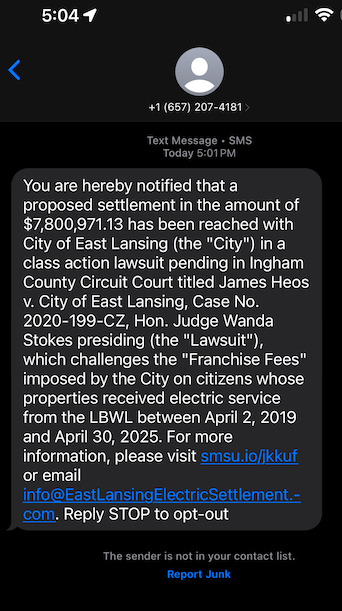
Now, there are questions about how many people will file a claim before the Sept. 2 deadline due to confusing communication around the settlement and fear about the rising threat of cyber scams.
“All of us have seen, over the last years, these phishing emails or communications that are just simply looking for information from you so they can steal your money,” Councilmember Mark Meadows said at the July 15 City Council meeting. “That’s the reaction that a lot of our citizens have had toward the notification [of the settlement].”
The city does not administer the payout of the lawsuit. Rather, the city created a settlement fund that is being administered by class attorneys Kickham Hanley, with the help of a third party administrator, according to the settlement agreement. The third party company assisting with the process is Simpluris.
Belleman told ELi the city has received “a lot of calls” from residents with questions about the settlement.
He was on vacation when the first text was sent out notifying class members of the settlement. He became aware of the message when an ELi reporter reached out to him asking if it was a legitimate notification or if it could be a scam. Belleman was unsure, and had to reach out to a city attorney.
“When I saw it, I was like ‘you’ve got to be kidding me,’” Belleman said. “In today’s day and age… we’re taught to be suspicious of texts and emails that you don’t know where they’re coming from.”
The settlement has been communicated through several channels, including mailed notices, text messages, emails and social media advertisements.
ELi received questions from a few readers who said they should be eligible for a reimbursement payment, but have not received any sort of notice about the settlement.
According to the settlement, addresses and information used to contact class members were provided by BWL. However, it is unclear if this information was sufficient to reach all class members, and if factors like a new address or phone number would prevent someone from being noticed. This is especially important considering the large transient population of Michigan State University students that cycle through East Lansing.
ELi reached out to three class attorneys, Simpluris and BWL, hoping to gain clarification on details about communication and other aspects of the settlement, but received either a “no comment” or no response to each inquiry.
Cyber scams, diverse media streams are making it hard to communicate with a broad audience.
Belleman said if he knew ahead of time that the notices were going out, he would’ve had the city’s communications department put out a press release about what to expect.
“I wish, looking at what has come out, they had done a better job at setting the foundation for our residents to understand what it is, and how they were to receive these communications,” he said.
Tom Holt is an expert on cyber security and a professor at the Michigan State University School of Criminal Justice. He said the URL sent to residents through text being shortened, and not containing the full website name, could lead people to believe something was amiss.
Holt added that people have become so used to automated text messages from political campaigns and other sources, that many will ignore these types of messages. He said it may have been helpful for the text to come from a Lansing area phone number.
It’s helpful to try several routes to reach people, but there is no silver bullet method of mass communication, Holt said. Many people will scroll past a Facebook advertisement, it’s common for mail to be thrown out and most emails pick up a good amount of spam.
“The best messaging would be to make it easier for people to understand it is legitimate by minimizing fraudulent indicators like blanket messaging, avoiding scammy numbers, using full URLs that tie to a real entity – something that can be examined and assessed and validated – as opposed to, like, a tiny URL,” Holt said.

It isn’t just East Lansing residents who have mistaken legitimate communication for a scam. Holt said the problem is far reaching.
“Longterm, it’s a huge bummer because we’re seeing this dramatic decline in survey responses and contact responses for anything,” Holt said. “Everything is just going down and I think it’s because people are getting cognizant of risk and are just becoming risk averse of responding to anything, unless it’s a known family member or friend.”
While the city is not responsible for advertising the settlement, it has issued press releases and created a web page to share information. The web page has been shared on the city’s social media pages but it is more difficult to reach everyone when there are so many different places people go to for information, said Erika Rosebrook, director of the Michigan State University Extension Center for Local Government Finance and Policy.
“It used to be, if you got something in the local newspaper or you got the local television station to do a story, you covered almost everyone,” she said. “Then maybe you have someone from the city stop down at the local coffee shop.”
Now, residents don’t just get their information from local media. Many rely on a variety of social media sites like TikTok or Reddit. Getting information to all these mediums is labor intensive and local governments, including East Lansing, have much smaller communications teams than they used to.
“It’s so tough, nobody has the right answer,” Rosebrook said.