
Teacher Pay Keeps Many Educators Working Through the Summer
For teachers, is the idea of summer vacation a myth?
Some use summer break as a time to rest and recoup from the school year, but others work just to stay afloat. A Gallup study published earlier this year found that most K-12 teachers hold at least one second job, a trend hitting close to home for some teachers in the East Lansing school district.
Teachers often enter the profession carrying significant college debt, and for many, a second job is necessary to earn enough to support a family. In East Lansing, some teachers supplement their income by taking on additional school-related roles, such as coaching sports or advising student clubs, while others work second jobs outside the school system.
East Lansing teachers have the option to be paid in 21 pay periods during the school year or 26 pay periods spread across the entire year. While the latter option ensures paychecks keep arriving over the summer, it does not mean extra money, it simply stretches the same base salary into smaller, year-round increments.
Entering his 10th year of teaching in East Lansing, Ross Gorman takes the summer pay option, hoping he won’t need to work. Yet, this is the first year he felt the financial need to secure summer employment.
“I saved myself from needing to get a traditional job by getting a Michigan State [University] fellowship,” Gorman said, adding that he is doing academic and scholarship curriculum work.

Because there is no statewide teacher salary schedule, Michigan school districts and teacher unions determine pay through collective bargaining. Most districts utilize a “step and lane” salary schedule, which determines pay based on experience and educational qualifications, such as having a bachelor’s or master’s degree.
In the recent 2025-2028 East Lansing school district contract, each full step increases salary by 5%, and the entire schedule table bumps up 1% annually. The grid contains 17 total steps, including half steps. Ideally, a teacher advances one step for every year of working. However, due to historical budget cuts and frozen contracts, the step Gorman is at does not correlate directly to the number of years he has taught.
Gorman, who teaches high school social studies classes, recalls starting at the bottom of the pay scale when he was hired in 2016. Entering his 10th year, he is only at step 8.5 for the upcoming school year, which corresponds to $59,280.05 on the bachelor’s lane and $62,718.81 on the master’s lane.
Due to past wage freezes following the 2008 recession, the school district and the union created half steps. This system was originally developed so teachers would still receive a smaller pay increase when budgets were spread thin.
“For most of my time as a teacher we have received one step on the payscale for each year,” Gorman said. “But early in my career, and for a considerable amount of my colleagues, there were pay freezes and half-step increases through the recession and the years afterwards.”
This historical freezing creates a frustrating dynamic, veteran teachers can be trapped on lower steps, while new hires can successfully negotiate higher starting steps based on external experience, effectively passing veterans in pay.
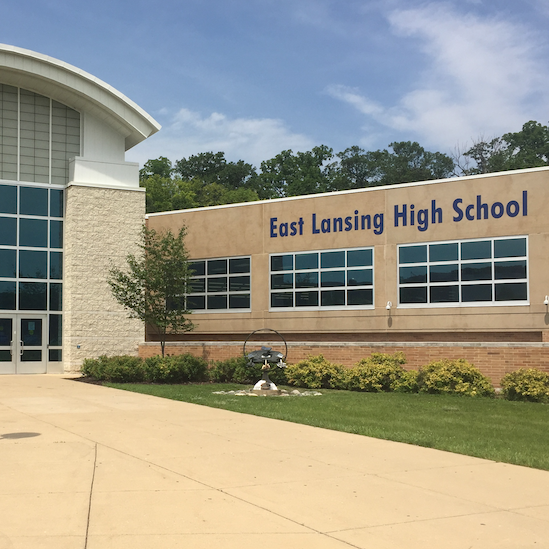
Cody Harrell, who teaches English and journalism at East Lansing High School, explained this dynamic to East Lansing Info. Harrell is entering his 11th year as a teacher but is only at step 9.5. Harrell started in East Lansing on step one, while a colleague hired one year after Harrell was hired on step two.
“In one year, that’s a pretty small amount,” Harrell said. “But over the course of 10 years that we’ve now been working together, they’ve made a substantial sum more than I have, and I’ve been in the district longer.”
Harrell added that when a teacher is first hired, they have an opportunity to counter-offer the step placement suggested by the administration. Because there is no guarantee that a step in one district matches another, placement can fluctuate, which Harrell sees as a downside of the salary schedule.
Harrell added that initial hiring is the most leverage a teacher ever has because future raises are strictly locked into the union contract.
Harrell has been the advisor of the Gay-Straight Alliance at East Lansing High School his entire tenure, a position for which he receives extra compensation. However, he only receives that alliance pay during the school year when the club is active.
To supplement his income during the summer, he bounces between multiple side jobs. This year he is offering critiques for student publications across the country, and teaching yearbook workshops at MSU and in Austin, Texas, during July.
“Now, I do need the extra money. It does make a difference in my mortgage and my ability to survive,” Harrell said. “But I wouldn’t say that’s a fault of ELHS or East Lansing Public Schools. I think it’s just a plight of what all teachers are paid and afforded and how we make it work.”
Despite working in the summer, Harrell noted he enjoys the hustle. Working keeps him sharp and connects him to new communities.
This reliance on summer income is not unique to mid-career teachers like Harrell and Gorman, older generations of educators faced the same pressure.
Jeff Lyon, a longtime East Lansing teacher with the district since the early 2000s, worked at a boat company in Mackinaw City for a few summers while teaching until 2009. For the past 16 years, he has run the Archer Trojan Community Soccer Camp during the summer.
Lyon shared that his first few years in the district were unstable due to statewide public school financial troubles in the early 2000s, leading him being laid off multiple times until he secured permanent employment in 2005.
“Luckily at that time I was single and didn’t have a family to raise so it wasn’t as pertinent as it might be for teachers with families,” Lyon said.
Gorman, who served as lead negotiator during the last round of bargaining, shared that union negotiations were challenging this year due to the state’s delayed budget, which left school districts uncertain about funding. While the final agreement was a 1% annual pay increase, Gorman noted that this does not keep up with long-term inflation.
“During those negotiations, if I’m going to play devil’s advocate, the legislature hadn’t passed a budget quite yet, and the district is saying they don’t know what the budget is going to be,” Gorman said. “There’s tension on that point … there’s back-and-forth disagreement on how much we think they can afford versus how much they think they can afford, and certainly what money should be spent on.”
Disclosure: Cody Harrell serves on ELi’s volunteer board of directors.