
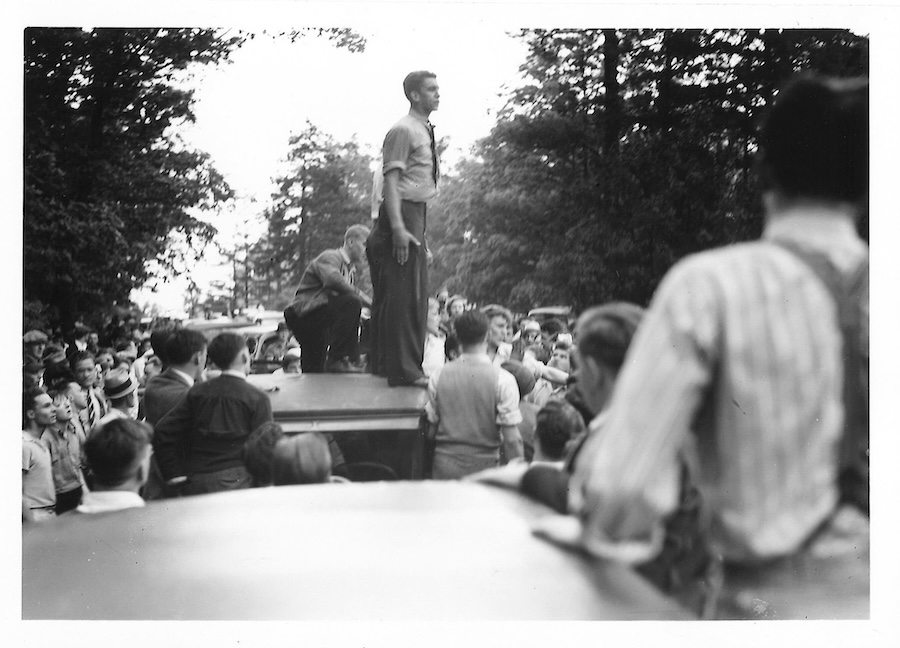
The Forgotten Battle of East Lansing
With 3-foot-long concrete reinforcing rods in their hands, students at Michigan State College took to the streets of East Lansing on Monday, June 7, 1937, to push back an invasion of Lansing labor union members, kicking off the one-day — and oft-forgotten — Battle of East Lansing.
(Perhaps if it had a catchy folk song sung by a local Peter, Paul and Mary-type group, future generations would better remember it?)
Recounting these events nearly five decades later in an interview with labor historian Ken Germanson, Lester Washburn, president of United Auto Workers union of Lansing — Local 182 — said the trouble started when the union had racked up a series of wins.
Lansing was a major automobile producer, with the 52-acre Oldsmobile assembly plant on the south side, the Fisher body plant on the west side and the city’s own REO Motor Car Company plant in the neighborhood to which it gave its name.
Earlier in 1937, the latter was the site of a four-week sit-down strike that led to the recognition of UAW Local 182 as the chief collective bargaining representative for the autoworkers.
“We were being too successful as far as organizing was concerned in that town,” Washburn said in the 1986 interview. “Everybody wanted to join the auto workers. One night, we had 19 people come in the hall and ask for a union; Capital City Wrecking Company. They wreck buildings, sell used lumber as well as new lumber. They had 25 employees. 19 of them come in and ask for a union, we give them one that night, elected officers, set them up.”
The next morning, however, Capital City Wrecking Company fired the six newly elected officers and refused to recognize the union.
According to Washburn, what followed was a court fight and a strike. The legal battle found the union trying to prove that the company had violated its rights and the National Labor Board Act of 1935. The judge issued a temporary injunction against the union until he could rule.
The strike was staged by employees of the wrecking company and their UAW brothers from other local shops. Men would picket the company when they weren’t working their own jobs, and the auxiliary organization — made up of the wives of the union men — set up a tent to serve coffee and doughnuts to the strikers.
In the interview, Washburn said some authorities felt the strike violated the court’s injunction.
At 2 a.m. Monday, June 7, 1937, Lansing police pounded on the Washburns’ door to arrest him and his wife, Nevah, but the union leader was on a train back from Detroit. His wife was home with their three young children, all under 10.
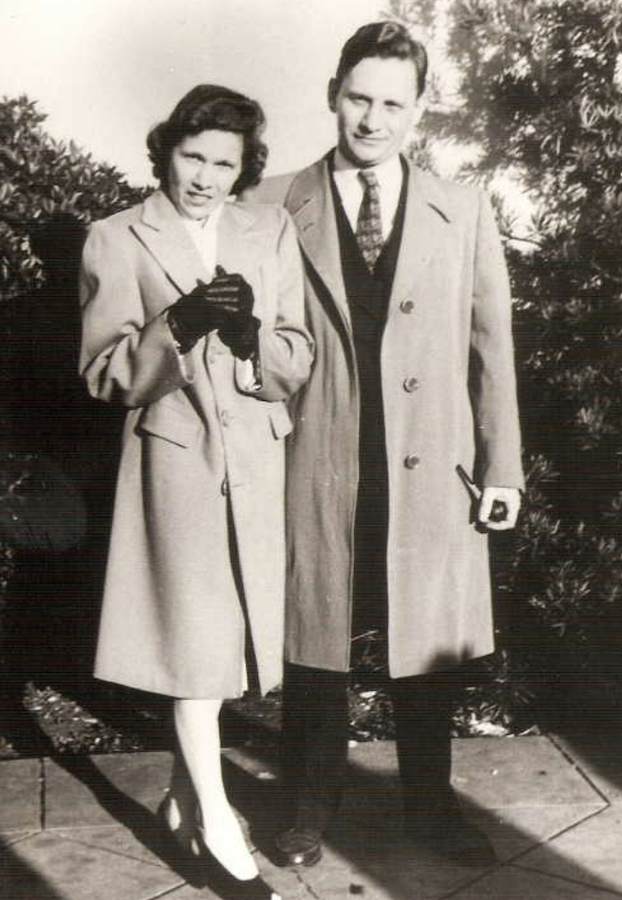
Nevah was arrested and left her children with a neighbor. Several labor union leaders and their wives were rounded up that night by the Lansing Police Department.
When Washburn returned to Lansing about an hour later and found out his wife was in jail, he hurried to a pay phone — he said police had cut the telephone wire outside their home before serving the warrant for their arrest — and started waking people up.
He gathered with other leaders who had escaped arrest and, within the next few hours, the UAW had declared a Lansing Labor Holiday.
Approximately 15,000 union members would not report to work that day to protest the arrests. The union members and their supporters took to the streets in a parade led by a gravel truck, Washburn recalled in the 1986 interview.
In a 1965 issue of Michigan History magazine, writers Albert A. Blum and Ira Spar described the labor holiday.
“They forced the closing of stores, factories, and theaters; halted all traffic and even picketed police headquarters, the city hall, and the state capitol,” they wrote. “The police force was completely immobilized while the workers paraded in the streets, their numbers growing each minute as more and more workers emerged from the closed stores and factories. Some sang ‘Solidarity Forever’ while others carried clubs, sticks, and two-by-fours. By early afternoon, just about everything that could be closed was closed because of the effective action of Washburn’s ‘flying squadron.’”
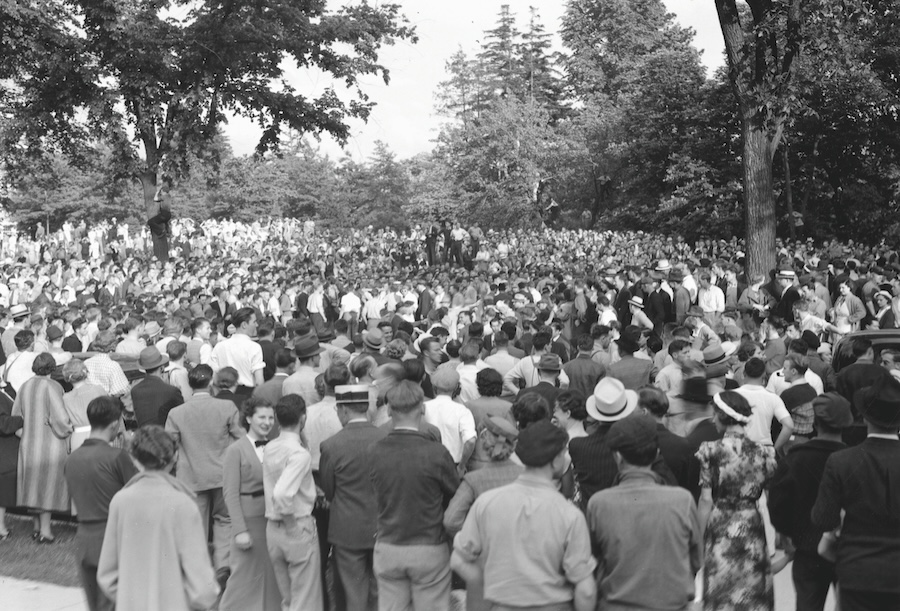
A UAW history from 2024 reports that the “flying squadron” was akin to the Minute Men of the early United States: militant and ready to strike at a moment’s notice. The UAW Local 182 Flying Squadron wore blue and gold overseas caps embroidered with the group’s name, according to Blum and Spar’s 1965 article.
Washburn said union stewards “invited” Lansing merchants to close down, and it was likely the Flying Squadron members who spread the word.
“Some of them may have gotten a little rambunctious,” he said of their invitations. “But there were no complaints or windows broken.”
In the next day’s issue of The State Journal, Washburn would say he had not given permission for union members to expand the holiday beyond Lansing’s borders, but carloads of union men started traveling east on Michigan Avenue into East Lansing and Okemos.
Laurence White’s family had moved to East Lansing from Indiana and his father was an engineer at Oldsmobile. The family lived at 546 Meadowlawn in the Glencairn neighborhood and 10-year-old White had a front row seat to this June battle. He wrote about his experience in 2010.
He said the union men blocked all major street intersections in East Lansing while “small groups of men convinced downtown merchants to lock their doors in honor of this holiday.”
Blum and Spar wrote that restaurant and business owners initially mistook the men for representatives of a veterans group because they still donned their Flying Squadron caps.
“But many Michigan State College students, overhearing the arguments between the unionists and the businessmen, quickly perceived the situation as a challenge to their sovereignty and to their eating places,” they wrote.
White said all the stores along Grand River closed, including the State College Book Store, an operation then run by MSC faculty and under the direction of College President Robert Shaw.
However, in a report to Time Magazine that appeared in the June 14, 1937, edition, Editorial Director Robert D. Burhans of the student newspaper Michigan State News said there was one exception.
“These first 60-odd men closed all stores along the main street with the exception of one,” Burhans wrote, “a pocket in the wall known as Jim Brakeman’s Bootery, [the] ‘smallest shoe store in the world.’ Jim, a 250-lb. former State footballer, does not close under just any order. And the student body likes Jim pretty well.”
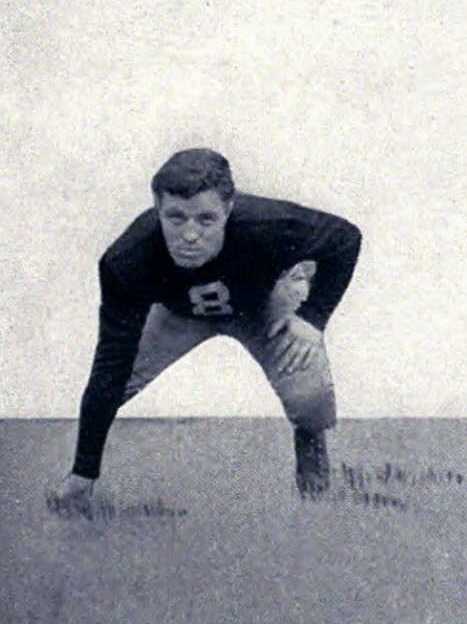
Brakeman helped lead the 1934 MSC football team to an 8-1 record and was indeed well loved by MSC and East Lansing.
When the camera store on Grand River reopened, The State Journal reported that it quickly sold out of film as students took countless pictures of the exciting events in their small town.
It was after 4 p.m. when the town’s restaurants and businesses began closing. White remembered that word of the “intrusion” had spread to Demonstration Hall, where Sgt. James Atchison had dismissed his ROTC class.
This group of young men, clad in uniform, were the first students the union men reportedly saw.
Blum and Spar wrote that some of the union men mistook the ROTC students for members of the National Guard because of their uniforms.
According to The State Journal, MSC students of all affiliation began to gather around the traffic light at Abbot Road and Michigan Avenue, with 500 assembling quickly to break the logjam of cars.
The students were now fully in charge of East Lansing.
Reports vary on how violent the altercation became. All sources agree that students began pulling union men from their vehicles. At least one automobile was flipped by students, and between eight and 20 men were thrown into the still-chilly water of the Red Cedar River.
“Egged on by their coed cheering section,” Blum and Spar wrote, “the students struck gently at first by shouting, ‘You may be able to run Lansing and Flint but you can’t run East Lansing,’ but then followed an onslaught of physical force as they charged…The outnumbered unionists stood their ground for a while, but soon began to back away from the staggering student attack. The scholars dragged eight strikers to the Red Cedar River and promptly tossed them into the cold and dirty stream for what one student called ‘a much needed cooling off.’”
The State Journal printed a photo the next day of wet, demoralized union men emerging from the river.
An unnamed alumnus years later told Blum and Spar that the scene resembled “The Battle of Bunker Hill and a Mardi Gras all rolled into one.”
Another student, Gerald Cox of Detroit, spoke on behalf of the students when talking to The State Journal.
“The student body isn’t going to allow the union to come to East Lansing and tell stores and restaurants how they shall run their business,” he said. “The students depend too much on these restaurants and eating places to allow them to close. The union may have the right to organize and carry on their bargaining and otherwise maintain their rights, but other people have rights, too.”
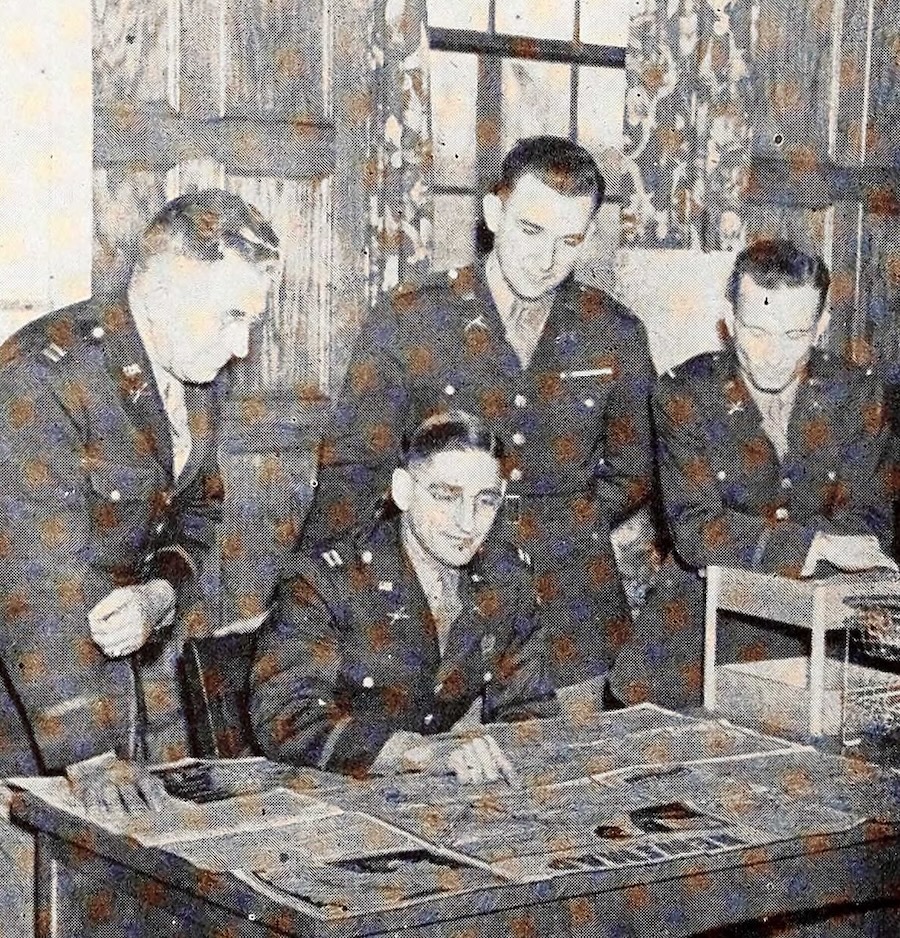
The State Journal’s Tuesday edition reported that students took over the duties of directing traffic, with the “battle sector” extending from the intersection of Grand River and Michigan Avenue opposite the People’s Church westward to Harrison Road as the students pushed the union forces three blocks toward Lansing.
Students held hands to form a human blockade, and several Lansing workers were slightly injured after being pulled from cars and thrown to the pavement.
When the fighters reached the area where Williams Hall was being constructed, fisticuffs again broke out. East Lansing Police Chief Castle Pratt pushed his way between the union men and students in hopes of evoking peace, but intense fighting broke out again.
News reports said both sides were armed with wooden clubs and the short pieces of aforementioned iron from the dormitory construction — but fists remained the primary weapon.
Coincidentally, Gov. Frank Murphy was riding horseback at the MSC stables when the East Lansing battle broke out. He was there when members of the ROTC cavalry arrived and requested use of the horses so they could ride into battle.
The State Journal reported that Murphy declined permission on behalf of the college, remarking that the action was “too Cossack-like,” referring to 15th-century Slavic warriors on horseback.
Murphy himself rode his steed to a hill near the college hospital, located where Gilchrist Hall sits now. He sat on the hill and watched the action.
Michigan State News reported later that week that the bright blue caps worn by the Flying Squadron members were the most coveted souvenirs that MSC students clung to.
“We’re not going to let them close our eating places,” the paper reported students shouting. “There’s not going to be a revolution in East Lansing!”
In his reflections, White wrote that during the height of the battle, rumors flew that the laborers were bringing union members in from Flint’s Chevrolet and Buick plants to act as backup, while MSC fraternities had put in calls to brothers in Ann Arbor to ask for assistance. Neither claim turned out to be true.
He also said allegations persisted that “many union men had to return to Lansing by wading the Red Cedar River.”
Sophomore Harold Conrad Jr. was reportedly the only student warranting a trip to the college hospital after being hit on the head by something akin to a piece of pipe. He was checked out by the staff and released shortly thereafter. Other students had black eyes and bruises, but nothing more serious.
The State Journal borders on the dramatic in its reporting, reading like an early version of a Ken Burns documentary.
“A group of students withdrew from the fighting,” the paper reported, “crossed the street, and then charged into the union forces from the flank and bottled up the UAW men between two student units. Seeing that they were outsmarted, the union men called for a cessation of fighting.”
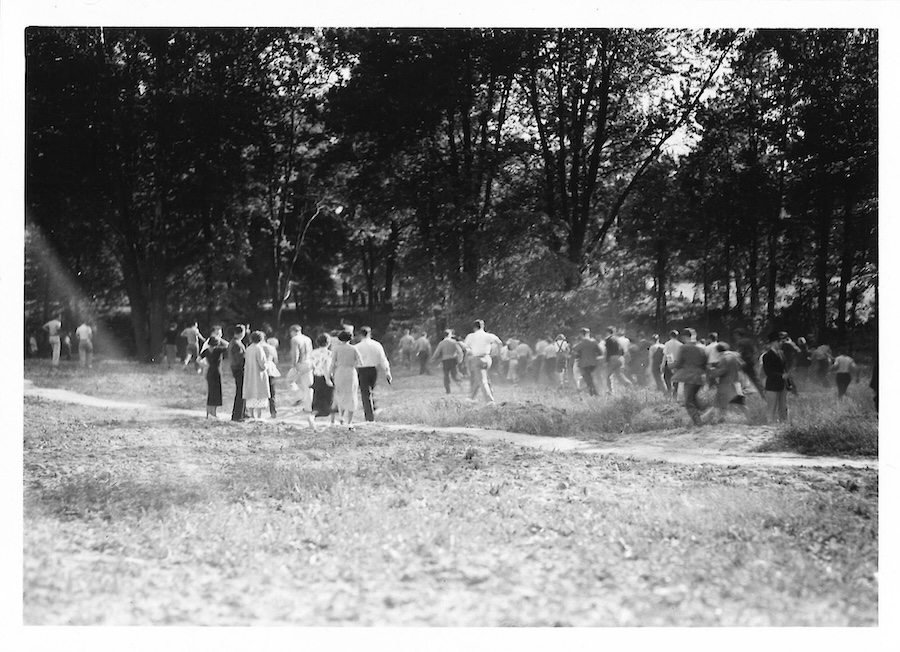
Earl Harrington, the union steward at the Oldsmobile plant, addressed the assembled students with a megaphone, asking them to permit the union men to return to Lansing.
“These young fellows don’t realize that we’re trying to make working conditions better for them,” an unnamed departing union member told a reporter for The State Journal. “I’ve youngsters of my own growing up, and I want them to go to college too. I wouldn’t want to see any of these students hurt.”
The students relented but remained on guard.
That night, The State Journal reported that students stood guard over all East Lansing restaurants, waiting for the union men to return. Between 200 and 300 of them held a mass meeting Tuesday morning when rumors circulated that outsiders would return that day to halt the construction projects on campus.
“The only visible signs of Monday’s conflict in East Lansing on Tuesday,” the paper said, “was uprooted grass and trampled shrubbery on the boulevard along West Michigan avenue.”
Later in the week, Michigan State News reported on the happenings as if the MSC student body had conquered Troy.
College President Shaw was allegedly swamped with messages of praise and congratulations from throughout the state, including from members of the Michigan House of Representatives.
“It is indeed refreshing to know,” wrote one lawmaker, “that we have at least one instance of higher learning that is not shot through with communism.”
Another House member wrote, “more power to your American boy.”
A Dearborn pastor simply said, “I am greatly pleased with your students.”
And finally, a Merrill, Michigan, businessman said the incident had helped him decide his daughter’s future.
“There was some doubt in my mind where my daughter would enter college next September,” he said, “but I am sure she is going to M.S.C. where there are red blooded Americans.”
Editorials in the Detroit News and the Detroit Free Press also celebrated the MSC students.
Despite the anti-union rhetoric in the media, legislature and college, labor won the larger battle of the day.
Washburn ended his interview with the news that Capital City Wrecking Company ended the labor holiday by signing a contract that very day to permit the UAW to collectively bargain for its workers. The leader’s wife and the other union representatives were released from jail, and all charges were dropped.
The only legitimate consequence was that Washburn was required to pay a $250 fine for skirting the temporary injunction placed against the union.
Today, the Battle of East Lansing is largely forgotten.
When will someone write its commemorative folk song?
This reporting would not have been possible without the help of Michigan State University Libraries, Michigan State University Archives and Librarian Leah Morin.