
East Lansing Scales Back Proposed Camping Ban but Critics Say New Rule Could Still Target Unhoused Residents
For months, advocates have come in droves to condemn the East Lansing City Council for considering ordinances that they say would criminalize homelessness. At Tuesday’s City Council meeting, council will vote on ordinances that would assess penalties for blocking public events and loitering in parking areas.
The proposed ordinance that addresses blocking public events is derived from a previous, broader proposal to ban public camping. At the March 10 discussion-only meeting, members of council opted to scrap a proposed camping ordinance after public backlash.
City leaders will also consider an ordinance that would ban loitering in parking areas. Initially, a ban on loitering in parking areas was introduced in the same ordinance as the camping ban, and pitched as a fix to concerns about unhoused people in the city. Council has separated the ordinances and rebranded the loitering ban as a solution for increased crime in parking garages.
Residents, researchers and homeless advocates have continued to criticize the ordinances, saying the city should instead focus on expanding resources for unhoused people. Advocates have also warned vague language in the ordinances could allow for them to be used to criminalize homelessness.
A proposed camping ban has been scaled back – but advocates still have concerns about the alternate approach.
At the March 10 discussion-only meeting, council was presented with three versions of an ordinance to address concerns about public camping. Members of council signaled support for a more narrow ordinance than previously proposed that focuses on keeping people from blocking event spaces.
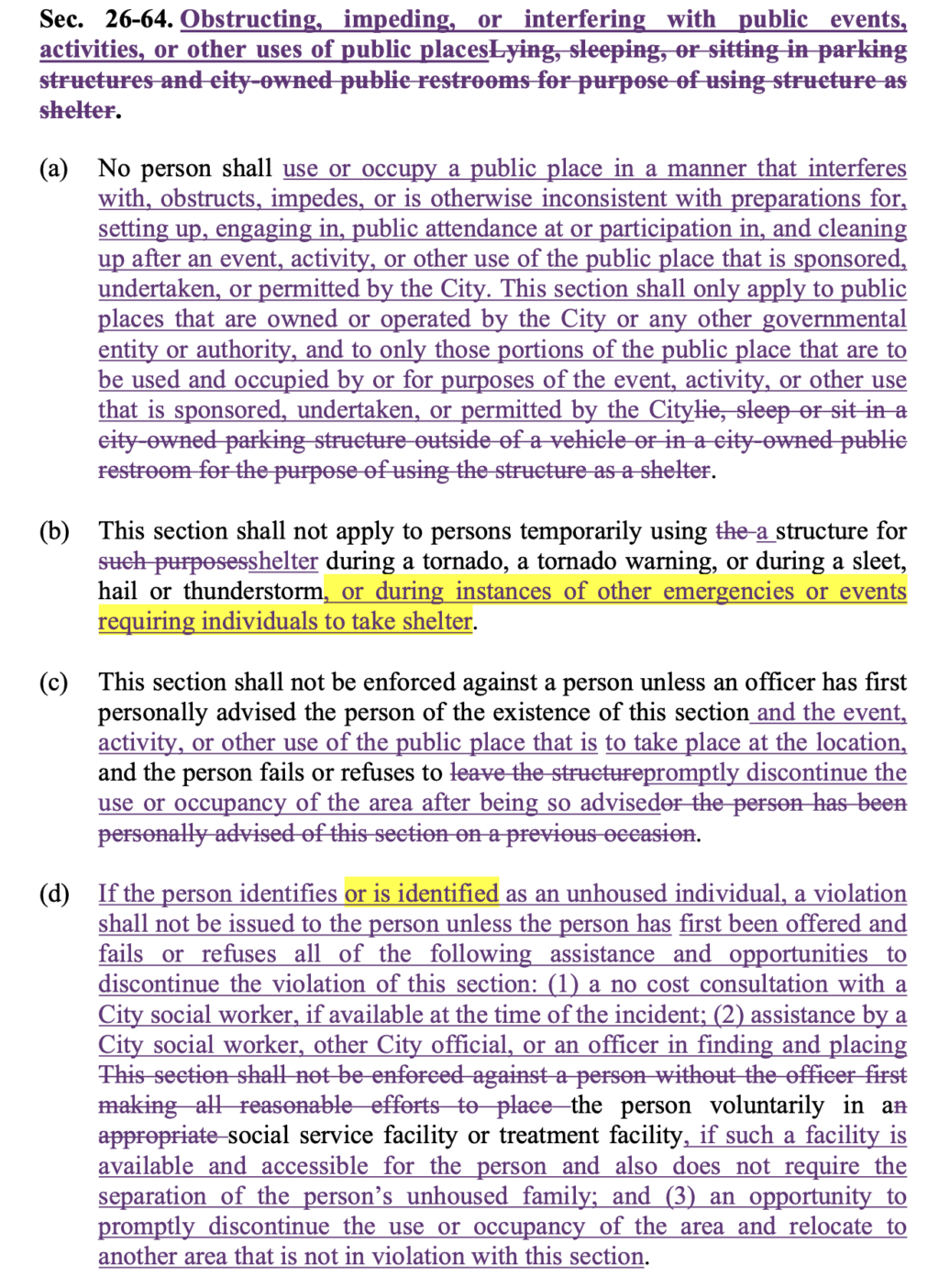
“No person shall use or occupy a public place in a manner that interferes with, obstructs, impedes, or is otherwise inconsistent with preparations for, setting up, engaging in, public attendance at or participation in, and cleaning up after an event, activity, or other use of the public place that is sponsored, undertaken, or permitted by the City,” the ordinance reads.
Violators would be given the opportunity to vacate and offered services from an ELPD social worker before they are fined under the new ordinance. Violations would be a civil infraction that would carry a fine no greater than $100.
The ordinance would not be enforced during severe weather events like a tornado warning, tornado, sleet or thunderstorm.
During council’s discussion, members said they favor the new ordinance over previous proposals because it has a more narrow focus and could protect public spaces that are needed for events.
Days after council discussed a broader camping ban at the Feb. 17 council meeting, East Lansing Info spoke to each member of City Council, asking why the ordinance was being considered and what problem it solves. Councilmembers Steve Whelan and Kerry Ebersole Singh and Mayor Erik Altmann mentioned that a person could set up an encampment and block an event.
There was an incident last summer where a person had a tent set up downtown at a location that was set to host a concert, Whelan said. The person moved after they were contacted by police and a social worker, and the band was able to perform.
City Attorney Steven Joppich said at the March 10 meeting that the ordinance would be limited to enforcement in the area of an event.
“It doesn’t cover other areas of the city and in fact, it indicates in subsection D that an individual would be allowed to relocate to another area that’s outside of the area of the event,” he said. “So, it does allow relocation of, for example, an unhoused individual.”
In a phone call with ELi on March 13, Michigan Coalition Against Homelessness Director of Public Policy Nick Cook said he has concerns about how broad language like “public place” in the ordinance could be interpreted.
“We feel it could still target the homeless and be weaponized against the homeless,” he said.
Cook added that advocates have recommended the city introduce a permitting system to clearly indicate what areas are to be used for events.
Many unhoused people will not be able to pay a $100 fine, and new fees could push them further away from becoming housed. Failure to pay a fine could also lead to a bench warrant and eventually incarceration, Cook said.
Council is rebranding its parking lot loitering ordinance.
City Council again discussed a proposed ordinance that would fine people who loiter in parking areas.
If the ordinance is put in place, violators could be fined up to $100. This ordinance also has a provision not to be enforced during emergency weather events and to give violators the opportunity to comply before penalties are assessed.
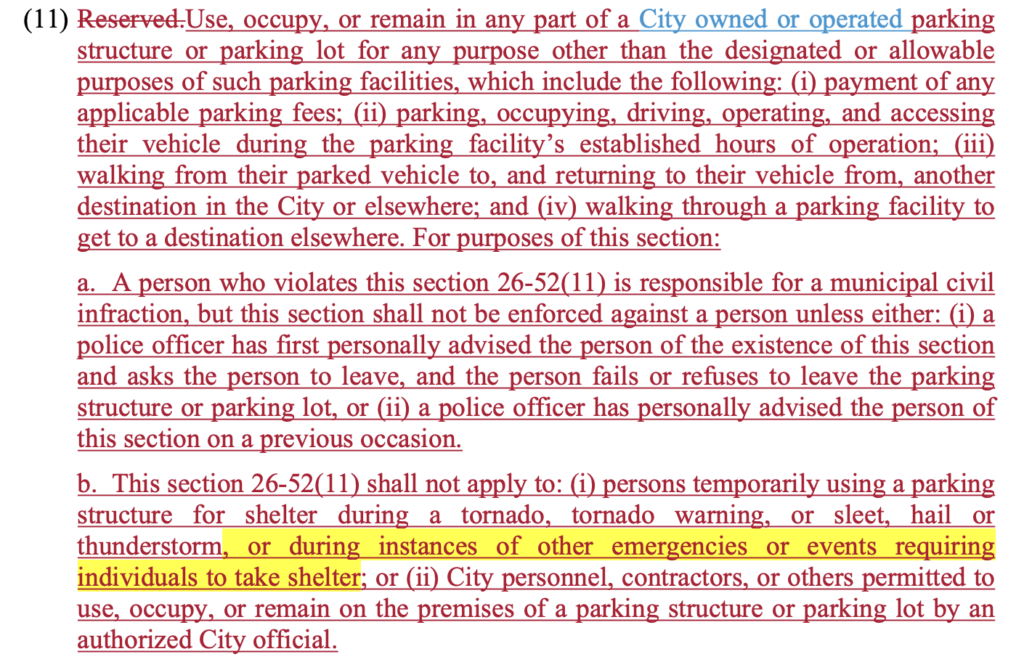
The ordinance has drawn sharp condemnation from advocates for unhoused people, but city leaders are now saying the central need for the ordinance is to give police a mechanism to break up gatherings and reduce crime in parking facilities.
“From some of the public, I believe there’s been some misconception that this is addressing any situation with the unhoused,” Whelan said. “This is really not targeted at that, it’s more of a situation where people are not using the ramp for its intended use.”
The ordinance originated with a recommendation from a city committee that was assembled to improve safety downtown. The ban on loitering in parking areas was initially part of a larger proposed ordinance that included the camping ban and pitched as a way to address concerns about the unhoused population.
At the March 10 meeting, Joppich said unhoused people could receive fines under the ordinance but it wasn’t written to target any particular population.
Advocates continue to have concerns about the proposed ordinance. Cook said vague language in the ordinance would give ELPD officers room to make a “judgement call” about who is in violation.
East Lansing should focus its attention on providing resources to unhoused people, instead of adopting ordinances that would put further strain on the community’s most vulnerable people, Cook said.
“It’s unfortunate,” he said. “There’s a lot of ability in East Lansing to connect people to resources and they’re just choosing to criminalize homelessness.”
Disclosure: Lucas Day worked as an intern for the Michigan Coalition Against Homelessness while in graduate school.