

Pioneering Judge Carolyn Stell Opened Doors for Women in Mid-Michigan Law
When Carolyn Stell was elected in 1982 to serve as Ingham County’s first female circuit court judge, the weight of that moment and her position was not lost on her, Stell’s husband David Jordon said.
Nor was it lost on the army of women that took on the task to help Stell in that campaign, Jordon added, at a time where there weren’t too many women in the legal field for other women to look up to.
In fact, when Stell first began practicing law in Ingham County in the mid-70s, she was one of four female attorneys practicing in the county.
“I think there’s some tendency if people see somebody doing something successfully, and you can relate to them and think, ‘well, maybe I could do that too’… that women [would be] willing to run as judges themselves,” Jordon said. “The idea that judges are men… it started changing, and now… it’s common that there’s more women judges than men on any given court. So it makes me really proud to have a part in [her] serving three terms.”
Reflecting on the 1982 campaign, Jordon regaled warmly with East Lansing Info about Stell’s willingness to do things differently, like placing campaign signs on the back of buses, instead of the side. Stell did this so drivers behind the buses would see her signs for a longer time, rather than just catching a quick glimpse.
“And I used to go out every night, once they were up, and go to the bus barn and wash them off. She was very detailed, that’s all I can say. And it went well with becoming a judge,” Jordon said.
Once she became a judge, Stell used her position to empower other women in the legal field and challenged status quos in court that the longstanding male-dominated arena had upheld, Eaton County Circuit Court Judge Janice Cunningham said.
Stell made herself available as a resource for other women climbing the ranks in the legal field, Cunningham said. As a law student, there aren’t always many opportunities to interact and receive mentorship from circuit court judges, she said, but Stell was a diligent attendee at Women Lawyers Association of Michigan, or WLAM, meetings in Mid-Michigan.
Connecting with Stell as a law student is something she’ll never forget, Cunningham said, adding that Stell’s gracious treatment of young lawyers and law students was a hallmark of her character and everyone associated with the WLAM was fortunate to know her.
Stell left such a legacy with her commitment to uplifting the legal careers of women in Mid-Michigan area that the WLAM has an award named after her that is given to individuals who support the advancement of women in the legal field. It has been awarded to the likes of Cunningham in 2014 and Gov. Gretchen Whitmer in 2010, several years before she took the state’s highest office.
When it came time for Cunningham to blaze her own path and attempt to be elected as Eaton County’s first female circuit court judge in 2012, she said she opened the newspaper to see a glowing endorsement from Stell, who didn’t tell Cunningham beforehand that she would be writing to the newspaper and who had been retired from the bench for more than a decade.
“I got goosebumps. It meant so much to me,” Cunningham said. “That’s kind of how she was like…I mean, a lot of people wouldn’t do that. They’re retired, they’re out …I think she was a very loyal friend.”
Cunningham won that election and has served in Eaton County Circuit Court since. In her office, Cunningham has two photos on display in her office that feature Stell.
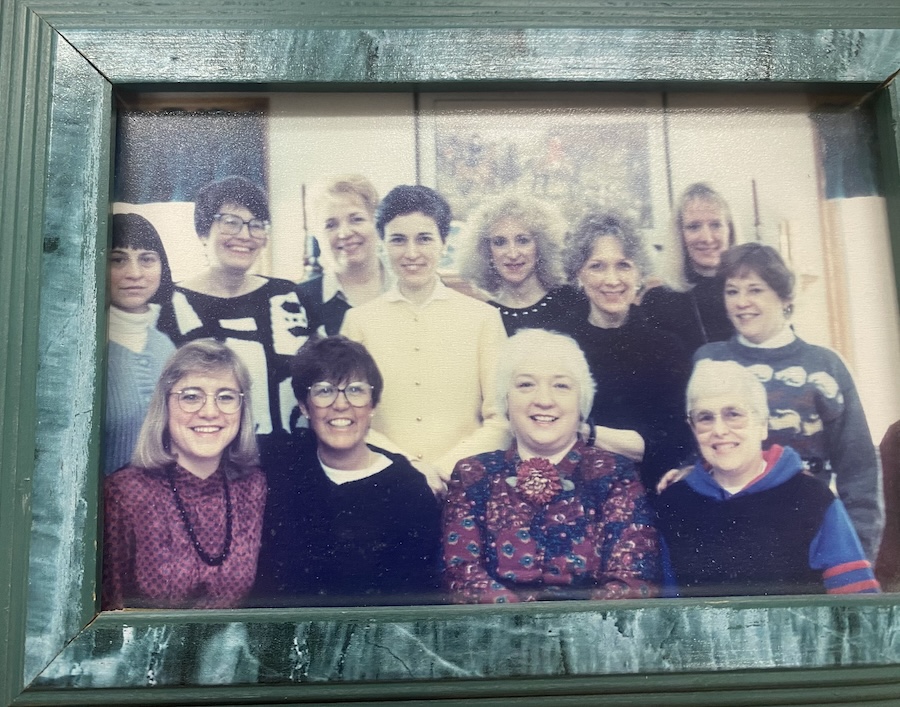
But despite all the support Stell received in her winning 1982 judgeship campaign, when Stell took the circuit court bench she was not received well by all in the legal field.
“There were people that didn’t really feel that women should be on the bench,” Cunningham said.
Stell was a judge that commanded preparedness and adherence to the rules of the court, Cunningham said.
“She did not suffer fools very well, and she definitely would not tolerate sloppiness, people being late, people not following the rules,” Cunningham said. “She held people’s feet to the fire, and I would say that made her unpopular with a lot of people.”
Stell challenged the “good old boy” network in the court system and there were mutters of resentment for her not falling in line, former Ingham County Prosecutor Carol Siemon said.
As an assistant prosecuting attorney during Stell’s tenure, Siemon said she knew anyone entering Stell’s courtroom needed to be prepared, providing legal basis for objections, able to cite appropriate case law and abiding by rules of evidence.
“It used to be there would just be people sitting around in the judge’s office and talking about football scores and stuff, and she didn’t have a lot of patience with that, which I personally appreciated,” Siemon said. “She was no nonsense… she didn’t want that kind of old boys, ‘we’re just going to kind of all play together in the courtroom’, kind of mentality that still was a part of court, especially for the older attorneys.”
This made court more predictable and better at offering equal treatment under the law, Siemon said, at a time that in some courts, especially in smaller jurisdictions, playing golf or going to the same church as a judge could be influential in an attorney’s case.
Siemon was the first woman to be elected as county prosecutor for Ingham County in 2016, but serving as an assistant prosecutor in the mid-80s, Ingham County had many women working in the prosecutor’s office. At the same time, juries weren’t always used to seeing female lawyers, Siemon said, and she would ask individuals during jury selection, especially for domestic violence cases, if they would hold it against her in trial that she was a female attorney.
Mid-Michigan WLAM meetings provided a lot of opportunity for mentorship and to share stories about the experiences of women in the legal field, Siemon said. And as Ingham County prosecutor, Siemon said she held space for the women in her office to share their lived experiences.
“At the time that I was a young lawyer, it was not at all unusual that other attorneys or judges would make sexual comments sometimes in social settings, and sometimes not,” Siemon said. “I would say that that’s gone down. That’s less common now… but there’s still people who do that.”
For as serious a presence Stell held in court, in her personal life she had a great sense of humor and a love for a good pair of shoes, Cunningham said, reflecting on one time at a conference in California when Stell enticed her during a break to go shoe shopping because Stell knew all the good places to shop.
One time, Stell arranged for members of WLAM to get a color analysis by a professional, which was a popular beauty trend in the 80s where an analyst would examine a person’s skin tone, eye color and hair to determine what “season” a person was and what colors they should wear.
Stell was a winter, Cunningham said, and loved wearing reds and purples.
Bright red tiles, tri-colored stripes and other bold design features adorned the homes he and Stell shared, Jordon said. And after Stell died in September of 2019 at age 78, Jordon said he took a lot of pride in looking after her fun legacy of color in their home.
Stell was a person of integrity and had an intimidating presence in court for those who weren’t prepared to follow court rules, Jordon said. But she also understood the importance of being a kind and supportive presence for the court ecosystem.
Jordon, who also served as a judge for some years in East Lansing district court, said one of the things he learned from Stell was how crucial it was to support juries as they make life-changing decisions for people facing criminal charges and all the other people their decision impacts.
“She didn’t become a judge without forming that coalition. She knew how she wanted to be a judge, and she did it, and it was a very rewarding career for her. She was good. She was outstanding,” Jordon said.
Her strong sense of duty to others was rooted in her parents’ commitments growing up, Jordon said.
Stell’s father was “a union guy” who helped to build power plants across the Southwest United States where Stell grew up, Jordon said. When the unions began to open up for members of minority groups to join, Stell’s father arranged for them to come to Stell’s mother, a teacher, so they could get reading and math lessons so they could better advocate for themselves at work.
“She saw that, helping people who needed help, as a model from her family and she always worked with the people, if they were on probation and they were trying to do a good job on the criminal side. She always worked to be sure they did their best,” Jordon said. “There’s room in judging for more than just sitting there and pounding the gavel.”