
East Lansing Schools Targeted by Two “Swatting” Calls in Three School Days. It’s Part of a Larger Trend.
For the second time in three school days, police rushed to East Lansing Public Schools following a threatening call on Tuesday.
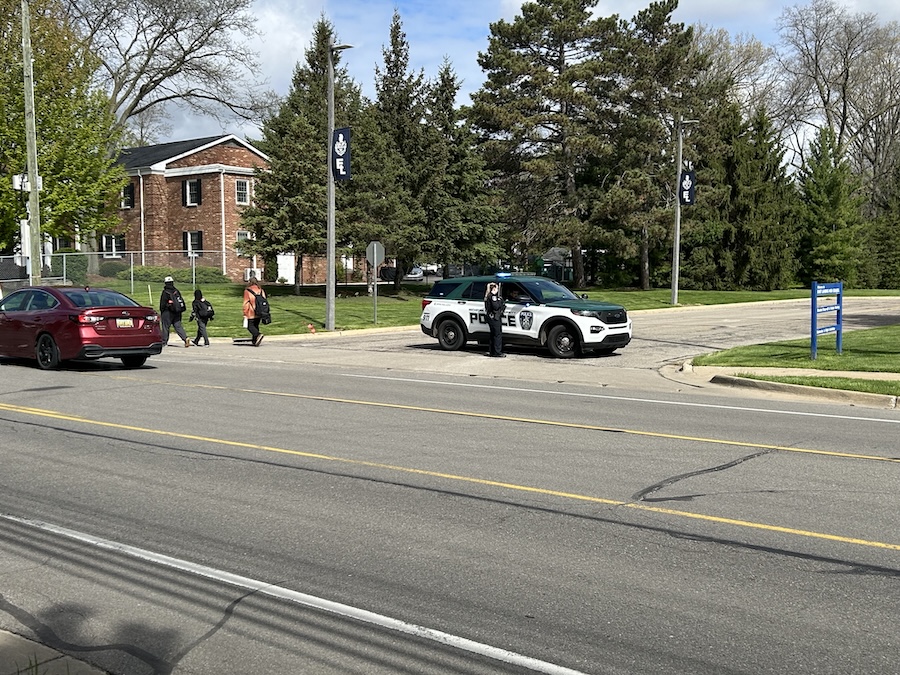
On Friday, the high school was evacuated and students were sent home after a bomb threat targeting the school was called in. Tuesday afternoon, schools were again placed on lockdown in response to a call about an armed suspect outside the building. Both calls were eventually deemed to be false threats, or “swatting” calls.
Following the incident on Friday, Attorney General Dana Nessel issued a statement calling on lawmakers to enact stricter penalties for those who make false threats, pointing to how these incidents divert resources from law enforcement and the psychological harm they cause for those targeted.
Making a false threat to draw a large response from law enforcement is not a new trend. Going back more than two decades, there have been instances of people calling in false emergencies, like bomb threats and hostage situations, aiming to elicit a response from Special Weapons and Tactics, or SWAT, teams.
What has changed is who is being targeted by swatting calls. Previously, the calls tended to be individuals targeting other individuals at their homes. Now, swatting calls often target larger entities, like schools, explained David Carter, criminal justice professor and director of the intelligence program at Michigan State University.
Swatting calls are sometimes done by individuals with a connection to the entity they’re targeting, but it is now much more common for the type of calls that East Lansing schools received to be done by a “small digital collective” that has no geographic ties to its target, Carter said.
Carter said swatting calls are becoming more common and it seems like the calls have been coming in “sprees” across the country, which indicates the same people are responsible for many calls in a short period of time.
Over the last week, several other schools, universities, zoos, hospitals and businesses received similar false threats to those called in to East Lansing schools.
Last year, an 18-year-old California man was sentenced to four years in prison for making more than 375 swatting and threat calls between August 2022 and January 2024, according to a Department of Justice memo Carter shared with ELi. The calls targeted religious institutions, high schools, colleges and universities, government officials and individuals across the U.S.
It’s unclear how the people who make these calls select targets, Carter said. The goal of swatting calls seems to be creating chaos.
“They don’t think about the ramifications, nor do they care about the economic or … psychological impacts it has on students, teachers, parents,” Carter said. “It’s for their own gratification.
“A threat typically has a motivation and a target,” he added. “These don’t seem to have that.”
The people who make swatting calls often use technology to hide their geographic location and modify their voices, making it difficult for police to find perpetrators, Carter said.
The emergencies described in swatting calls are usually so serious, local first responders must send all available resources.
“Even if your gut tells you ‘This is a hoax,’ you can’t risk it,” Carter said. “There’s too much at stake if you’re wrong.”
To aid first responders it can help for whoever receives a call to ask questions, as incorrect responses can help first responders assess the threat. In 2023, for example, police were able to determine a swatting call at an Ann Arbor school was a hoax in part because the classroom number provided by the caller did not exist, MLive reported.
However, it takes training to prepare people to probe callers for more information, Carter acknowledged, and calls can be received by 911 dispatchers, school receptionists or numerous other people, making swatting calls hard to prepare for.