

East Lansing Police Use of Force Spiked in 2025 as Oversight Mechanisms Collapsed
There was a more than 50% increase in the number of incidents where East Lansing Police Department officers used force in 2025 compared to the year before, records produced by the police department show.
The data comes amid a year marked by a series of local policing controversies, calls from the city’s police oversight and human rights commissions for Police Chief Jennifer Brown to step down, and transparency rollbacks that have made it harder to get information about the police department.
Shortly after East Lansing established an independent Police Oversight Commission in 2021, the police department began producing monthly reports about instances where officers used force while on the job. Use of force can range from officers grabbing a person’s arm to keep them from walking away to unholstering or using their pepper spray to tackling someone to the ground.
The reports show how many incidents police use force and how many individuals are subjected to force, as sometimes multiple people are involved in single incidents.
Data East Lansing Info compiled through the monthly use of force reports produced by ELPD shows there were 198 incidents where ELPD used force in 2025, a more than 50% increase from 131 incidents the city’s Police Oversight Commission reported the year prior. Last year also saw the most use of force incidents during the four years data was collected.
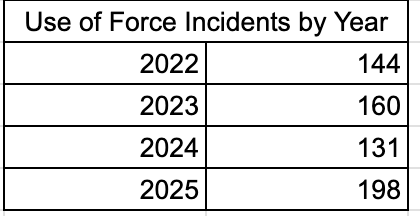
A change to how the police department collects data makes the disparity between 2025 and the first two years data was collected larger than it initially appears.
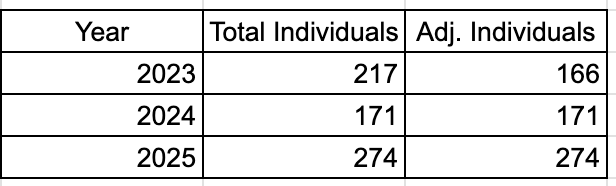
In 2022 and 2023, “non-arrest handcuffing” was a common type of force included in reports. However, it was not included as a type of force starting in 2024, a change that is consistent with policing guidelines but leaves the department with an inconsistent database, according to the Police Oversight Commission’s 2024 annual report.
The change in data collection makes a significant difference. The oversight commission analyzed 2023 reports and found that 51 of the 217 people force was used against were only subject to non-arrest handcuffing – more than one-fifth of individuals.
The data compiled by ELi also shows a persistent racial gap. According to U.S. Census Bureau data, about 73% of East Lansing residents and 74% of Ingham County residents are white.
In 2025, about 32% of individuals police used force against were white, compared to 68% that were listed as other races or unknown race, according to the monthly reports analyzed by ELi.
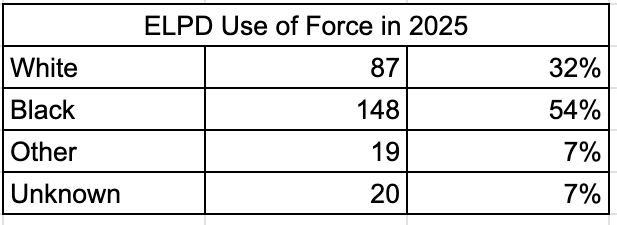
According to annual reports produced by the Police Oversight Commission, about 49% of the individuals who force was used against in 2024 were white and 46% were Black. In 2023, about 33% were white and 58% were Black. In 2022, about 37% were white and 56% were Black.
There have been major delays to the police department providing data on use of force.
It is not clear why use of force increased so much in 2025, and four and a half months into the following year, there still is not publicly available data that can be easily analyzed to explain the difference.
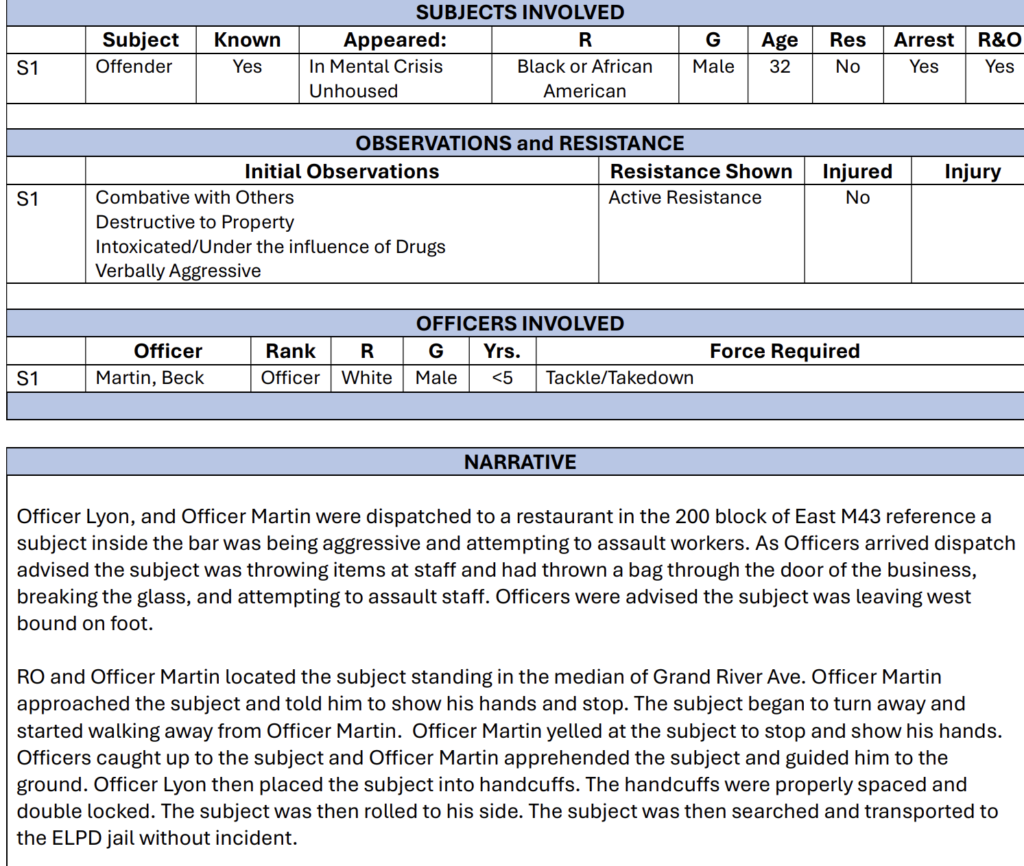
The use of force reports ELi examined were gutted by ELPD. Detailed narratives specific to incidents that were previously included in the reports were reduced to the same few lines that did not provide details of individual incidents during the last two months of 2025.
At the May 6 Police Oversight Commission meeting, Brown said the police department will go back and add detailed narratives to the November and December 2025 use of force reports, updates that have since been added to a city webpage but were a topic of uncertainty for months.
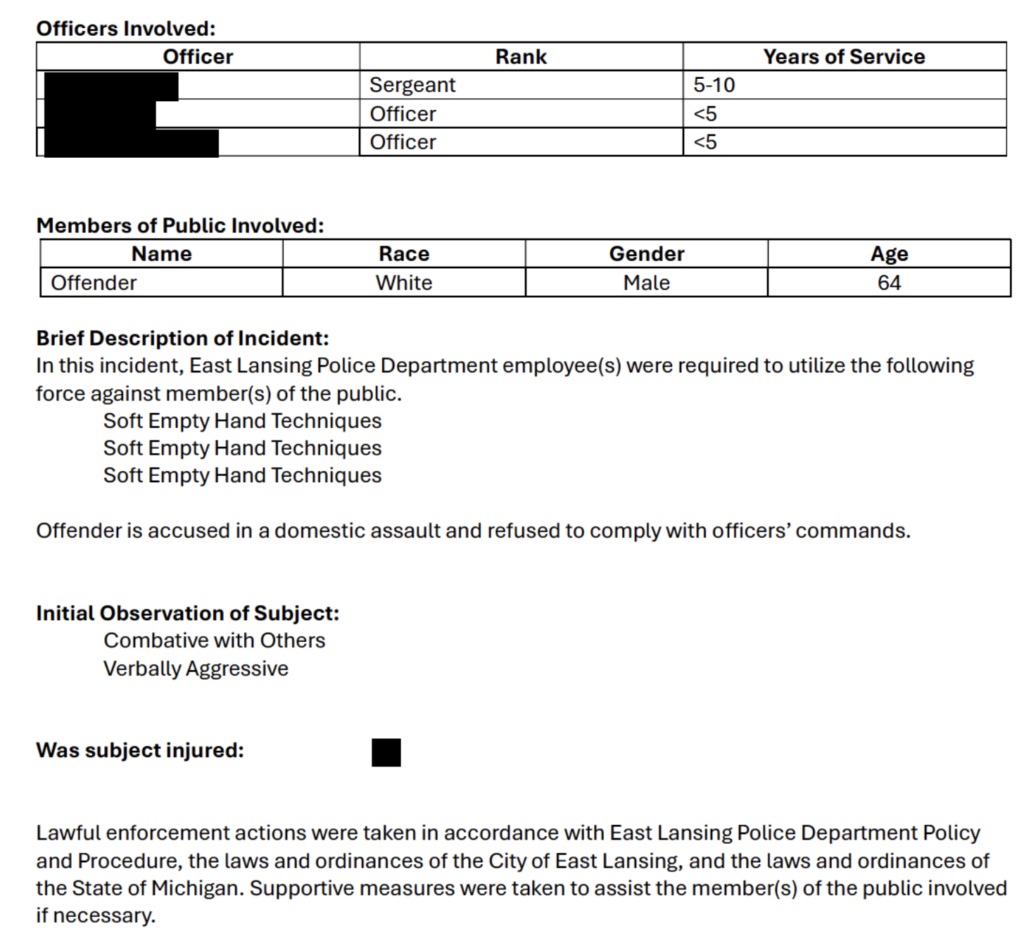
Cedrick Heraux is an Adrian College professor of sociology and criminology who created a 25-page report on ELPD use of force incidents in 2024. The detailed report examined raw data and narrative reports to analyze the severity of force used, circumstances surrounding use of force incidents and much more.
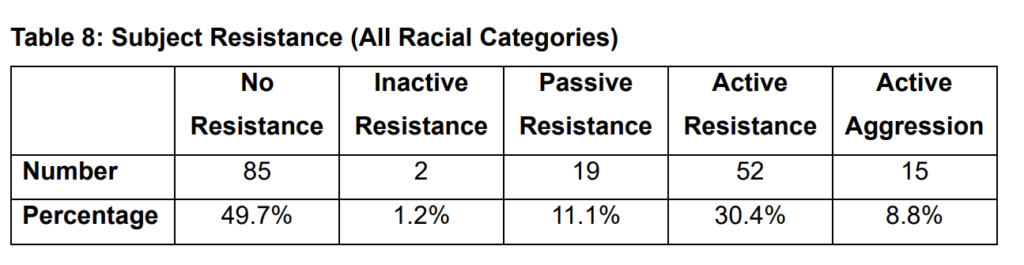
Heraux said the narratives are critical to his work. The narratives give details about what happened during each incident, which is key when the ELPD uses broad categories to group data.
Soft empty hands is a type of force that could describe an officer grabbing someone by the shoulder to keep them from walking away or wrestling them to the ground, Heraux explained to ELi in an April interview.
Beyond delays in receiving the narrative reports, a spreadsheet that the ELPD provided to the oversight commission in 2024 that tracked data related to use of force incidents has not yet been turned over. The spreadsheet provided a wide range of data, like the race and age of the individuals involved, where the incident occurred, the type of force used, if individuals are being prosecuted and much more.
Police Oversight Commissioner Chris Root told ELi on Tuesday that the commission has received monthly versions of the spreadsheet throughout the year, but those reports were provided inconsistently and the commission never received two months of data.
Brown said at the oversight commission’s May 6 meeting that the police department will not provide a spreadsheet for 2025. However, Root told ELi on Tuesday that the commission’s use of force subcommittee was told Monday evening that the department now plans to provide the spreadsheet.
It’s unclear when the spreadsheet will be provided but commissioners hope to meet with Brown and City Manager Robert Belleman as soon as possible, Root said.
In March, the police department denied a freedom of information act request from ELi that asked for “the year-end compilation for Response To Resistance [use of force] incidents in 2025,” as the department said the records do not exist.
Further, a budget recommendation recently made by Belleman cast ambiguity about if the commission has funding to pay Heraux for his review. Belleman proposed removing $6,000 from the oversight commission’s budget for data analysis during the next fiscal year because the funding was not spent in previous years.
However, the commission did pay Heraux for his review last fiscal year, Root told ELi, and commissioners have said they would like to pay him for a similar review of 2025 data – but have been unable to because they do not have data for him to analyze.
In a May 11 phone call with ELi, Belleman clarified that the City Council can still opt to restore funding for Heraux’s review during the next fiscal year ahead of the budget’s adoption on May 26.
If the city does eventually provide funding and data for Heraux’s review, it will likely take him “a few weeks” to put together a report, Heraux told ELi via text on Tuesday.
Transparency reversals, speech limitations and other changes were imposed on the oversight commission in 2025.
In 2020, protests against racial bias in policing swept across East Lansing and the United States. In the aftermath, East Lansing moved to establish a citizen review board to increase police accountability and transparency, as data at the time showed racial gaps in officer-initiated stops.
A main goal when creating the Police Oversight Commission was reducing use of force within the police department and in the fourth year of the commission’s existence, these incidents spiked. Recent changes to the ordinance governing the commission made as part of a collective bargaining agreement with a police union threaten other essential functions of the commission.
The commission is no longer allowed to use police employees’ names in reports or in their official capacity as commissioners. Investigatory powers have been stripped from the commission and more information must now be kept confidential.
While oversight commissioners have for months bristled at speech limitations imposed by ordinance changes, the shift was especially apparent at the commission’s most recent meeting.
After the April 15 police shooting of 21-year-old Isaiah Kirby, who is suspected of stabbing a man prior to the shooting, the commission was not allowed to talk about the incident at its next meeting due to an active complaint.
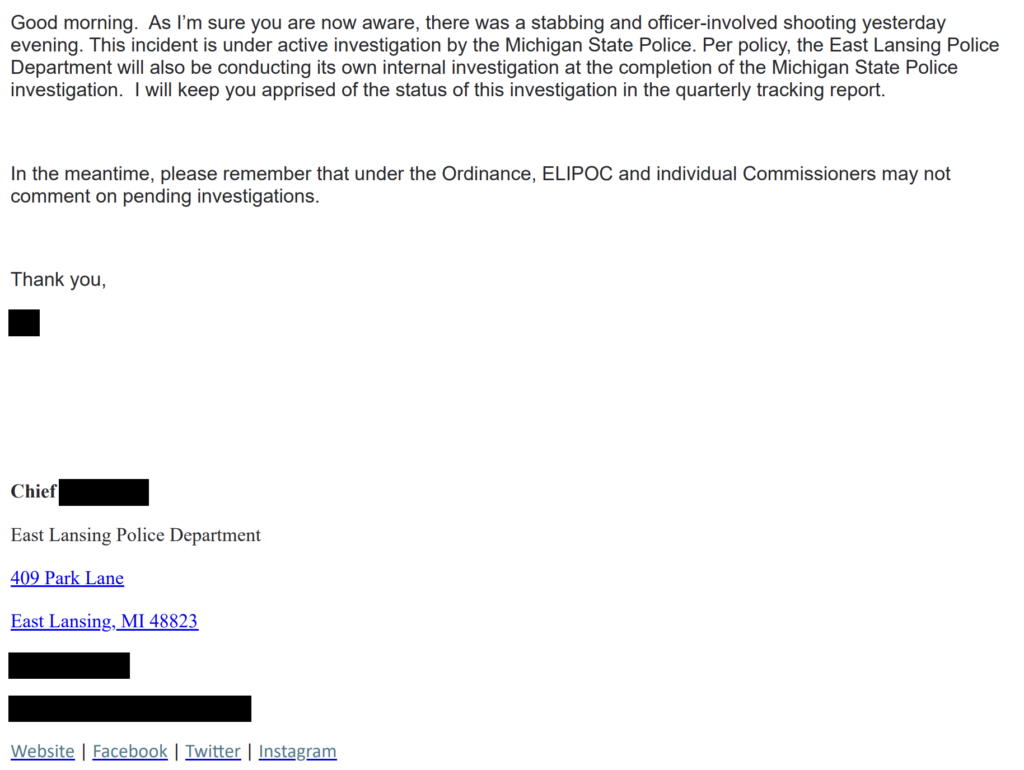
“What happened on the night of our last meeting [the shooting] should be discussed, it should be discussed in public,” Commissioner Simon Perazza said at the end of the May 6 oversight commission meeting. “I’m very upset that the body that is supposed to be promoting accountability, transparency is constantly being met and stonewalled.”