

Who Should Police the City? East Lansing Debates Human Rights Commission’s Future
The East Lansing Human Rights Commission is pushing back against proposed amendments to the ordinance that governs the commission, changes that would strip the body’s investigatory powers and eliminate its ability to weigh-in on complaints against city officials.
The changes were proposed on the heels of a months-long investigation by the Human Rights Commission, or HRC, into an incident where an ELPD officer pepper-sprayed two Black men downtown in August and later published a misleading press release about the interaction. Charges against both men, Lonnie Smith and Mason Woods, were later dropped and Smith and Woods have filed lawsuits against the city.
After a failed mediation attempt, the HRC issued several corrective actions to the city at its May 27 meeting. These include that the city pay Smith and Woods $50,000 each for reputational harm and other damages. The HRC also added the city cover any ongoing medical, psychological and legal costs, and that the police department post a retraction statement for its press release and apologize.
Commissioners believe they can order the city to take these actions under current rules because of language in the current ordinance that allow the commission to order “Any other relief the commission deems appropriate.”
The commission’s involvement in investigating the pepper-spray incident was unique because the commission was investigating a city entity, with city attorneys urging the commission to not accept the complaint after it was filed in November. Councilmember Mark Meadows said he asked for the HRC’s longstanding ordinance to be reviewed after he heard the body planned to order the city to pay restitution.
“When I reviewed it [the ordinance], I thought, ‘oh man I voted for this but I don’t think we can do this.’ I should’ve paid better attention to it … and I think we made a mistake,” Meadows said in a phone call with East Lansing Info on May 28.
Meadows, who has served on the City Council on-and-off for more than 30 years, said this is the only time he remembers the body ordering restitution be paid. He said the commission doesn’t have the power to do this because it is an extension of the City Council, and the council does not have this authority.
While Meadows initially only requested a legal review regarding restitution powers, City Attorney Steven Joppich introduced additional ordinance changes that he says bring the text into compliance with the city charter and state laws.
Joppich said the proposed amendments include three main changes: a new requirement that a member on the commission has mediation experience, an exemption for the city entities and employees from HRC reviews, and the removal of the HRC’s investigatory powers.
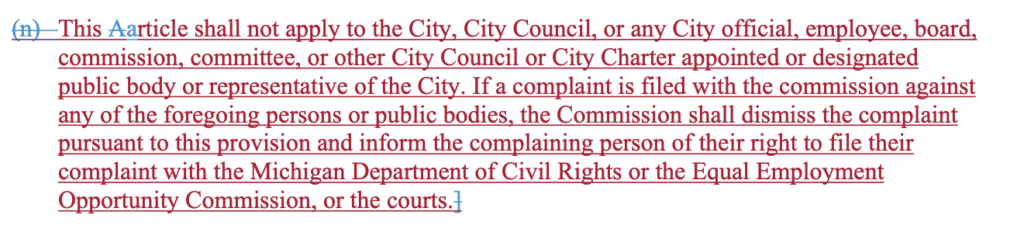
Under the new rules, the HRC could still receive complaints and hold hearings for matters that don’t involve city officials, but it would have to refer complaints involving city workers to the city manager, external mediators, or state and federal agencies. Joppich argued that independent HRC investigations into city staff violate the city charter.
Commissioner Matthew Boughton pushed back on leaving complaints to the city manager at the HRC’s May 27 meeting, held the same day a suspension imposed on City Manager Robert Belleman began. Boughton said the change can be problematic “especially if that city manager has a history of not being just and judicious.”
Because the HRC’s core investigatory powers have remained unchanged since 1963, commissioners view these sudden changes as direct retaliation for investigating the police department.
“First there was an attempt in November to bully us … it has escalated to the point of implying that we were going to get individually sued, and then when none of that caused us to back down, this is the latest retaliation against us,” Commissioner Rebecca Kasen said.
When the HRC first accepted the pepper-spray complaints in November 2025, City Attorney Carlito Young claimed the body lacked the authority to investigate city employees and warned the HRC could cause negative legal consequences for East Lansing, as the city is simultaneously being sued in federal court.
Julia Walters, who previously served on the HRC for nearly four years, disagreed with Young’s interpretation. In a phone call with ELi on May 27, she noted that she did not see this reflected anywhere in the ordinance language.
“It’s funny to me that … that was their position because — if truly — under the current ordinance the HRC did not have the authority to investigate city employees, why are they changing the ordinance to make it so the HRC is not allowed to investigate city employees?” Walters asked. “If that was the case under current law then there would be no need for change, right?”

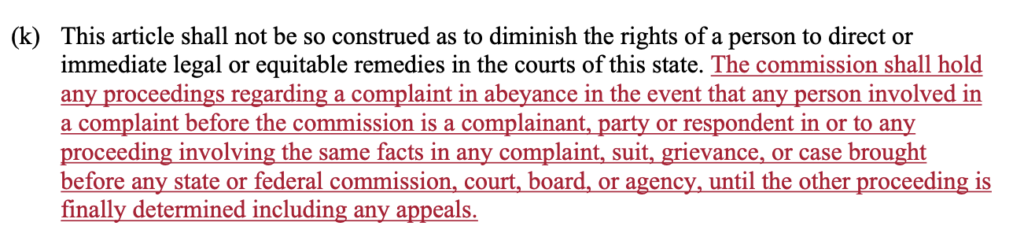
At the May 27 HRC meeting, City Attorney Gopi Patel suggested that under the proposed ordinance, those who felt they have been discriminated against by a city employee could pursue other avenues instead of the HRC, including the federal court system, state court system or the Michigan Department of Civil Rights.
Commissioners pushed back, saying that local commissions are vital because they are free, provide quicker investigation turnarounds and offer a less complicated system to navigate.
“Not to mention that it’s already hard to get them to report to us [HRC]; they’ve already been hurt,” Commissioner Kayla Gomez said. “It’s hard to get trauma survivors to speak, of any kind, so now you want them to go farther away and do more steps? It’s not going to happen.”
The HRC voted to hold a public hearing at its June 8 meeting to hear the community’s thoughts regarding the potential changes before providing an opinion to the City Council for consideration.
If the changes are approved, it would be the second time in about a year oversight powers have been taken from a city commission that interacts with city employees. Last year, the City Council adopted amendments to the ordinance governing the city’s Police Oversight Commission that removed investigatory powers and required more information be kept confidential.
The City Council has already voted to introduce the ordinance amendments and could pass the changes at the June 16 meeting.