
East Lansing Council Considers $300 Million Plan to Address Growing Flooding Problems
An expansive stormwater study found that East Lansing’s infrastructure is often unable to stand up against modern storms, while infrastructure projects to address key issues will cost hundreds of millions of dollars to complete.
During a discussion at Tuesday night’s City Council meeting, some members of the East Lansing council indicated they would like to move forward with the projects recommended by the study. To finance the improvements, residents may have to pay a new utility bill.
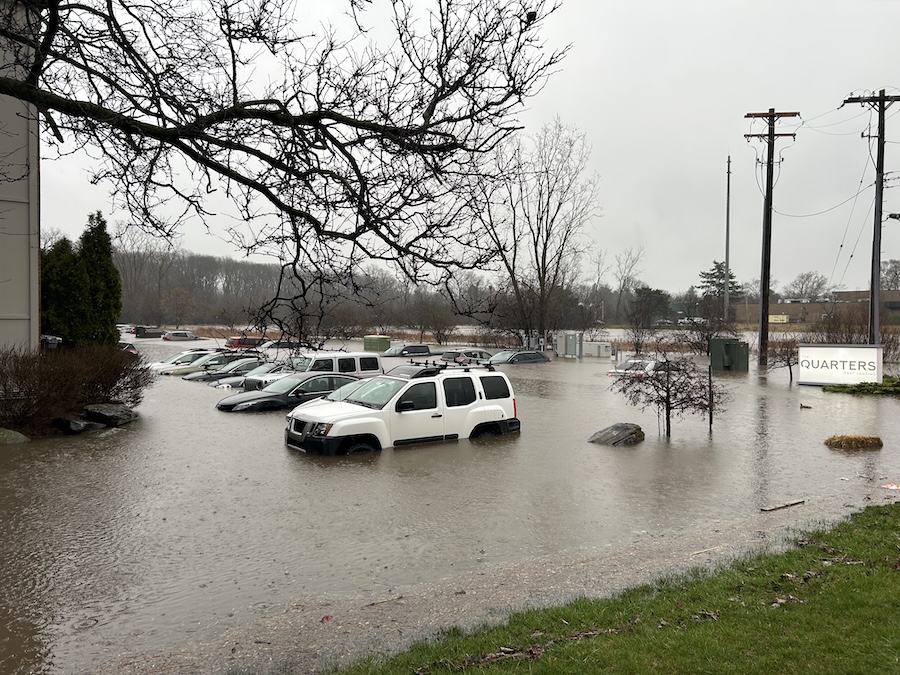
Since 2011, the city has had several storms that brought widespread flooding to city streets and backed sewage up into basements. Storms too big for the city’s infrastructure to contain have become more common as climate change advances and, according to the draft Wet Weather Resiliency Plan presented to the City Council, residents should expect this trend to continue.
To reduce the frequency of flooding events, the plan proposed five large infrastructure projects that would separate large portions of the city’s sewer system, direct stormwater to city parks and upsize pipes. The projects are estimated to carry a combined cost of $309 million and could take decades to complete.
To pay for the infrastructure improvements, city leaders could install a new stormwater utility, an idea that was floated years ago but has picked up momentum since Ann Arbor successfully defended a legal challenge to its stormwater utility.
Five large infrastructure projects are proposed in a draft plan to manage stormwater.
Worries about stormwater accelerated after a storm in August of 2021 dumped more than 7 inches of rain on East Lansing in 6 hours, closing streets and flooding basements.
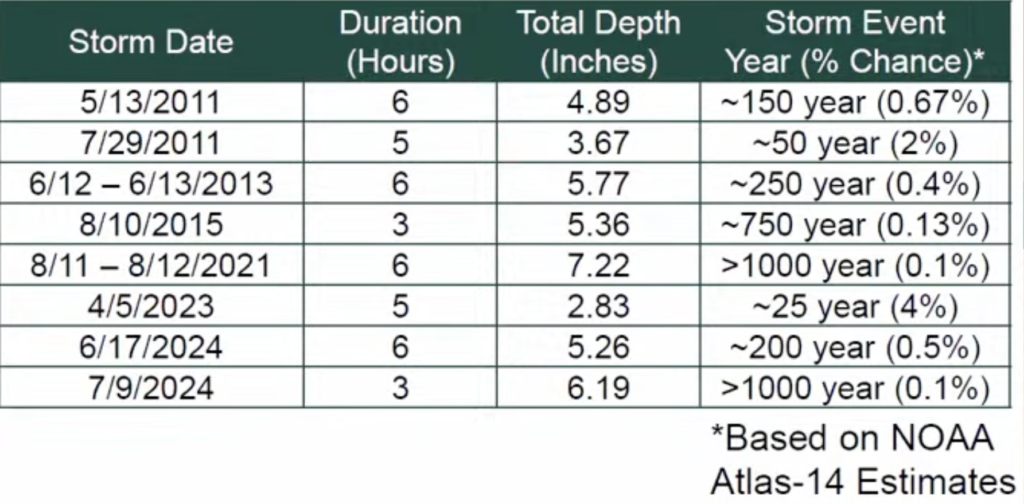
The city moved to hire engineering firm HDR to complete a Wet Weather Resiliency Plan, which examined how water moves through the city’s pipes to identify flooding hotspots and propose solutions to the biggest issues.
East Lansing Environmental Sustainability and Resiliency Manager Cliff Walls said the projects proposed in the Wet Weather Resiliency Plan would go a long way towards addressing key flooding issues. But some storms will still be too large for even the upgraded infrastructure to contain.
“The projects that you’re going to hear about tonight are going to increase the resiliency against this trend, but it cannot address every extreme storm,” Walls said. “This plan definitely moves the needle significantly but we cannot flood-proof East Lansing and anyone who tells you that is possible is not being straight with you. There’s always the chance of a bigger storm.”
Some homeowners have told East Lansing Info after large storms that their homes with no flood history have now flooded multiple times over the last few years and they believe the repeated issues have hurt their home’s value. With much of East Lansing’s infrastructure already unable to stand up to modern storms, some members of the City Council indicated they believe the investment is worthwhile, as big storms are only expected to become more common.
“We’ve got to do something about this stuff,” Councilmember Steve Whelan said at Tuesday’s meeting. “If you’re afraid your house is going to go underwater, that affects our house values … it affects our quality of life.”
The scope of the infrastructure projects is so large and expensive, it will need to be completed in phases. The highest priority projects address sections of the city that still depend on a combined sewer system.
Previously, OHM Advisers Engineer Erica Morgan explained to ELi that combined sewer systems take both stormwater and wastewater from homes and businesses to be treated at the city’s wastewater recovery facility before it is discharged – in East Lansing water is often discharged in the Red Cedar River. With separated sewer systems, wastewater can continue to be treated, while stormwater travels through different pipes to be directly discharged during large storms.
Julie Stein, stormwater business class director for HDR, outlined the five projects the study recommends the city prioritize. If the city decides to complete the projects, they are expected to significantly reduce basement flooding in the areas it is most common and limit the most problematic street flooding, Stein said.
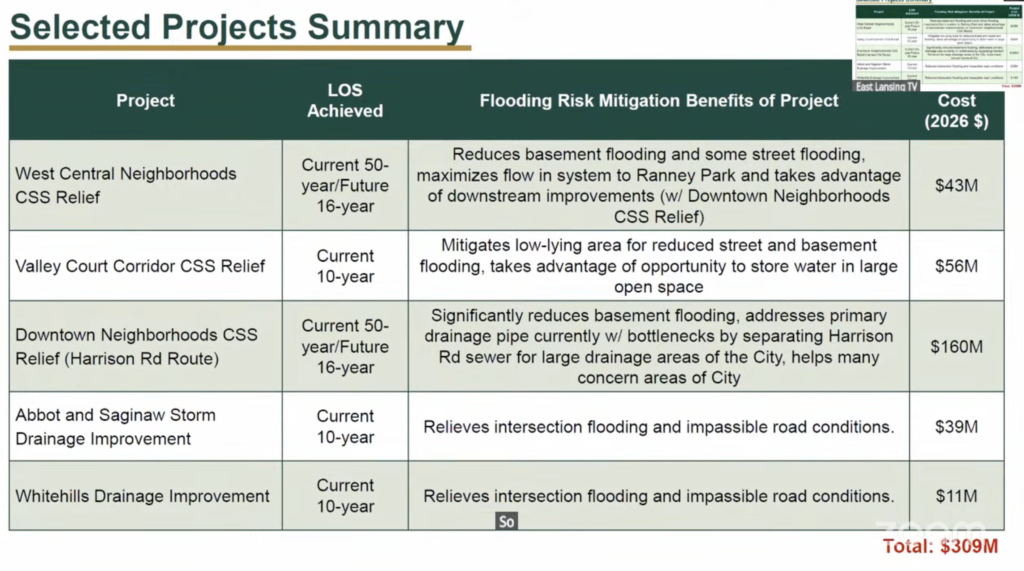
The projects would reduce flooding in areas that are close by, and Stein said that because sections of the sewer are connected around the city, some of the projects will give relief to homeowners far away from the project area.
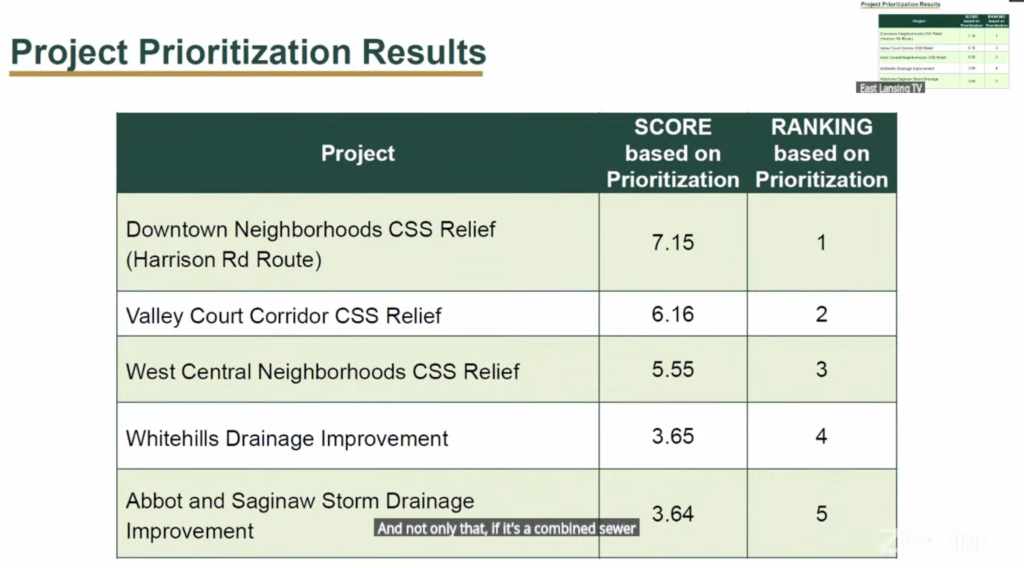
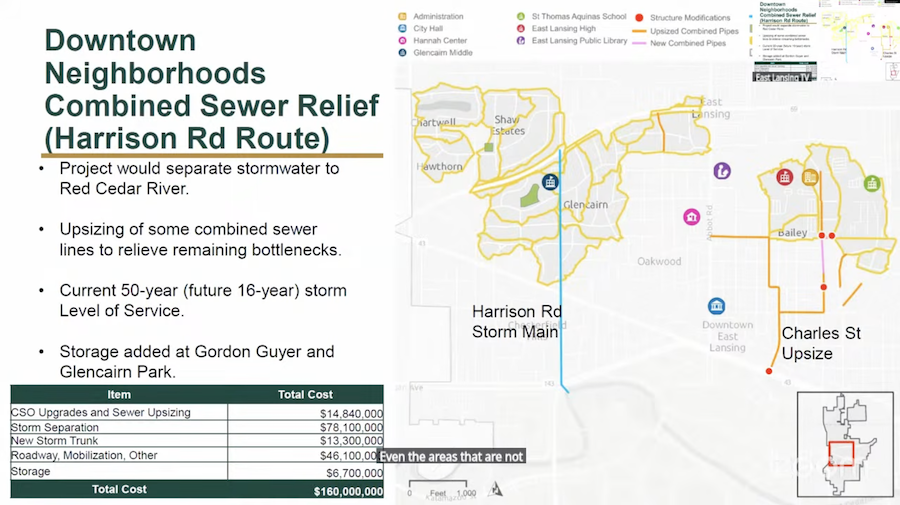
The project that the study determined to be the highest priority is also the largest and most expensive. This project would separate about 270 acres of combined sewer system that is used by neighborhoods near the downtown, with stormwater to be discharged in the Red Cedar River. This project would also direct water to be stored in Gordon Guyer Park and Glencairn Park, Stein said. This project would cost about $160 million.
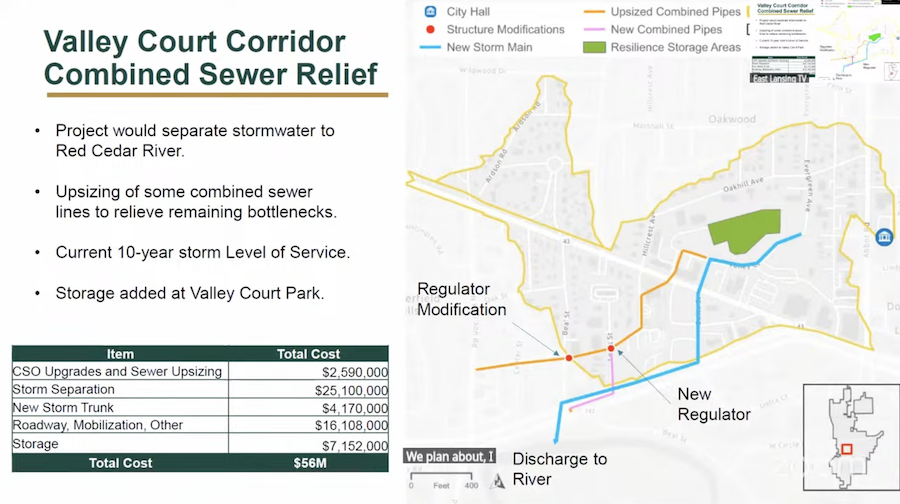
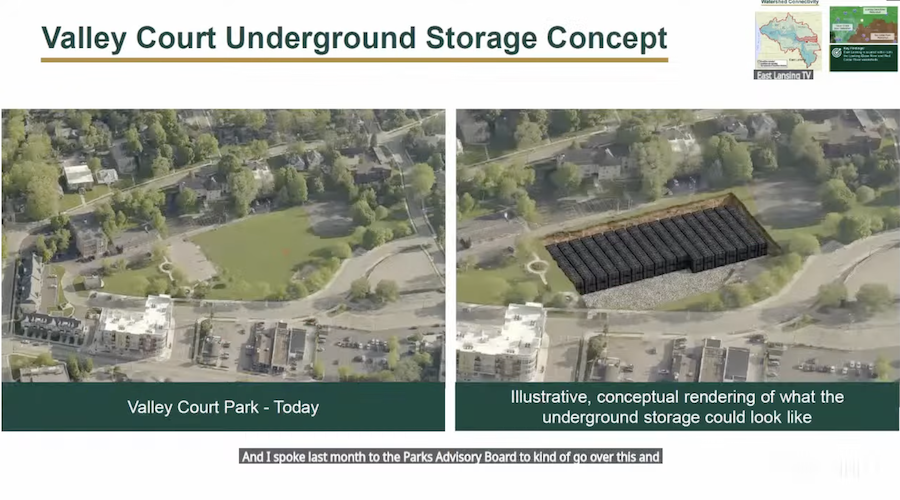
The next highest priority project addresses the combined sewer system in the Valley Court Park corridor. This project would separate about 90 acres of sewer, with stormwater being discharged in the Red Cedar River. The project would include about 2.2 million gallons of storage built under Valley Court Park, which is equivalent to about five Olympic swimming pools, Stein said. This project is estimated to cost about $56 million.
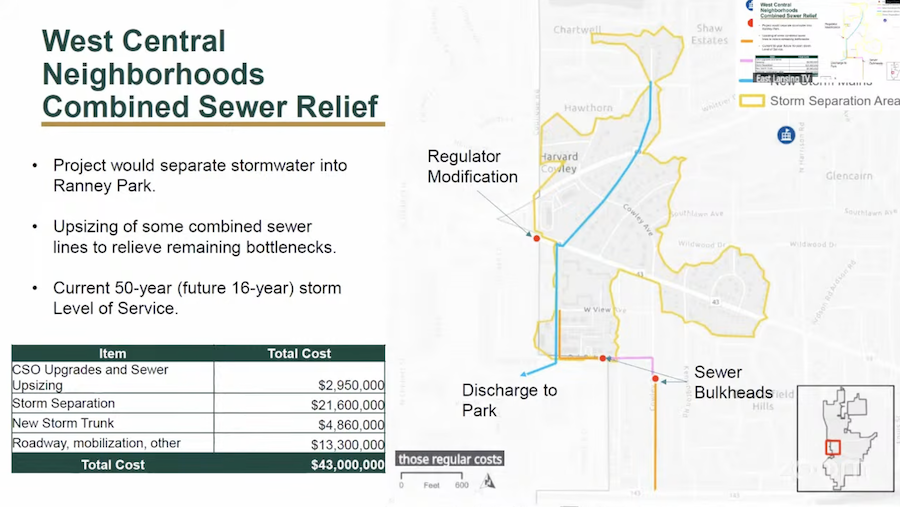
The project prioritized third addresses the combined sewer system in the west central neighborhoods. The project would separate about 77 acres of sewer. The separated stormwater would be discharged in Ranney Park, Stein said. This project carries an estimated $43 million price tag.
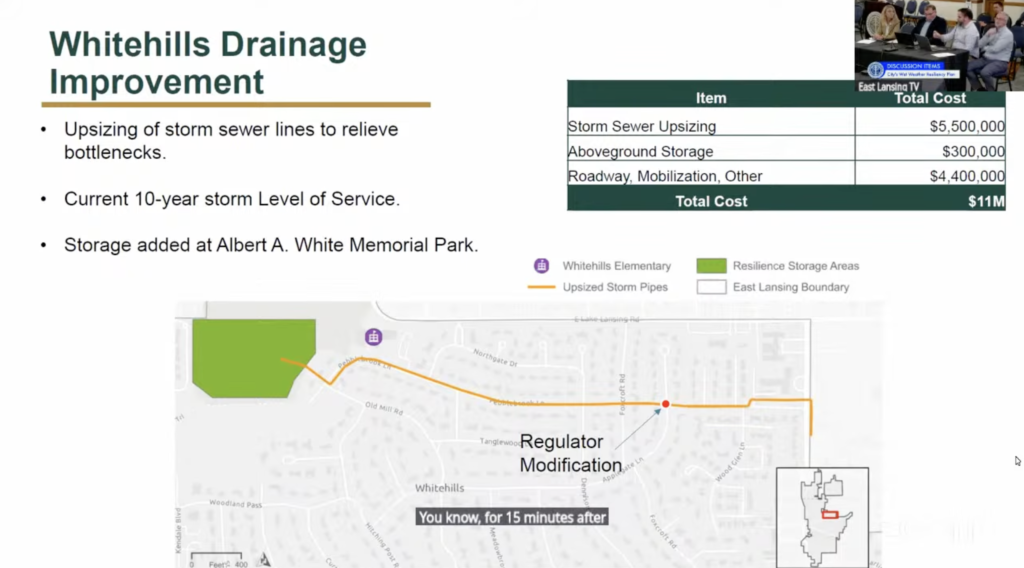
The project with the fourth highest priority would improve drainage in the Whitehills Neighborhood. This project would upsize sewer lines and redirect stormwater to Albert A. White Memorial Park, Stein said. This project would cost about $11 million.
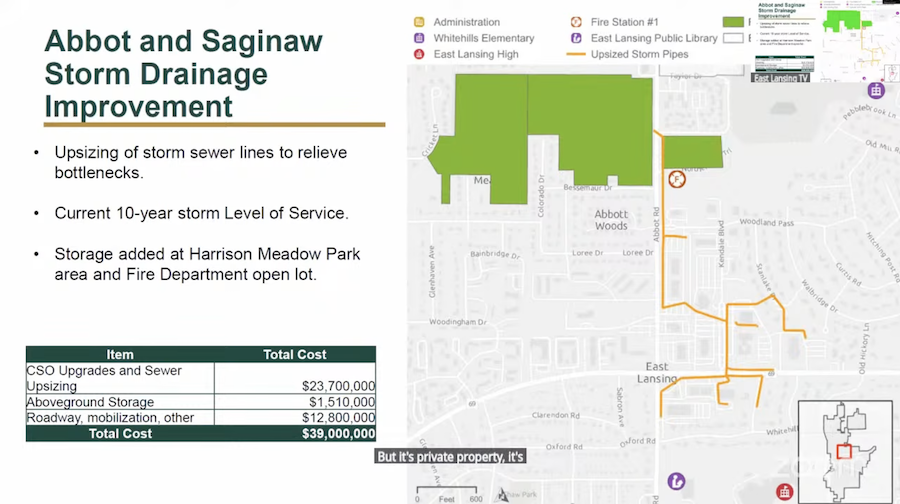
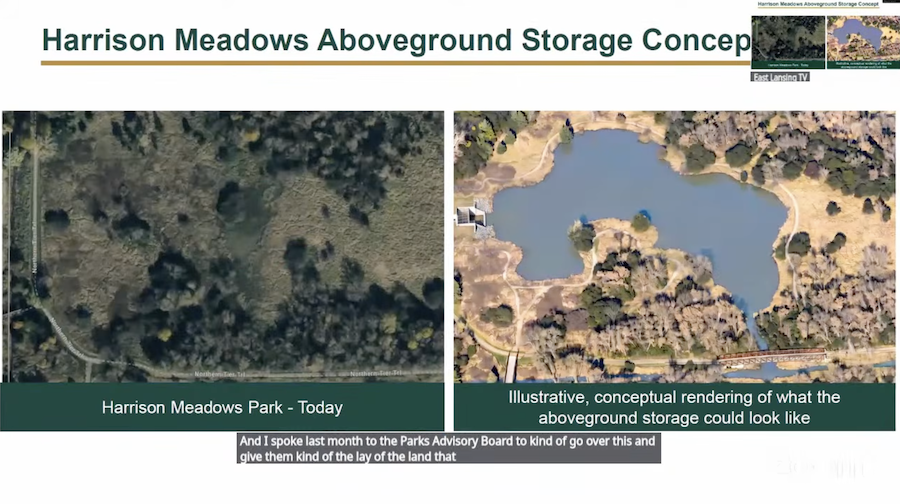
The fifth project prioritized would improve drainage on Abbot Road and Saginaw Street. This project takes place in an area that is already serviced by a separated sewer, and would upsize sewer lines and would direct stormwater to be stored above Harrison Meadows Park, Stein said. This project will cost about $39 million.
The plan presented at Tuesday’s meeting is still a draft and the City Council will need to formally accept it for it to become the city’s stormwater management plan. If it is adopted, it is unclear how long the projects will take to finance and build, but Stein said work of this scope could take decades.
East Lansing residents could be charged a new utility to pay for infrastructure improvements.
The infrastructure projects are estimated to cost $309 million, a figure that will grow due to inflation over the years it takes to complete the projects.
The price tag is substantial – Mayor Erik Altmann pointed out at Tuesday’s meeting it is about double the city’s total annual budget and about six times the discretionary general fund. The city does not currently generate enough money to pay for the infrastructure projects, but some city leaders said they believe there is a path to raising the funds.
“309 million [dollars] divided by 50,000 people is about 6,000 [dollars] per person,” Altmann said. “The question is how do you get that $6,000 from everybody, that’s what we’re going to run up against. But it would be a different story if it was $100,000 from everybody, but it’s not.”
Adding a stormwater utility was floated by Altmann in 2024 after a pair of large storms hit the city. However, at the time East Lansing was still fighting a lawsuit over a fee it installed in Lansing Board of Water and Light bills that the city said covered the cost of maintaining infrastructure in right-of-ways, but the Michigan Supreme Court eventually ruled was an illegal “disguised tax.”
Ann Arbor recently successfully defended its stormwater utility in court, paving the way for East Lansing to install its own utility.
Interim City Manager Annette Irwin said Ann Arbor was represented by Steve Joppich, who was previously East Lansing’s primary city attorney and whose firm continues to provide East Lansing legal representation. Irwin said she and other city leaders recently met with Joppich to establish a framework for what a stormwater utility could look like.
Irwin said city officials will meet again late in September to discuss the stormwater utility.