
Privacy Concerns Persist as ELPD Shares Flock Data Broadly With Michigan Police Agencies
Following a lengthy East Lansing Info investigation that found police departments tap into East Lansing’s Flock data thousands of times weekly, conversations have continued at city meetings about privacy in an era of advancing police technology.
Flock Safety creates cameras known as automated license plate readers that take a photo of every passing car, recording the date, time and information about the vehicle, like the make, model, license plate number and even unique features like dents and bumper stickers. The information is stored in a database that the camera owners and those granted permission can search through. Flock, and other companies that create license plate reader cameras, have drawn bipartisan backlash, largely due to privacy concerns.
Critics worry that Flock’s expansion has created the infrastructure to carry out mass surveillance. Additionally, police departments have shared data with the U.S. Immigration and Customs Enforcement to carry out President Donald Trump’s mass deportation campaign. Law enforcement officers have also misused the technology for purposes like stalking ex-partners.
An investigation ELi published in September found that over a 30-day stretch in July and August, ELPD officers searched the city’s Flock database fewer than 200 times. The vast majority of searches that tapped into the local data came from other Michigan law enforcement agencies, as police departments around the state searched the ELPD’s data tens of thousands of times during the same 30-day window. In turn, the ELPD was given access to a vast array of cameras, pinging up to 855 networks in searches.
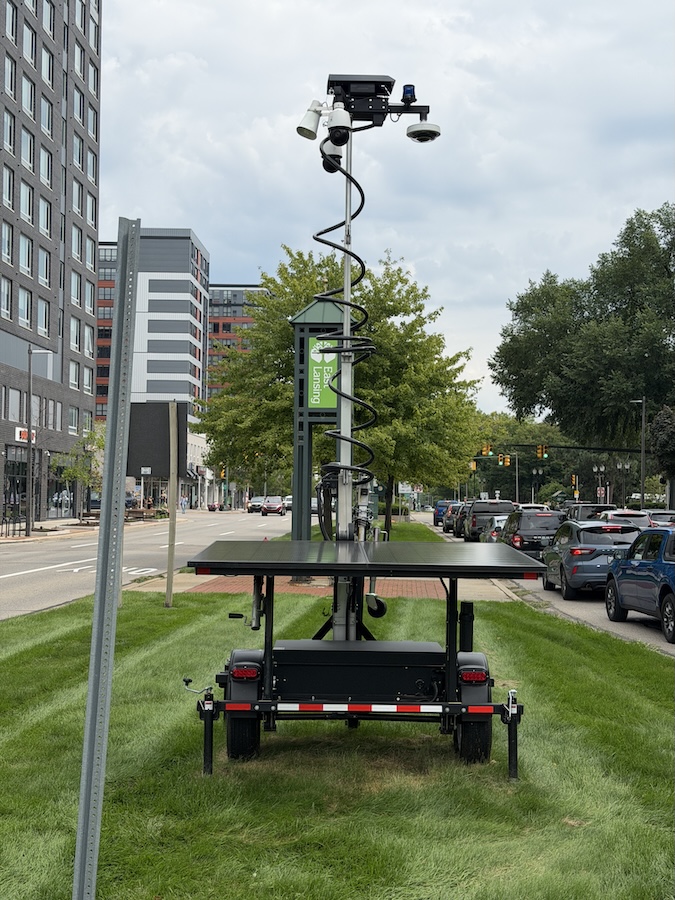
ELi’s investigation has raised concerns at city meetings about the oversight of data from the city’s lone Flock camera, which is stationed on a mobile trailer that has been positioned on busy roadways like Grand River Avenue.
While fielding questions from the East Lansing City Council about data-sharing and ELi’s reporting at the Sept. 15 discussion-only City Council meeting, ELPD Capt. Adrian Ojerio said ELPD only shares data with partner agencies in Michigan. He also said the department must approve requests from agencies before they are able to access ELPD’s Flock data.
The search log previously obtained by ELi shows these partner agencies are as far as hundreds of miles away, including the Gogebic County Sheriff’s Office, located in the Upper Peninsula’s westernmost county.
At the Sept. 15 council meeting, Ojerio stressed that ELPD officers only use the Flock data after they receive a related call and that the city’s camera has helped generate leads in instances of motor vehicle theft, criminal sexual conduct, weapons offenses and to help find runaways, among other things.
The ELPD has received leads on serious crimes committed in East Lansing through Flock pings on partner agency’s cameras, Ojerio added. He said the department only has three detectives and the technology helps them to work more quickly.
At the Oct. 5 Human Rights Commission meeting, commissioners said they worry about how other agencies may be using East Lansing’s Flock data, as the information is being shared much too broadly for the ELPD to properly oversee.
“It doesn’t seem to be much of a tool that they’re [ELPD] relying on, but agencies across the state are using it much more which is surveilling primarily our citizens, our residents, and visitors to our town for purposes that aren’t even tied to our city,” Commissioner Jonathan Forman said.
Forman, who works as a defense attorney, spoke about the evolving legal landscape around new police technology, including license plate readers.
In a recent case Forman highlighted, Oklahoma Federal Judge Sara Hill ruled that an officer’s use of AI-powered surveillance camera data to search an individual’s location history through automated license plate reader databases violated the Fourth Amendment.
In this case, an officer was following a woman with an out-of-state license plate. He searched her license plate through Flock and another similar license plate reader system, which picked up her vehicle more than 50 times across several different states. The officer eventually observed an infraction, pulled over the driver and eventually arrested her for drug-related charges. The judge did not rule that Flock cameras are illegal to use in criminal investigations, rather that the officer did not have probable cause for the search so it was an invasion of privacy, according to The Hill.
“What’s different about Flock and these automatic license readers is that police aren’t getting warrants before accessing this data,” Forman said. “They’re just doing it because it’s available to them in a database.”
He added, “Is this something that requires a warrant, such that you need some level of probable cause to access that information, as opposed to just saying ‘who was here at this time’ and get the information?”
Forman believes this is a topic that will be litigated in the next few years and that it’s pertinent to include community groups in conversations about the police department’s Flock usage.
“Respectfully to ELPD, of course they’re going to say ‘yes this is an extremely useful public safety tool,’” he said. “It is an extremely useful public safety tool, but that also has to be counterbalanced against the constitution and people’s rights. If you’re not hearing both perspectives, then I’m not sure council is able to make the best informed decision about policy.”
ELPD updates Flock policy, introduces transparency page to website.
The ELPD has made a couple of changes over the last month, adding a transparency page to provide information about the department’s Flock camera usage and updating the department’s policy governing license plate readers.
The Flock transparency page says that the ELPD shares data with more than 100 different Michigan law enforcement agencies and is able to tap into the data of many more cameras in Michigan and in other states.
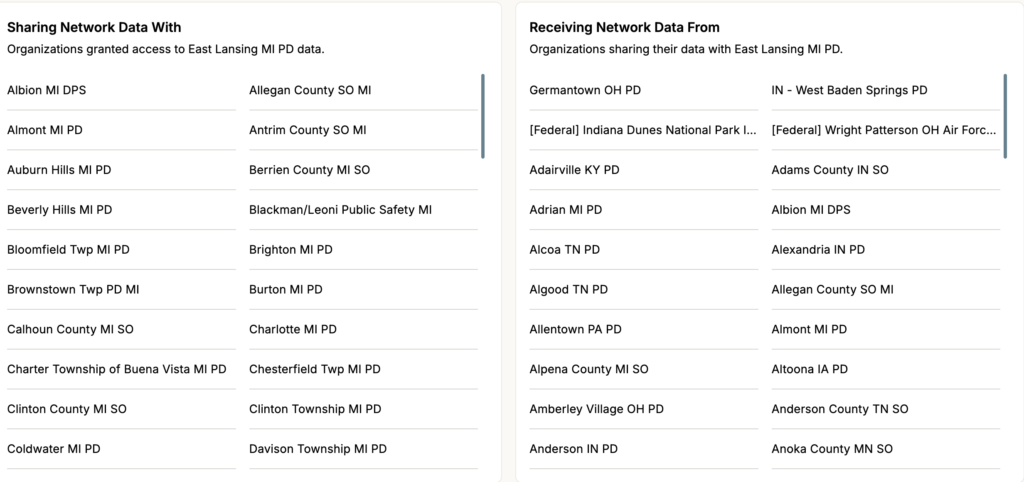
The transparency page also says that in the last 30 days, there have been 29 search sessions by ELPD officers. In the Flock search logs from July and August that ELi previously examined, it was common for officers to make several searches in a short period of time.
The ELPD also updated the policy that governs its Flock camera usage, though the new policy does not add restrictions on data sharing.
Under a policy signed by ELPD Chief Jennifer Brown on Sept. 21, the ELPD will retain data from its Flock camera for seven days. This is a significant reduction from the 30 days the policy previously allowed data to be retained, but still more than the 48-hour recommendation from the ACLU, which has been critical of Flock.
Also under the new policy, the ELPD will audit Flock usage by randomly selecting 10 searches every quarter to ensure they complied with standards. Under the previous policy, the ELPD audited 10 searches per year.