

It’s Hard to Be ________ Right Now
Political leaders, religious officials and private citizens are increasingly being asked to denounce the actions of others.
Michigan Democratic U.S. Senate candidate Abdul El-Sayed — who would become the nation’s first Muslim senator — has been pressured by opponents and allies alike to denounce antisemitism. Yet, El-Sayed has also been the target of anti-Muslim rhetoric throughout the campaign, including President Donald Trump saying El-Sayed was “on the side of the terrorists” at a recent Port Huron campaign event, according to NPR.
At the same time, American Jews feel under attack, and some feel pressured to denounce the actions of the Israeli government amid accusations of state-sanctioned genocide against Palestinians following the Oct. 7, 2023, Hamas terrorist attack and kidnapping of Israeli citizens.
East Lansing Info spoke with local leaders of both faith communities to learn more about the challenges and frustrations they and their congregations are experiencing.
“What we have seen is a fundamental reassessing of what it means to be a Jew in America, or a Jew in any country, frankly, at this time,” said Rabbi Matthew Kaufman of Lansing’s Congregation Kehillat Israel. “And it’s a less comfortable assessment than it ever used to be. I would say that one thing that has changed – and this would probably apply more to secular Jews – Jews who didn’t have any particular affiliation before, who may not have actually prioritized a Jewish community, or Jewish observance, or Jewish living particularly in any way, suddenly had their awareness – their feelings – jarred into awakening around Jewish identity. And so Jewish identity became more important and more central to figure out for people who had never particularly thought about it before.”
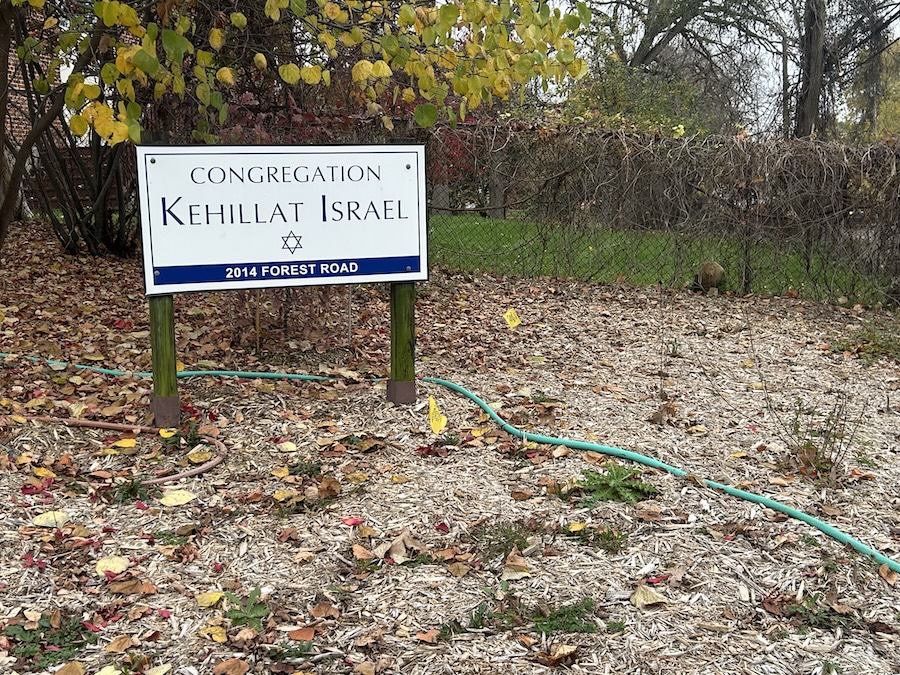
Kaufman, an Okemos native who grew up in the congregation he now leads, said things feel less safe and stable for Jews, leaving many questioning their safety, security and place in society. Jewish organizations in the Greater Lansing area have faced numerous acts of vandalism and threats in recent years. Just last year, someone threw rocks at and spray-painted Nazi symbols on the MSU Chabad Jewish Center in East Lansing.
Protests across U.S. college campuses have also caused tension for Jewish students, Kaufman said.
“It was far more intense in other cities and in other campuses than it was locally,” he said, “and that doesn’t mean it was not present locally, but we did not experience the same intensity here as we’ve seen elsewhere. That said, it hasn’t been absent of tension. So what I’ve noticed is that for Jewish students at Michigan State there’s a lot more cautiousness about publicly connecting to Jewish identity.”
Kaufman said the contention has created two categories in the eyes of some: “good Jews,” who disavow any connection to Zionism, and “bad Jews,” who do not.
Some Jews have felt compelled to accept that distinction, he said, while others have no problem with it. But Kaufman said the vast majority of American Jews believe Israel has a right to exist.
For Muslims, the pressure to answer for the actions and beliefs of others is a familiar experience.
Islamic Center of East Lansing Imam Sohail Chaudhry, said Islamophobia has repeatedly resurfaced throughout his life, particularly during moments of political upheaval.
“It keeps coming back,” he said. “I remember what happened after 9/11. I was a student back then. It’s the same thing which keeps resurfacing. In the first Trump election in 2016, the same thing happened. This idea that Muslims are the enemy and demonizing the Muslim community, and portraying them as people who [are] trying to take over America, and misconceptions around terms like Sharia law and jihad and women’s rights in Islam. It’s the same Islamophobia which keeps coming back after every few years, whenever the politicians see the need.”
Chaudhry has served the Greater Lansing Islamic community for nearly 12 years, relocating here after 15 years in West Virginia.
He said many Americans do not know what the Muslim Brotherhood is or what connection, if any, it has to Muslims in the United States. Still, El-Sayed’s opponents have tried to draw ties between him and the group, a connection fact checkers say lacks evidence. Older worshippers, however, recognize what Chaudhry described as an organized, multimillion-dollar Islamophobia industry that spends money employing people who hate Islam.
While older generations of Muslims have experienced these cycles before, Chaudhry said younger Muslims are confronting them for the first time.
“Many of them are confused,” he said. “They don’t know what’s going on.”
And for both religious leaders, the impact on young people is among their greatest concerns.
“The biggest challenge more recently for a lot of Muslim youth,” Chaudhry said, “is going to school and being identified as Muslims and the bullying that goes on. The subtle forms of Islamophobia that many students witness.”
He said young Muslims encounter hateful messages on social media, leaving them confused and under pressure. Many turn to him for counseling.
Chaudhry said one of the biggest challenges facing his community is maintaining a Muslim identity, particularly for those whose faith is outwardly visible, including women who wear the hijab, men who wear beards and anyone who prays in public.

Kaufman expressed similar concerns about the messages children in his congregation encounter in public schools, saying some of the narratives they hear about their faith and identity can be harmful to their development.
“When we talk to everybody about Israel,” he said, “are we really only going to talk about the government? What about the culture? What about our connection? What about the values we share and the peoplehood? What about the complexity of life there?”
Kaufman said the synagogue teaches children Hebrew to help them develop positive connections to their Jewish identity, giving them strength as they grow.
He believes Jewish communities need to do a better job responding to hostility and equipping their children with an understanding of Jewish history and identity, “so they can have some kind of defenses against the narratives that they’re hearing, which are … in fact, just lies being told about Jews.
“And it hammers at you, you know, if you’re a person who’s being told, and especially for young people, you know, you’re being told you should be ashamed of yourself — and if you don’t have the defenses to say, ‘Well, actually, the story of the Jewish people returning to the land of Israel, our historic land, is a miracle story, and it’s a wonderful source of pride,’” Kaufman said.
Beyond concerns about young people, both religious leaders described the burden of being held responsible for actions committed by others who share their faith or identity.
For Kaufman, that burden has become particularly pronounced amid criticism of Israel’s military actions.
He offered a historical comparison, invoking the antisemitic accusation known as “blood libel” where Jewish people have been falsely and baselessly accused of murdering non-Jewish children to use their blood in religious rituals.
Kaufman recounted the story of Simon of Trent, a 15th century Christian boy whose death was blamed on Jews accused of using his blood in a religious observance.
“I can’t even wrap my mind around it, it’s so warped,” Kaufman said, pausing his story.
Kaufman said the accusation expanded beyond those initially blamed, creating a belief that Jews collectively bore responsibility for the boy’s death.
“It is a blood libel,” he said. “The impact of it is, now, if you do not disavow this ‘genocidal state,’ you’re complicit. So now you’re partaking of the blame. You see, now you can become part of the accused group.”
Kaufman pointed to several acts of violence as examples of the dangers facing Jewish communities and individuals, including the firebombing of Pennsylvania Gov. Josh Shapiro’s home during Passover, the murder of an elderly woman in Colorado who was calling for Hamas to release Israeli hostages and a truck that was driven into a West Bloomfield synagogue while children were eating snacks inside.
“And so what is very scary for Jewish communities is not only that expansion, but the normalization of what this rhetoric means,” he said. “If there is a kind of acceptance that the normalization of the various negative ways in which Israel and its government are referred to, if there’s a normalization of this as a generalizable accusation, then Jews risk being considered complicit in any of the things of which the state of Israel is being accused. It ends up not being a confined political issue of foreign policy. It’s something that becomes very real to lived Jewish life in areas that have absolutely nothing to do with Israel.”
Chaudhry said Muslims understand the experience of being blamed collectively for the actions of a few.
“This is a problem across the different religions, is that events of a few have to be answered by the whole,” he said. “And of course, they do not represent us. There have been, in the past, many times where things happen elsewhere in the world, and the Muslim community is blamed for it, and we are questioned about it, and I’m sure the Jewish community also feels in a similar place.”
For Chaudhry, education and understanding are essential to breaking that cycle.
He emphasized the importance of learning about the religions and cultures of others rather than relying on portrayals offered by politicians or the media.
“Then we find out how many commonalities and similarities there are, and how all the faiths in the world agree when it comes to so many of the human rights and standing up for justice and taking care of the poor and the needy and the refugees,” Chaudhry said. “There’s so many values that we share across different people and their beliefs. So it’s very important that we educate.”
Chaudhry said people need to learn about Islam beyond how it is portrayed in public discourse. He added that Muslims have a responsibility to learn about other faiths and belief systems, too.
Neither Kaufman nor Chaudhry pretended that their religious communities agree on every issue.
Chaudhry acknowledged the complicated history between the faiths and said their leaders may differ on many fronts. But they work to ensure those differences do not destroy their local relationships.
Both men spoke of the ways local leaders from different faith communities have shown up for one another, even amid disagreements and tensions elsewhere.
The Interfaith Clergy Association of Greater Lansing organized a special service of healing and unity after the Oct. 7, 2023 attack, collecting donations for local synagogues and the mosque to support increased security efforts.
“It was really this incredible coming together of these various faith communities,” Kaufman said, “and…the Imam and I focused on getting the message out there that we care about our neighbors and ourselves right here. Never mind what is going on in America around us, and never mind what is going on overseas. Our priority is our neighbors and our friends here, and we need to look out for each other.”
Chaudhry said the faith communities will continue to work together, focusing on the shared space they inhabit and the people they can help.
“At the end of the day we have to recognize that we will be leaving our children, the next generations here together, and if we want a better future for them, we cannot afford those generations to be hating each other and fighting,” he said. “Rather, we would want them to live in peace and harmony.
“But it’s the people-to-people interaction that is going to change things.”