

East Lansing’s Sanctuary City Status at Center of Debate Over Federal Grant
East Lansing could soon accept a large federal grant to upgrade its security cameras, but the grant appears to come with conditions that conflict with East Lansing’s sanctuary city status and diversity, equity and inclusion programming.
The city has been awarded and could accept a $472,000 grant from the U.S. Department of Justice, or DOJ, that pays for upgrades for up to 350 security cameras. The city’s cameras are a decade old and the new cameras will have better image quality and motion detection, according to the staff report.
However, the grant comes with a series of conditions. One condition states recipients “may not prohibit, or in any way restrict, any government entity or official from sending to, receiving from, maintaining, or exchanging information regarding citizenship or immigration status, lawful or unlawful, of any individual with components of the U.S. Department of Homeland Security or any other federal, state or local government entity.”
Another condition says that by accepting the grant, recipients certify they do not operate diversity, equity and inclusion programs. The grant also stipulates recipients must comply with all presidential memoranda and executive orders.
The East Lansing City Council could accept the grant funding by approving the consent agenda at its meeting Tuesday night, a possibility that has some residents concerned about East Lansing’s sanctuary city status and other stances. East Lansing officials say accepting the grant would not force any policy changes and the city is asking the DOJ to remove the conditions. East Lansing’s mayor said if the federal government tries to challenge or revoke the funding, the community should have conversations about the best way to proceed.
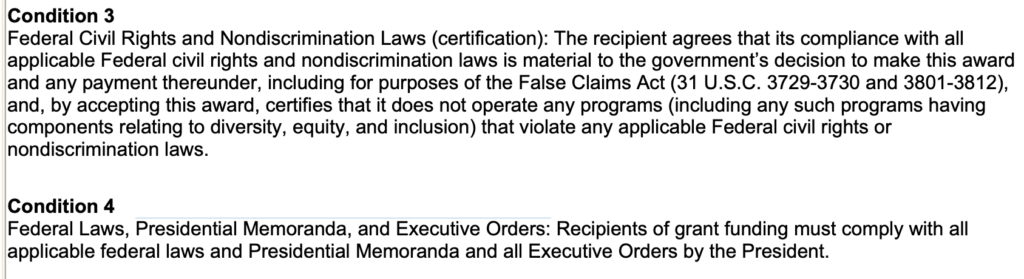
Residents are concerned that accepting the grant contradicts the city’s current sanctuary city status. The resolution declaring East Lansing a sanctuary city states that in a manner consistent with state and federal law, city officials will not actively collaborate with federal agents solely for the purpose of enforcing federal immigration law.
Further, East Lansing employs a DEI director.
“I have grave concerns that by accepting this grant money, that the city is committing to cooperating with the U.S. Department of Justice when it comes to immigration enforcement,” said Karen Hoene, chair of the city’s Human Rights Commission. “This is very concerning considering the fact that we are a sanctuary city and we have City Council members that have committed to remaining a sanctuary city.”
Hoene said that the City Council placing the resolution to accept the grant funding on the consent agenda, which is usually passed without discussion, is “sneaky” and feels like a “MAGA move.”
But city officials say the grant does not force it to change any of its operations. Councilmember Mark Meadows said the city’s policy is that officials do not communicate with federal officials on immigration enforcement, except in cases where federal law requires it. He said this will continue to be how the city operates.
Meadows said conditions the grant places are illegal and courts have ruled cities don’t have to comply with these regulations. He said the federal government cannot force municipalities to assist in federal immigration enforcement.
“It’s just another example of Trump’s administration trying to, I guess, create law that doesn’t exist,” Meadows said. “That’s how we’ve approached it.
“If they want to yank the grant, then they’ll have the opportunity to yank the grant. But we haven’t changed anything,” he continued. “We’re accepting it. If we get the money, they can order us to return the money. We’ll deal with that at that point in time.”
Mayor Erik Altmann said in a call on Tuesday that the city believes the conditions are unenforceable due to injunctions and court rulings. He pointed to a two-page memorandum that was added to the City Council agenda at some point on Tuesday after residents had reached out to East Lansing Info about the grant conditions.
The memorandum from Interim City Manager Annette Irwin, dated Nov. 18 – which is tomorrow – asks that the conditions referencing DEI, immigration enforcement and executive orders be removed. The memo argues that the conditions are not enforceable.
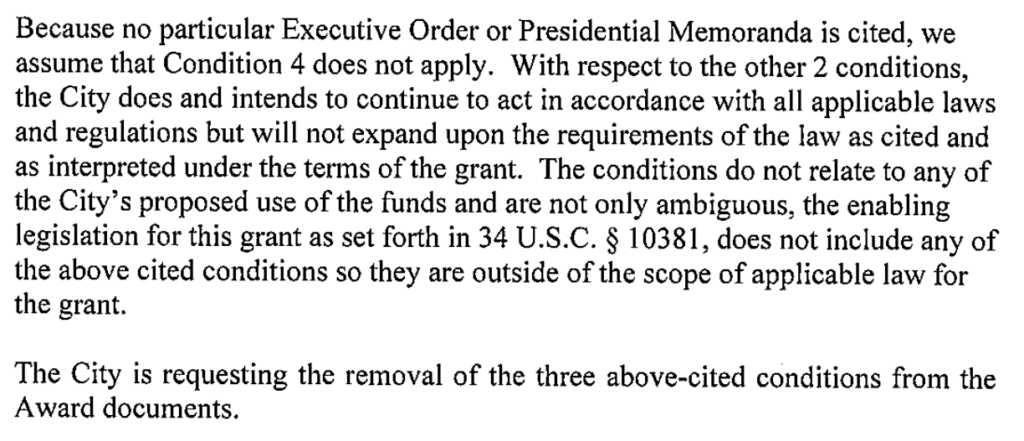
Altmann said accepting the grant does not change the city’s policies and the plan is to continue operating in the same way. He said he does not know how the federal government will respond.
“The problem is that we are in completely uncharted territory here,” Altmann said. “I have no idea because nobody can predict what the Trump administration is going to do on a given day.”
If the federal government does seek to challenge or revoke the funding, Altmann said the community should have conversations about the best way to proceed.
“That is a conversation we will have to have, not just at the council level but at the community level if we get to that point,” he said.
“We have a bunch of people writing to us at the City Council account saying basically ‘don’t take a half-million-dollar grant,’” Altmann continued. “There’s probably a lot of other people in the community who say ‘You better take a half-million-dollar grant.’”