

Council Roundup: City Approves Annual Deer Cull, Schedules Charter Amendment Votes, Funds Emergency Housing
The East Lansing City Council voted to have six charter amendments proposed by a city committee be placed on ballots this year.
At Tuesday’s City Council meeting, council voted to have three charter amendments be voted on at each the August and November elections this year. Before the amendments can officially be placed on the ballot, they will first have to be reviewed by the state attorney general’s office.
A city committee that reviewed the city charter, East Lansing’s foundational document, in 2024 and 2025 recommended 29 changes, which will need to be approved by voters before they are enshrined in the charter. Council is opting to spread the amendments out across several ballots to avoid voter fatigue and keep ballots from becoming multiple pages, though some members of the review committee said they would like to see the changes voted on across fewer elections.
Two of the amendments scheduled to be voted on in August impact proceedings after new City Council members are elected. These amendments would push the term of new council members and the election of mayor and mayor pro tem back to the first Tuesday after elections are certified. Currently, new members are sworn-in the first Tuesday after the election, leaving concern that there may not be enough time to confirm election results some years.
In 2023, City Council put a charter amendment on the ballot that would move the swearing-in date back about six or seven weeks to early January. This amendment was rejected by voters after concerns emerged about creating a lame duck period.
The other amendment council scheduled to be voted on in August would require future city managers live within 25 miles of East Lansing. The amendment also clarifies language about the city manager designating a deputy to take over, in case the city manager is suddenly unavailable to work.
The three amendments scheduled to go on the November ballot have to do with procedures around city meetings and the city entering into new contracts. ELi will provide in-depth explanations of each amendment closer to elections.
City Council approves deer cull without discussion.
Over the last four decades, the deer population in lower Michigan has exploded. The population growth has carried negative impacts, like increased deer-car collisions, overgrazing on native plants and damage to landscaping.
To manage the population, the East Lansing City Council voted to begin holding annual deer culls, where U.S. Department of Agriculture sharpshooters kill deer in city parks at night. Since 2021, sharpshooters have removed between 49 and 79 deer from East Lansing each year.
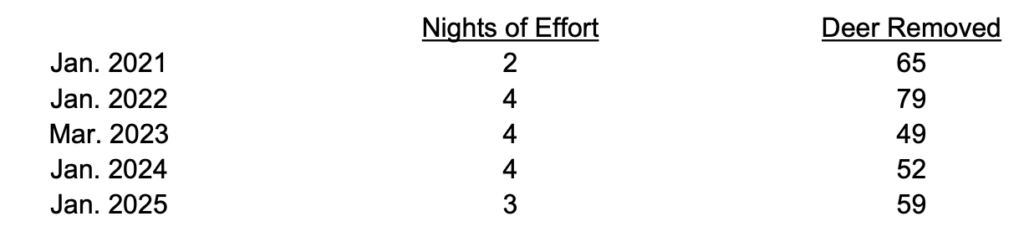
The cull was approved to take place again this year, after the City Council approved a cull to take place this month on the consent agenda at Tuesday’s meeting.
The vote happened without discussion, but the agenda packet said that in addition to the cull, the city will consider a regional approach to deer management by partnering with nearby municipalities, like Lansing and Meridian Township.
Taking a regional approach to deer management was discussed in late 2023, when City Council last discussed deer management. Surveys distributed in 2023 and 2025 show that residents are continuing to see negative impacts from deer, despite the city’s management efforts.
It’s unclear what a regional approach would look like locally, but last year East Lansing Info spoke with Meridian Township Land Stewardship Coordinator Emma Campbell about the more robust management program run by Meridian Township. That program turns to local sportsmen and the Meridian Township Police Department to remove about 300 deer annually.
Council approves funding for emergency shelter in hotels.
During the coldest days of an especially harsh winter, City Manager Robert Belleman has approved funding for emergency shelter in hotels for unhoused East Lansing residents.
With the city having spent about $10,000 to provide shelter in hotels, council approved a $30,000 budget amendment on the consent agenda so the city can continue providing shelter in hotels and area homeless shelters, if necessary.
“We need a regional solution that’s more of a longer term solution,” Councilmember Kerry Ebersole Singh said during her communications time on Tuesday. “But to be able to support our unhoused [population], to ensure there’s no further tragedies in our community due to the weather, I think this is a really important step for us.”