
Decades After Redlining, Wealth and Homeownership Gaps Persist Locally
The legacy of a 1930s federal housing program still shapes the Lansing area, where racial gaps in homeownership and income can be traced to government-drawn maps that marked Black neighborhoods as too “hazardous” for investment and helped cement segregation for generations.
After inheriting the worst economic depression in U.S. history, President Franklin Roosevelt’s administration created the Home Owners’ Loan Corporation, or HOLC, in 1933 to purchase and refinance foreclosing mortgages. By 1935, the agency had refinanced more than 20% of urban mortgages.
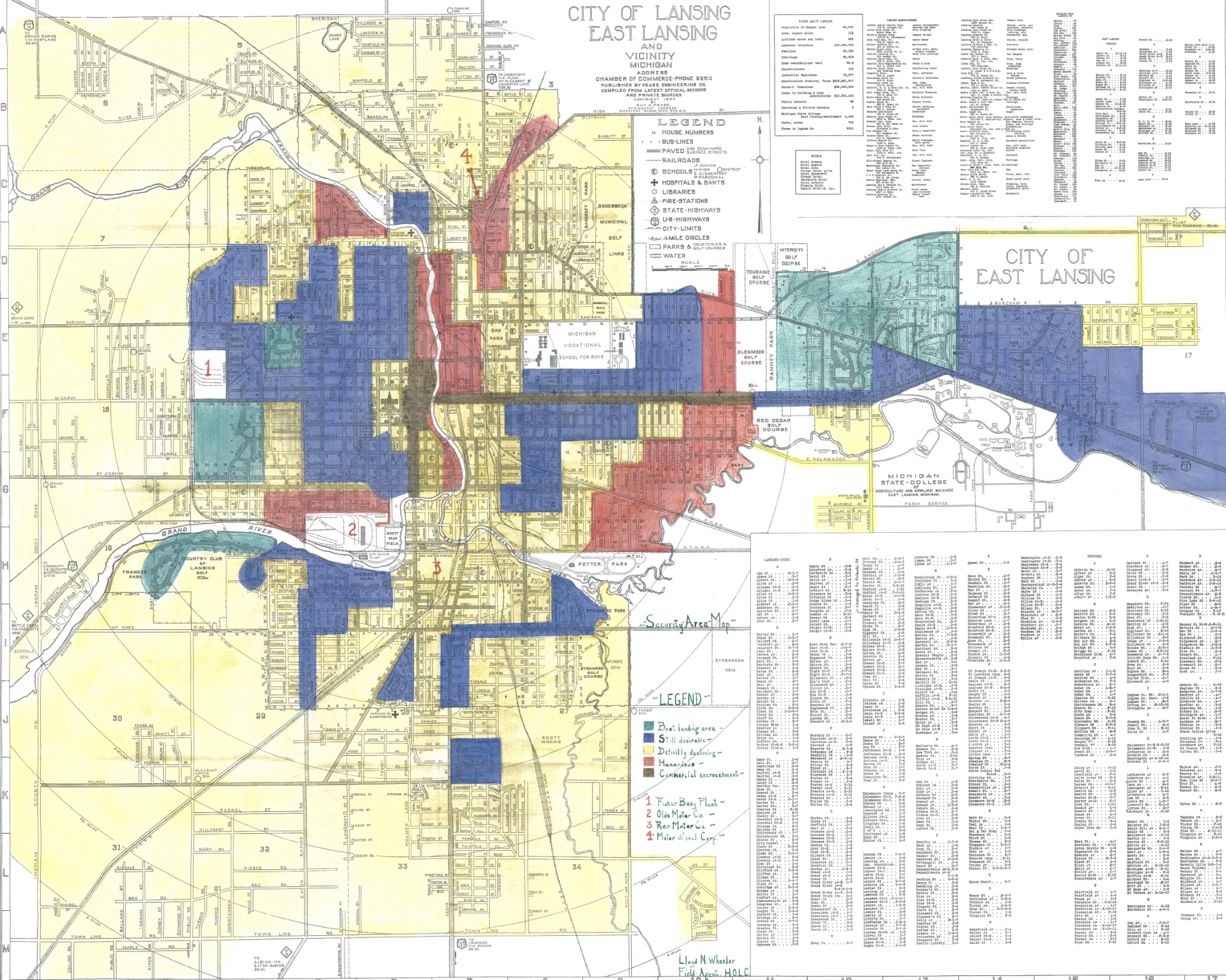
The HOLC then moved to create investment risk maps for nearly every U.S. city with a population of over 40,000, maps that would guide public and private investment in the U.S. for generations.
The maps assigned different grades to neighborhoods, with the lowest rated districts declared “hazardous” for investment and shaded red, or redlined, and systemically denied mortgage loans and other financial services. Neighborhoods where Black families lived were almost always redlined. Even neighborhoods adjacent to areas where Black people lived were given the second lowest rating of “declining,” according to researchers at Michigan State University.
“Even if it was a middle class Black neighborhood, it would be redlined just because the people in it were Black,” said Craig Carpenter, an MSU associate professor who has studied redlining locally.
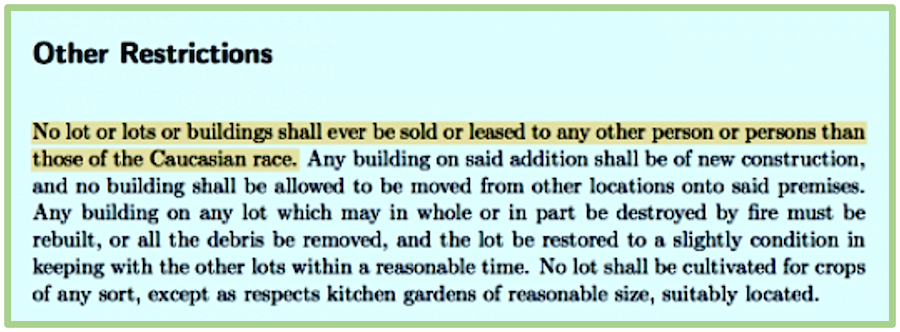
The maps were shared with financiers, realtors and other private industry groups. The practice encouraged segregation and institutionalized discriminatory lending practices, Carpenter explained. Existing racist practices like creating neighborhood housing covenant rules that banned homes from being sold to Black people were suddenly encouraged by the federal government.
This contributed to East Lansing and many other cities remaining segregated into the 1960s. East Lansing only integrated when Robert L. Green, a former Michigan State University faculty member and civil rights leader, successfully sued the city for housing discrimination in 1964.
While the explicitly racist practices of redlining were made illegal by the Fair Housing Act of 1968, the system built over the previous decades remained intact, explained LaDale Winling, an associate professor of history at Virginia Tech University who is a leading researcher on redlining.
Redlined neighborhoods received little public or private investment. The taxbase in redlined neighborhoods was smaller, leading schools, infrastructure and other community resources to be sorely underfunded. Racist real estate practices, like undervaluing Black-owned homes in appraisals, remained embedded in the system. Redlined neighborhoods were also at increased risk of being destroyed to make room for federal projects like new highways, Winling said.
In Lansing, nearly 800 homes in a redlined middle class Black neighborhood were demolished between 1963 and 1970 to build I-496, a period in history chronicled by the Historical Society of Greater Lansing’s Pave the Way documentary.
“We should, I think, see the redlining maps as a key and powerful moment in which varied private practices and local knowledge basically became the template that then informed generations of real estate professionals, as well as urban planners and financiers and so forth,” Winling said.
The maps led to Black families largely being excluded from the mortgage market. Areas where Black people could buy homes saw significantly less investment and the value of these homes grew significantly slower than other areas.
Winling recalls a time when he presented award winning investigative journalist and author Nikole Hannah-Jones with the HOLC maps of her hometown in Waterloo, Iowa. Hannah-Jones told him her parents’ home in a redlined neighborhood had only grown in value by several thousand dollars between the 1960s and mid-2010s.
“That’s incomprehensible,” Winling said. “The message is always: You buy a home, it’s going to make you thrifty, you’re going to build equity, you’re going to invest in a neighborhood and a community.”
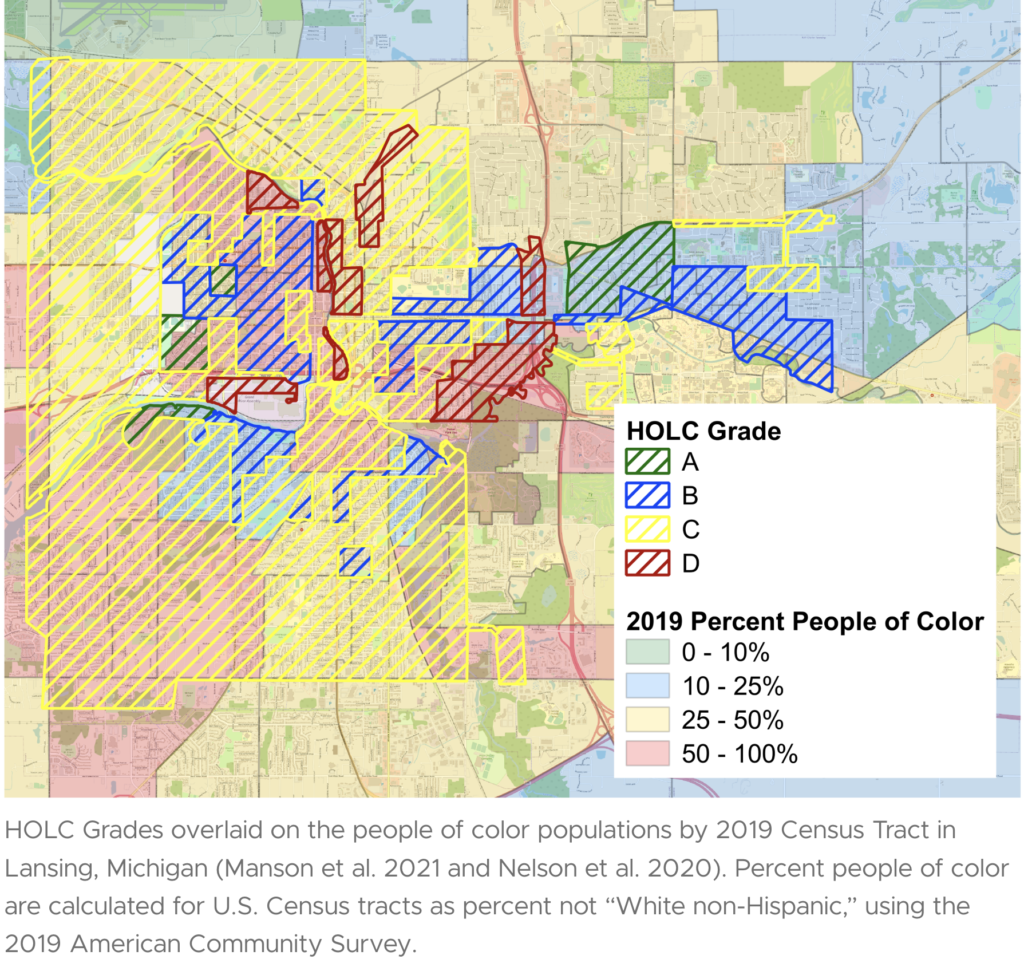
The persistence of redlining and segregation locally can be seen today. A map Carpenter created that overlays current day racial demographic data with the HOLC maps shows segregated communities, like East Lansing, still tend to have fewer people of color.
“Without actively working against these forces, they don’t just go away,” Carpenter said.
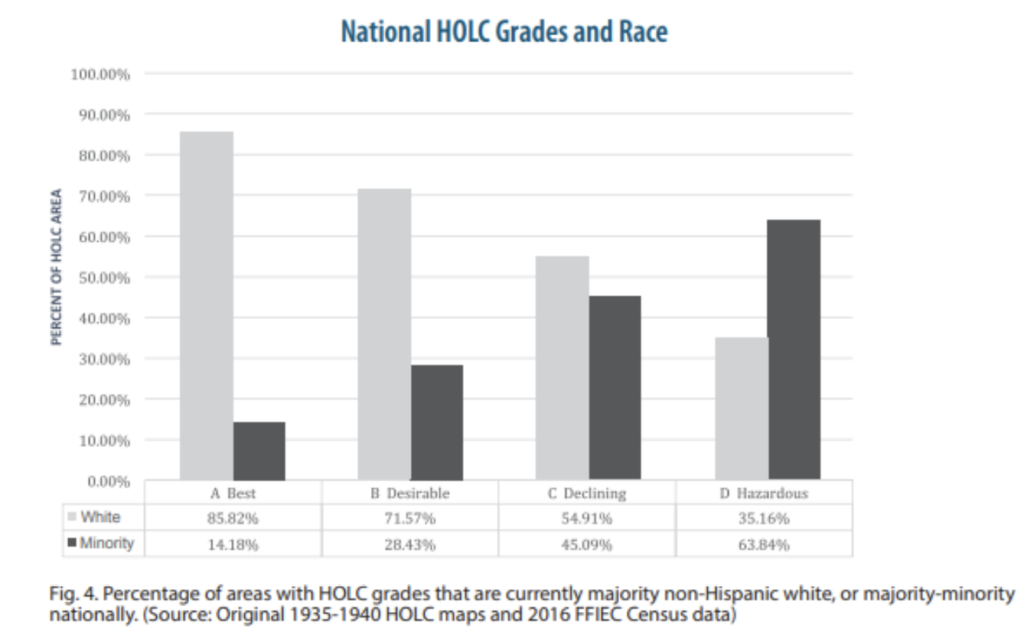
Last year, East Lansing updated its comprehensive plan, the city’s guiding document for development. One of the challenges identified in the comprehensive plan remains redlining, almost 60 years after the practice was made illegal.
“These restrictive practices led to impacts that have lasted for decades, even after legislation which made such practices illegal,” the comprehensive plan reads. “In 1996, homes in redlined neighborhoods were worth less than half that of the homes in what the government had deemed as ‘best’ for mortgage lending, according to research by home-sale company Zillow, which also found that the disparity only grew greater in the following two decades.”
White households have about nine times more wealth than Black households, largely because of the role of segregation and other forms of discrimination that have blocked the transfer of wealth between generations, the Pew Research Center found in 2023.
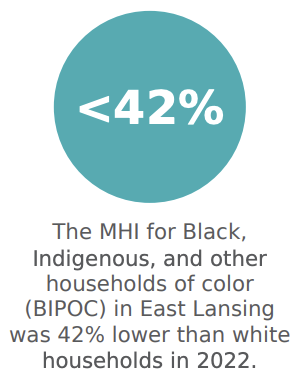
The racial wealth gap has brought other disparities like educational attainment and career opportunities, Winling explained. These factors contribute to an income gap that persists. In East Lansing, the median income for a household of color is 42% lower than white households, according to the city’s comprehensive plan.
Despite overwhelming evidence of lasting harm caused by racist federal practices, there has never been sweeping federal action to address the impacts of redlining, Winling said. He estimated it would take a century of active, reparative policy and work to address racial disparities caused by centuries of discrimination.
Even this seems far away. Lawmakers have routinely pitched race blind solutions as a fix to disparities caused by explicitly racist policies.
Willye Bryan isn’t waiting for the government to act.
During the summer of 2020, racial justice protests erupted nationwide after a Minneapolis police officer murdered George Floyd. Bryan watched as many around the U.S. learned about the legacy of discrimination that she lived through in the Jim Crow-stained South.
At the same time, Bryan saw the still-raging COVID-19 pandemic killing Black Americans at a greatly elevated rate due to disparities in healthcare, income and a myriad of other factors.
“Michigan’s African American population is about 14%,” Bryan said. “African Americans were 40% of the total number of deaths brought on by the pandemic… The suffering I saw at the hospitals, it was all so disproportionate.”
Desperate to create change and recognizing the opportunity to build on awareness about the lasting impact of discrimination, Bryan launched the Justice League of Greater Lansing in 2021. The organization eliminates barriers to homeownership, educational achievement and business ownership for Black residents by providing resources through a reparations fund.
In five years, the Justice League has raised more than $700,000 for its reparations fund.
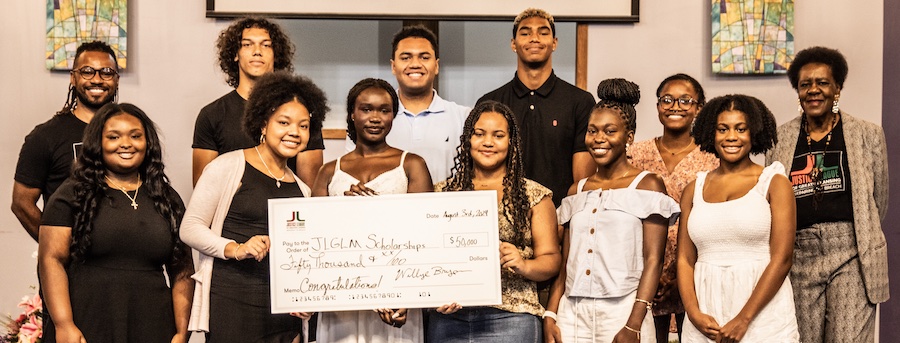
The Justice League has raised the money by partnering with other organizations – mostly predominately white churches. In 2021, Bryan began giving presentations about the history of racism in the U.S. and its lasting impacts. Many churches were quickly on board, with some pledging six figure contributions to the fund.
During a presentation at the Delhi Township Library earlier this month, four faith leaders spoke about their church’s involvement in the reparations program. Each said their congregation was mostly enthusiastic about participating in the reparations program.
The Rev. Kit Carlson, who retired as rector of All Saints Episcopal Church in East Lansing in 2024, helped usher in the church’s involvement in the reparations program.
At the library presentation, Carlson said All Saints donated half the proceeds the church made when it sold its rectory. Selling property to fund the donation underscored the importance of the Justice League’s work.
“We took the redlined Lansing map and I found some houses in the red area that were of comparable age to the rectory – same number of bedrooms, same number of bathrooms,” Carlson said. “They sold for 75, 80 thousand dollars. Our rectory [in East Lansing] sold for $240,000.”
Even as the Justice League has been building up its endowment fund, it has put Bryan’s vision of building wealth in the local Black community into action. For the third consecutive year, the Justice League will give out scholarships to local students. This year, 10 students will receive $2,500 scholarships to a university, college or vocational school.
Late in 2025, the Justice League contributed almost $70,000 and partnered with the Eastside Community Action Center to build a home in Lansing for an elderly first-time homeowner. The Justice League is working to build a second house this year, Bryan said.
Soon, the Justice League will begin distributing business grants to help Black-owned companies get their feet under them and hire employees.
“People have an idea and you can start a business out of your house or start a business out of a store front,” Bryan said. “But growing that business to be able to make it large enough to employ members of the community, being able to have a growing, thriving business escapes much of the Black community, they stay small, many of them.”
The Justice League’s early success has inspired other communities to consider similar models. Similar organizations are being explored or have launched in Kalamazoo, Grand Rapids, Greensboro and New Orleans, according to the Justice League’s website.
“Structural racism that we see… is in the education system, it’s in the employment system, it’s in healthcare, it’s in all of the established systems,” Bryan said. “My idea was that we could start to heal a lot of that.”
Editor’s note: Kit Carlson serves on East Lansing Info’s volunteer Board of Directors.