
East Lansing is in Year 25 of its 5-Year Plan to Replace Sidewalks
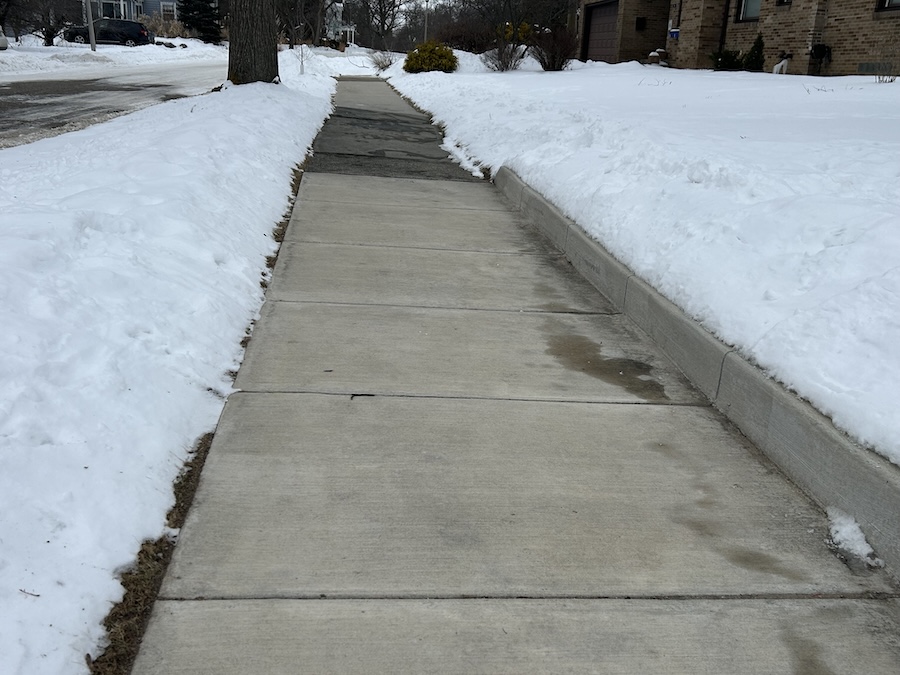
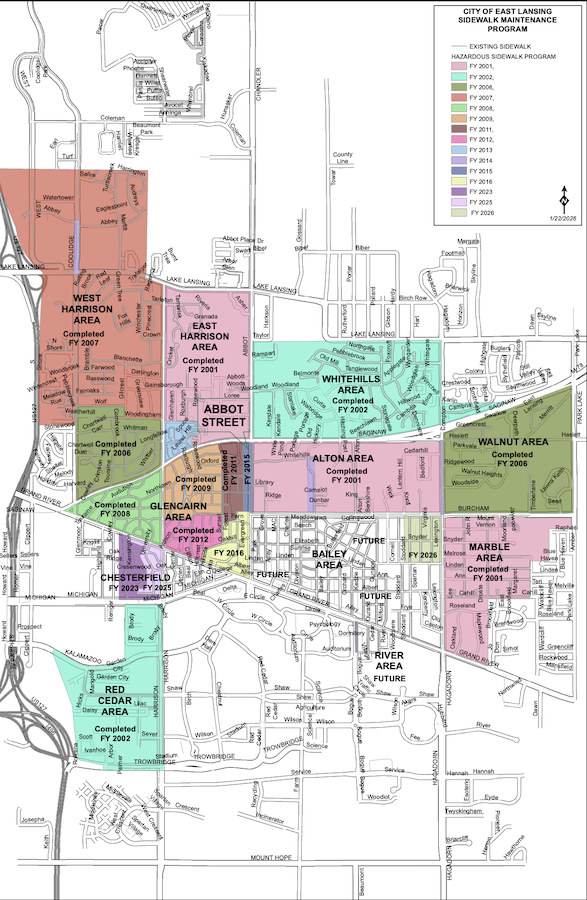
In 2001, East Lansing implemented its Hazardous Sidewalk Program with the ambitious goal of inspecting and repairing damaged sections of sidewalk. The Department of Public Works, or DPW, aimed to address the entire city within five years.
DPW Director Ron Lacasse told East Lansing Info that the job still isn’t complete in the program’s 25th year. Progress has been slowed by rising costs and budget reductions, and Americans with Disabilities Act ramp requirements have added “substantial expense,” Lacasse said.
“When the city begins work in a neighborhood,” he said, “City Council typically allocates about $250,000 per year for the program. City staff inspect sidewalks in an area that fits within that funding level. Letters are then sent to property owners explaining that the process has started, identifying the cause of damage, noting sidewalk ramps and providing an estimated bill where applicable. At the same time, staff prepare the project for bidding. Estimates provided to residents are intentionally conservative.”
He said the city focuses on one area at a time to remain cost-effective, rather than replacing sidewalks scattered across the entire city. Concentrating work in one area, Lacasse said, allows the city to secure better pricing.
The costs of repairing sidewalks in neighborhoods is split between homeowners and the city. Residents are usually responsible for the cost of repairing sidewalks adjacent to their homes, sometimes costing thousands of dollars.
“The city pays for damage caused by city-owned trees in the right-of-way, for sidewalk ramps at intersections, and for settlement documented to be caused by the installation of a city utility as part of a city project,” Lacasse said. “Any other causes of sidewalk damage are the responsibility of the property owner.”
The city understands residents may be frustrated when receiving a bill in the mail, as costs can be substantial, Lacasse said. Assessments are automatically spread over three years.
Each fall — as long as the city budgets funds for the work — DPW inspects the next area of focus. The administrative review process, hearings and council actions occur in winter and spring, with construction taking place during the summer.
Residents receive invoices in late summer or fall for completed work.
“Property owners may contact the city to request a meeting with staff to discuss the issues,” Lacasse said, “such as why specific sidewalk squares were selected or to dispute findings. If concerns remain, there is an administrative review with a DPW leadership staff member. If residents are still not satisfied, a public hearing is held before City Council prior to adoption of the assessment roll. Ultimately, City Council must approve the assessment roll, and residents have multiple opportunities to express concerns throughout the process.”
He added that council has never denied an assessment roll once it reaches that stage, as funding has already been approved through the budget. However, there have been years when no funding was allocated.
According to meeting agendas, in 2023 City Council approved a round of 130 sidewalk replacements in the eastern section of the Chesterfield Hills neighborhood. Residents and property owners were given work estimates totaling $305,830. The city was responsible for $97,989 in repairs. Repairs for seven properties were completely covered by the city, while owners of the remaining properties were charged between $247 and $9,475.
Lacasse said repairs to sidewalk ramps in the city — primarily at intersections — have been funded through Community Development Block Grant, or CDBG, funds, which are distributed by the U.S. Department of Housing and Urban Development.
“Using CDBG funds for ramps allows the hazardous sidewalk budget to stretch further and also supports ADA compliance,” he said.
The city is more than three-quarters of the way done with the sidewalk plan. Once the city finishes repairing sidewalks, likely in three or four years, it will start over, Lacasse said.
Despite occasionally issuing invoices, Lacasse said the department wants community members to know staff are committed to helping.
“Staff are carrying out their responsibilities under the city code and are willing to discuss concerns with residents,” he said. “The program includes multiple opportunities for public input, and the department is committed to working with residents as much as possible.”