

East Lansing Police Department Pledges Openness After Year Marked By Transparency Rollbacks
After a year filled with redactions, closed-door meetings and new provisions that roll back transparency, East Lansing Police Chief Jennifer Brown said the police department is going to put an emphasis on sharing information with the public.
Speaking to the East Lansing City Council on Feb. 10, Brown said the police department has started a newsletter to share information with the community and will soon create a dashboard to share statistics about traffic stops, calls for service and other categories.
“Transparency and communication are critical to maintaining trust,” Brown said at the Feb. 10 City Council meeting.
The vision of transparency laid out by Brown would be a reversal of the recent direction of the police department and is a far cry from complaints raised by the city’s Police Oversight Commission at recent meetings.
Early last year, rules the commission operates under changed after the city reached a new collective bargaining agreement with a union that represents ELPD patrol officers. Under the new rules, commissioners say their ability to investigate incidents is reduced, more information the commission receives must be kept confidential and commissioners cannot publicly name ELPD employees.
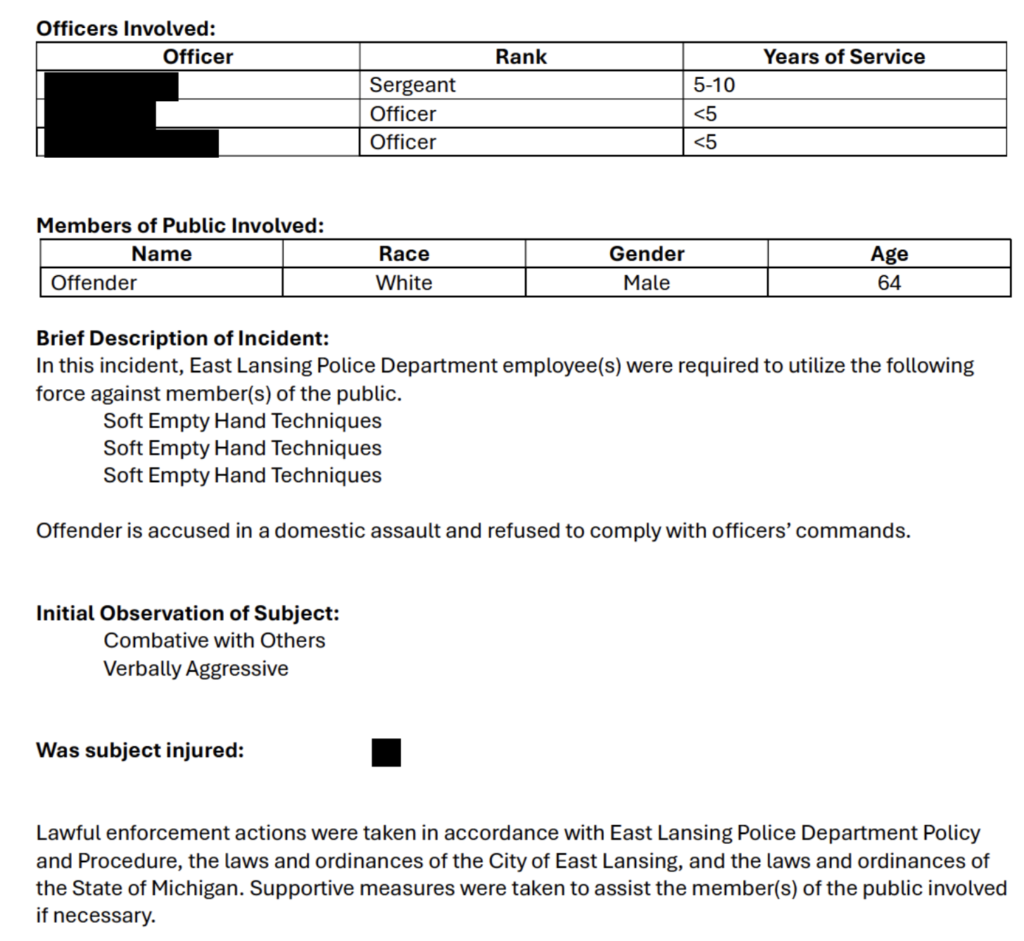
The transparency rollbacks can be seen in reports the oversight commission receives about incidents where ELPD officers use force.
Early last year, ELPD stopped including officer names in reports after the bargaining agreement was reached. Later, the police department began including officer names in the reports but told the commission the reports must be kept confidential because officer names have been included. East Lansing Info has been able to receive redacted versions of these reports through Freedom of Information Act requests, but the information included in the reports has been significantly whittled down in recent months.
Previously, reports would include detailed narratives about why officers used force and the outcome of incidents. After the new bargaining agreement was reached, the reports either did not include officer names or they were redacted in versions made available to the public. Report narratives in the last two months of 2025 included significantly less information than in the past.


Commissioners spent much of the Feb. 4 meeting in a closed-door meeting speaking to city attorneys, despite some commissioners saying they believe parts of the discussion could take place in public.
When commissioners were speaking publicly, they said that transparency rollbacks that are making it difficult to track trends within the police department. Commissioner Amanda Morgan, who works as a social worker, said the commission will struggle to create a report about ELPD interactions with people experiencing mental health crises because the police department stopped providing the same information as past years.
“I am concerned because the best interest of ELPD is transparency and building trust with the community, and when there is a veil over the information that something as simple as mental health crisis encounters, I’m concerned as a social worker,” Morgan said at the Feb. 4 oversight commission meeting.
ELPD chief said more information will be provided to the public than is currently being provided to the city’s Police Oversight Commission.
During her presentation at Tuesday’s meeting, Brown said that data transparency is a priority for the department.
Councilmember Kerry Ebersole Singh asked what type of data the department plans to make publicly available, nodding to recent complaints from the oversight commission about data sharing.
The department plans to share information on traffic stops, calls for service, and police interactions with people experiencing mental health crises and juveniles. Data will be broken down by race, gender and other categories, Brown said.
“The intent is to put more information up on our website than we’re able to provide the [police oversight] commission via the current ordinance,” Brown said.
Additionally, the police and fire departments will each regularly present at the city’s monthly discussion-only City Council meetings.
The Feb. 10 meeting came a day after WKAR reported ELPD is launching a “structured reset of media relations” using a 10-point plan developed with communications firm Mario Morrow and Associates, a firm the city hired to be a “communications coach” for Brown late last year.
The plan stresses increasing transparency and communication with the community and organizations that have been critical of Brown and ELPD. The plan also recommends an interactive dashboard that includes data on police stops, arrests and use of force, WKAR reported.
ELPD has been at the center of controversy after a pair of incidents at the start of the Michigan State University school year. In a news interview last fall, Brown said East Lansing has a “disproportionate number of minorities come into the community and commit crimes,” when addressing concerns about ELPD officers disproportionately using force against Black individuals. The comment has been broadly condemned as racist.
In August 2025, an ELPD officer deployed pepper-spray on two young Black men downtown. The police department published a press release that named the two men pepper-sprayed and said they were charged with crimes related to fighting. The attorney for the men subsequently released security footage of the incident that painted a different picture and charges against the two men were dropped. The incident and press release are now the subject of lawsuits filed in federal court.
City officials have said very little about the pepper-spray incident because speaking about it while litigation is ongoing could impact the city’s insurance coverage, City Manager Robert Belleman recently told ELi.
High ranking city officials like Mayor Erik Altmann and Belleman have signaled support for Brown amid the controversy, and the city’s awards committee heaped praise on Brown when it nominated her for the Inspiration Award at a Dec. 12, 2025 award ceremony for city employees. Part of the reason Brown was nominated is her response to public criticism.
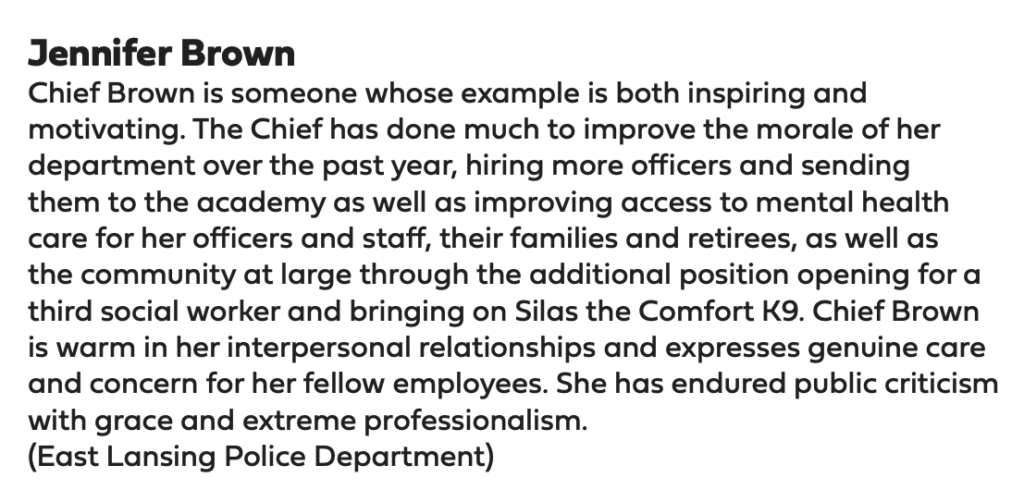
While city officials have largely supported Brown, city meetings are regularly filled with members of the public calling for the chief’s resignation and substantial change to ELPD. Two city commissions and prominent local organizations like the Women’s Center of Greater Lansing and the Lansing NAACP branch have called for Brown’s resignation.
Ayah Imran contributed to this reporting.