

East Lansing Police Use of Force Has Surged and Racial Disparities Have Grown, Data Shows
An analysis of reports produced by the East Lansing Police Department shows that ELPD officers are using force more often this Michigan State University school year than the start of the previous three school years, and the racial disparity of who force is used against is wider than past years.
After the East Lansing Independent Police Oversight Commission started meeting in late 2021, ELPD began providing monthly reports that outline instances where ELPD officers used force. The public reports include a narrative of each instance, demographic data of the people police were interacting with and, until recently, the names of officers involved.
Reviewing reports from August through October, the first three months of Michigan State University’s school year, from 2022 until this year shows that ELPD has used force more frequently than previous years.
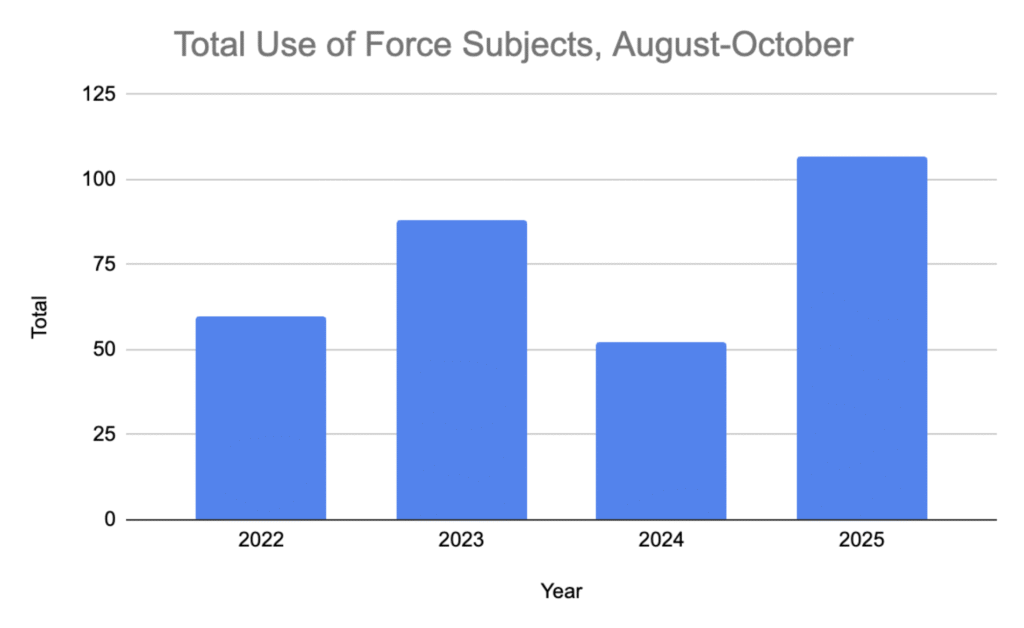
The reports also show a widening gap in the racial disparity in use of force incidents. Examining the same window of August through October in every year since 2022 shows that 2025 has the largest racial gap. About 83% of individuals ELPD used force interacting with were non-white in 2025, compared to about 54% in 2024, 68% in 2023 and 67% in 2022.

Recent use of force data was highlighted as a concern by East Lansing Independent Police Oversight Commission Vice Chair Kath Edsall at the body’s meeting last week.
In a phone call with East Lansing Info today, Edsall said she thinks that the increase in use of force is a result of new leadership at ELPD and shifting priorities in the city. She said Police Chief Jen Brown and city leaders have sent the message that they will support officers regardless of their actions, and that de-escalation is no longer highlighted as a priority for the police department. Brown took over as ELPD interim chief about a year ago and had the interim tag lifted in the spring.
“I do think that the drastic change is in large part who’s the captain of the ship,” Edsall said.

Tonight, City Council may vote to fund more police positions, order more bias training.
Since August, ELPD has been mired in a pair of controversies. During Michigan State University’s welcome weekend, an ELPD officer deployed pepper-spray on two men downtown and the department subsequently published a misleading press release about the incident. Brown also made comments in a news interview that have been characterized as racist by city officials and speakers during public comment at meetings.
The incidents have been condemned by the city’s Police Oversight Commission and Human Rights Commission, and the Lansing NAACP branch, including calls for Brown’s resignation or removal.
In October, City Council voted to hire an independent investigator to review ELPD policies and actions, specifying the review should look into actions around MSU’s welcome weekend and the time since. The city’s police oversight commission has asked that report be made public when it is completed.
City officials are seemingly acknowledging a growing rift between portions of the community and the city’s police department. On tonight’s City Council meeting agenda, one item looks to address “heightened community concern, particularly within communities of color.”
Council will vote whether or not to approve contracts for more bias training for East Lansing police officers and a “communications coach” for Brown, among other things. Brown recommended the actions, the agenda report says.
The proposed action does not take one step that NAACP Lansing branch President Harold Pope says is necessary, which is apologizing to the two men pepper sprayed during welcome weekend and issuing a formal retraction of the press release that named them.
“That should’ve been the first step, clean that up,” he said. “I shared that with the police chief and the city manager almost two months ago… You owe those two young men an apology. You owe it to the community to retract your statement.”
The proposed steps council will vote on tonight are a “superficial band-aid” and won’t address the problems within ELPD, Edsall said.
“They’re throwing out some trainings right now, but if the underlying message is ‘I’ll still support you regardless of what you do,’ there’s not going to be real change,” she said.
The police oversight commission consulted with use of force specialists and spent about a year rewriting ELPD use of force policies. The recommendations went to former Police Chief Kim Johnson, but he resigned shortly after receiving them. His successors have not implemented the proposed changes, Edsall said.
Edsall added that Brown stopped attending oversight commission meetings a few months ago, and said the commission could be a resource for her. Over the first three-plus years of the commission’s existence, the city’s police chief or an ELPD employee would attend oversight commission meetings, but that presence has been missing at recent meetings.
Also on tonight’s agenda, there is a large package of public safety proposals that were developed by a task force made up of ELPD and city employees. The recommendations include adding four more police officers to ELPD, and adding cameras and lighting downtown.
Edsall said she doesn’t think adding police officers will fix problems the department or city is facing, and suggested the city implement social welfare programs modeled in other cities or contract with other police departments to increase police presence on especially busy days. She added that the new hires will further strain a city budget that is already running at a deficit.
Adding four police officers is budgeted to cost $377,720 in the first year, a cost that would be split between the city’s general fund and the Downtown Development Authority, the agenda report says.
Police expenses have been growing in recent years. In the fiscal year 2026 budget, City Council approved the ELPD ask of more than $16 million in expenses. This is more than 25% greater than the budget passed four years ago that allotted about $12.5 million to police expenses.
Correction: This story initially stated the August-October 2024 proportion of non-white subjects in use of force reports was 48% instead of 54%. The story and chart were corrected shortly after publication.