

East Lansing’s Deer Concerns Persist as Officials Seek Lasting Solutions
East Lansing residents are growing tired of sharing their community with an increasing deer population that too often finds its way into residents’ gardens and in the path of traffic, a community survey found.
As the East Lansing City Council considers next steps in managing the local deer population, the city’s parks department presented a survey at Tuesday’s council meeting that reflects residents are growing tired of their furry cohabitants.
Since the city began the community survey concerning deer in 2014, the percentage of people who say they enjoy seeing and having deer around the community has decreased slightly, Parks, Recreation and Arts Director Justin Drwencke told council members Tuesday.
In the most recent survey, which had 242 respondents in early 2025, about 30% of respondents said they enjoy having deer around, while just as many respondents said the deer population is a nuisance. At the same time, about 40% of respondents said while they enjoy seeing a few deer, the population makes them concerned about problems.
The overarching concern survey participants have with the local deer population is deer-vehicle collisions, Drwencke said, with 74% of respondents in the most recent survey saying the deer population makes them worried about collisions.
East Lansing was on a downward trajectory for deer-car collisions, Drwencke told council members, but in 2025, the city saw a spike.
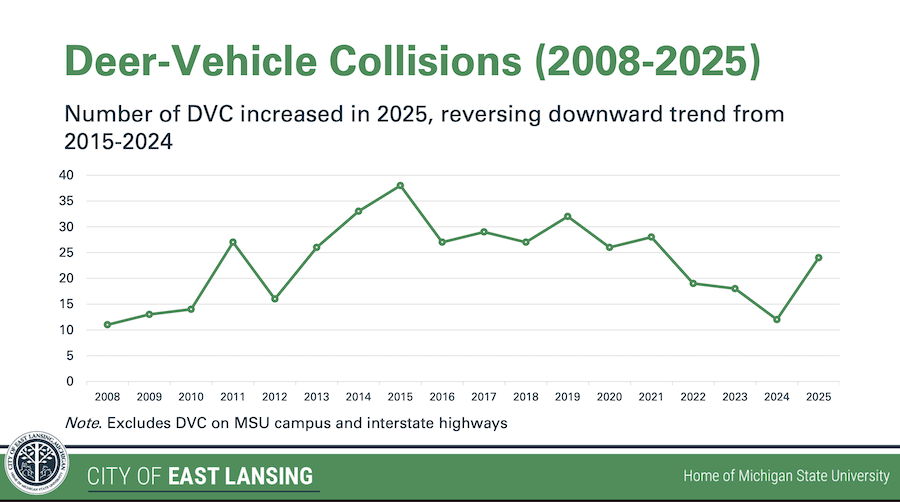
“The greatest predator of these deer are cars, and that hurts people,” Councilmember Steve Whelan said during Tuesday’s meeting.
But in identifying the major concerns East Lansing residents’ have with the deer population, Whelan pointed out that the most recent survey was taken before Michigan saw a surge of Lyme disease cases.
Blacklegged ticks, commonly known as “deer ticks,” are the main host for the bacteria that causes Lyme disease and they often feed off deer before laying new eggs. Because deer are blacklegged ticks’ primary food source, some researchers and wildlife management experts assert that growths and reductions in the deer population impact the tick population and Lyme disease cases.
There are a number of strategies that could be implemented to manage the deer population, Drwencke said. However, each method’s effectiveness and permanence differs.
Methods to manage damage control such as fences and repellants only work in small areas, Drwencke said, and don’t reduce the deer population or lessen damage, instead shifting the damage to another area where the deer will migrate.
Other methods implement either lethal or non-lethal techniques. Non-lethal avenues like relocating deer, sterilization or introducing birth control to the population are not only ineffective and highly stressful for animals, they are not approved deer management strategies in Michigan, Drwencke said.
In 2020 the East Lansing City Council authorized the deer population to managed through an annual cull, amid residents’ concerns about Chronic Wasting Disease, damaged landscaping and traffic hazards.
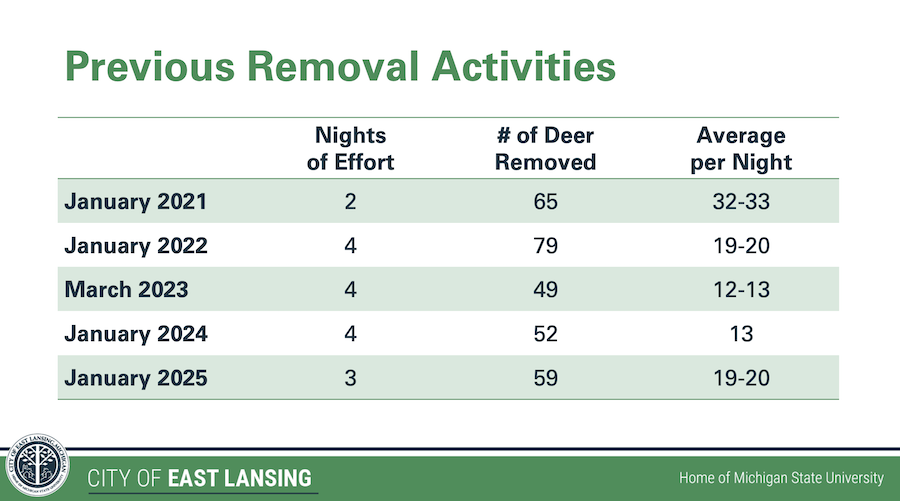
For the cull the U.S. Department of Agriculture, or USDA, sends sharpshooters to kill deer in city parks and other remote areas at night for a few days in the winter. Whereas much of East Lansing’s more rural surrounding communities can manage the deer population through recreational hunting, Drwencke told East Lansing Info this spring, East Lansing and more urban areas commonly implement deer culls through similar programs.
Deer culling through lethal methods can be controversial as some critics have beseeched Michigan municipalities to find non lethal methods to manage the deer population, but Drwenke told ELi in the spring that the USDA deer cull manages the population in a manner that has a more permanent impact than non-lethal methods. He added that in his opinion, it’s more humane to manage the deer population to a size the area can sustain, so deer can thrive.
“There has to be some type of intervention in order to create that opportunity to coexist in that space in a way that doesn’t cause the deer population to suffer. Ultimately, if you see overpopulation in a deer population … not only do you have more conflicts with humans, but they also then are more likely to transfer diseases among themselves,” Drwencke said. “They really start to compete with each other more and it ends up with worse health outcomes for the deer population themselves.”
The City of East Lansing was approved by the Michigan Department of Natural Resources to remove up to 80 deer in its deer cull for 2027, Drwencke announced to council members Tuesday.
The cull only seems to give the city respite from deer overpopulation issues for a year until it’s time to perform another cull, Mayor Pro Tem Chuck Grigsby said.
“We’re not really managing. We’re just reacting,” Grigsby said.
For years, the city has been searching for more impactful deer management solutions.
One solution would be to implement a program like the Kent County Deer Management Coalition, Drwencke said, where Grand Rapids and surrounding communities pooled resources to come up with a combined strategy to manage the deer population.
East Lansing had been in conversations with its neighboring communities on the feasibility of creating a similar program, Drwencke said, but conversations toppled off of the priority list due to transitions in city leadership. But, he said he’s eager to reignite conversations that could involve a coalition of municipalities funding a full-time wildlife biologist to partner with city governments to execute a regional strategy to create long-term wildlife management strategies for the Greater Lansing Area.