
From East Lansing to Lansing’s East Side, ELFCO Faces Another Fight for Survival
In 1976, self-proclaimed former hippies, aided by professors of agriculture at Michigan State University, banded together to create the East Lansing Food Co-Op. Fifty years and a name change later, that operation has experienced turbulent times and an evolving view of community.
A food co-op is similar to a grocery store, except it is owned, governed and sometimes operated by the people who shop there. Members pay a regular fee — like membership dues, for example — in addition to paying for their groceries. ELFCO allowed nonmembers to shop the co-op, as well.
According to a history published in 2022 by City Pulse, ELFCO was born at a bicycle co-op owned by MSU student Thomas Moore at 211 Evergreen Avenue in East Lansing. Over the next five decades, it would expand and contract. A review of articles over the years by the Lansing State Journal shows that ELFCO has fluctuated between prosperity and insolvency a host of times.
Former employee Dave Finet had a long history with co-ops before working with ELFCO in the mid-2000s. His family had been involved in similar operations in Champaign, Illinois and Madison, Wisconsin.
“One of the first places we stopped when we moved to Michigan was the co-op to get our membership,” he said.
The condition of the operation was tenuous, however. Finet said a longtime general manager had been let go before he arrived and members were divided in their opinion of him, while his replacement had little retail experience. Finet said the co-op was losing approximately $15,000 each month. ELFCO had received a lump-sum payment from a former vendor, he said, and was burning through the money quickly.
Despite this, he remembers that membership was steady. ELFCO took advantage of advice from the National Cooperative Grocers Association, which helped the co-op turn things around.
“They suggested that it was important to not be in a perpetual state of being …challenged, and that what we really needed to look at was to talk about the potential of the store, not just to sell groceries cooperatively, but to build community,” he said.
Finet became general manager and said his team worked hard to make the store a success. The co-op was the first store to bring Zingerman’s products to East Lansing. It offered a robust bulk-purchasing system through which members could buy cases of goods. It even supported the Lansing Bike Co-Op after it lost its space.
ELFCO also launched the Northwind Community Garden in a space next to the co-op. Members of the community could apply for a microloan from ELFCO for startup costs and grow their own vegetables in the formerly empty urban lot.
Jim Coty managed the community garden program for ELFCO. He told ELi it became very successful and helped the larger community begin growing its own produce while connecting people with the co-op.
“The co-op movement, they’re like-minded folks,” Coty said, “environmentally conscious, interested in organic, being [the] kind to not pollute, not using pesticides. Those same people were involved in the garden project.”
Despite the success of the garden, the co-op continued to encounter hard times.
In 2013, the community learned that Whole Foods was coming to East Lansing, bringing its penchant for organic produce and diverse whole ingredients — products which, up to that point, the co-op and other organic retailers like Foods for Living had specialized in. Foods for Living closed in 2024.
“[Whole Foods] was a big catalyst or factor,” Coty said. “But we knew that was happening. And there are a number of things. Some choices were made. There was a whole lot of little, you know, cuts by inches.”
Coty said the ethos of the co-op also broke down when the operation stopped utilizing members as volunteers who stocked shelves and worked the checkout line. Members who volunteered received discounts on products, but Coty said the co-op was advised by lawyers to stop the practice because another co-op was sued by a member over discounts that were equal to minimum wage.
“In my estimation,” he said, “that undercut the connection. People went there to see each other. They were friends [but] that started to erode as a result of that.”
Coty said he was briefly on the board of directors during that time. With Whole Foods coming in, he said there was a sense that the co-op needed to move toward Lansing to develop more of a neighborhood clientele.
Coty said he renewed his membership once the current location opened in 2019 and even went a couple of times.
“But to be honest, it’s quite a hike,” he said. “I live in Haslett. A lot of the other people lived in Okemos and east of the co-op. People found alternative resources. Kroger carries organic [food] now.”
Finet, meanwhile, said he was tired and didn’t feel like he was the right person to fight this fight. He left the co-op in 2015, two years before the East Lansing store closed.
“I think the writing was on the wall,” he said. “We weren’t able to find the right place and we didn’t move as quickly as we probably should have to keep looking.”
For Finet, the co-op’s future depended on offering something beyond products that had become increasingly available elsewhere.
“I think it was important to be more than just a food store because you can get almost everything that the co-op sold [from other stores],” Finet told ELi. “They can often be purchased for less in other stores now, and so there’s not a corner on natural foods. But the thing we can do is be genuine parts of communities, and I think that’s what I see many successful co-ops doing is being more than just a grocery store.”
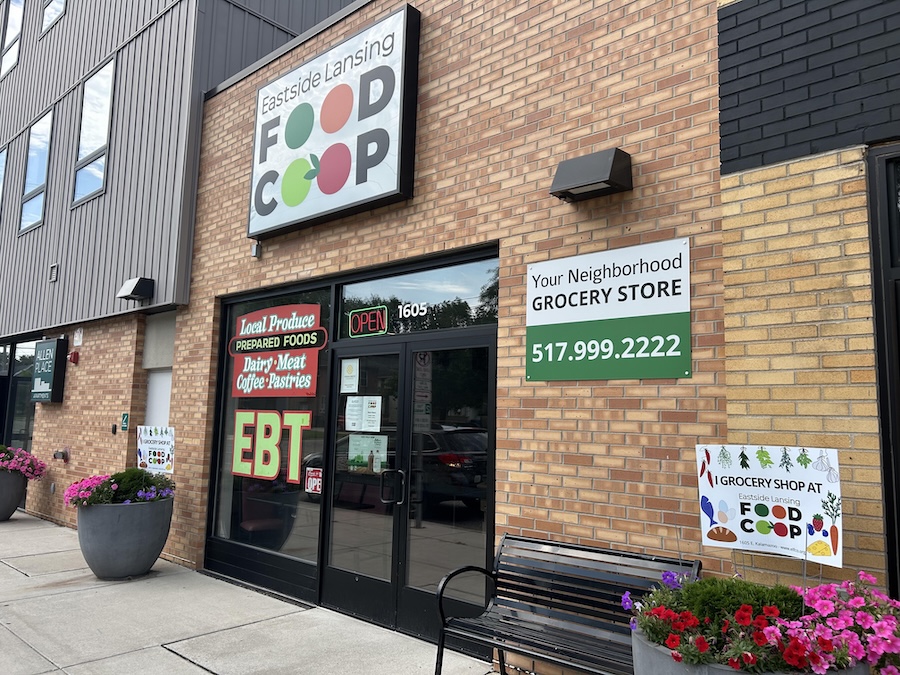
In 2019, the ELFCO board opened a new location in conjunction with Allen Neighborhood Center at 1605 E. Kalamazoo Street in Lansing.
Now, the operation is called Eastside Lansing Food Co-Op.
holly jo Sparks is president of ELFCO’s board of directors. When she joined the board in June 2024, ELFCO was already in transition after its general manager had left.
“At that time, we did not have good access to the day-to-day financial conditions,” she said. “We had lines of credit, we had some debt, and we were working with interim management. The first thing we expected was access to the financial records and state of the co-op, and we didn’t have a lot of that information.”
The board hired a consultant with a history of advising food co-ops nationally. Sparks told ELi the consultant performed a full evaluation of the feasibility of the Kalamazoo Street location and how operations could be tightened. The board also worked with a coach who provided advice for several months.
The consultant said that the co-op would face significant challenges and need to have about $750,000 in sales per year to be sustainable, Sparks said.
With this information, the board recruited and hired Gary Snow, ELFCO’s now-general manager. Snow came to them with grocery retail and operations experience, Sparks said. Their consultant and coach had advised them that reaching $750,000 would require expanding their location and filling their space.
“That was a very ambitious goal that we came into the fall of 2024 with,” Sparks said.
Despite their efforts, the operation is still struggling. In August, City Pulse reported that ELFCO’s future depended on its September profit.
“Our metric is an average of $1,200 per day,” Sparks told ELi. “That is based on what is required to keep the lights on. [But] we can’t just stop at $1,200. We need to continue to grow in order to reinvest in the store, increase our inventory, increase our hours, our staffing, and provide all of the kind of community services that we want to be able to offer.”
Sparks said generous anonymous donors have helped the co-op keep its doors open, but it wasn’t a sustainable existence.
Legacy members of ELFCO — those who have been with the organization since its East Lansing days — have stuck with it through thick and thin, Sparks said. The co-op has retained its values despite its transition to a different community with different products and prices.
“We’re not a carbon copy of what it used to be in East Lansing,” she said. “But we still want to have community ownership. We still want the neighbors to direct the kinds of products and services that we’re able to provide. If you support cooperation in the area, then we need you.”