

Residents Push Back on Proposed Limits to East Lansing Human Rights Commission at Forum
Community members spoke in opposition to proposed changes that would limit the powers of the East Lansing Human Rights Commission at a forum Monday night.
The ordinance changes were introduced by the City Council last month, shortly after an investigation by the Human Rights Commission, or HRC, found East Lansing police officers violated the civil rights of two Black men who an officer pepper-sprayed last August. The commission said the city should pay $50,000 to each of the men and take other steps to rectify the situation.
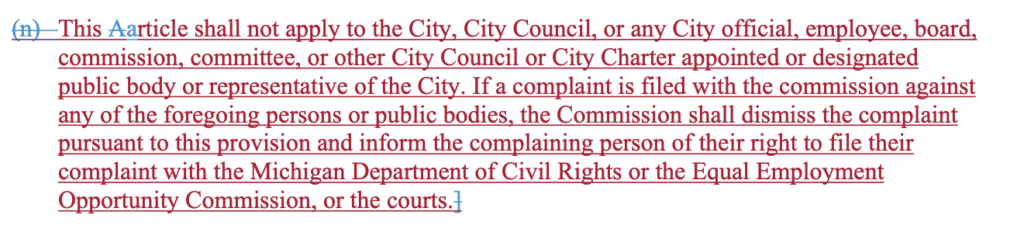
Previously, Councilmember Mark Meadows told East Lansing Info he asked city attorneys to review the ordinance because he heard the commission planned to order the city to pay restitution, an ability he does not believe the commission can legally possess. However, at Monday’s meeting, most of the concerns were about other changes to the ordinance, like stripping investigatory powers and exempting city employees from complaint reviews that can be done by the HRC.
The discussion about the proposed changes lasted so long on Monday, the commission opted to schedule another meeting at 6 p.m. Wednesday at the Hannah Community Center to continue the discussion. The City Council could adopt the ordinance changes at its June 16 meeting.
At the May 26 City Council meeting, City Attorney Steven Joppich presented the changes to the ordinance. He used an attorney general’s opinion from 1978 as the foundation for why changes are needed regarding the commission’s abilities. Further, he explained to the council that if the HRC were to order restitution, that would be an exercise of judicial powers that the commission does not have.
Despite the city attorney’s stated position, HRC members and community members feel the changes are retaliation for investigating complaints about the police department.
Nadia Sellers, the mother of one of the men pepper-sprayed, addressed the HRC at Monday’s meeting and said she feels the complaints are what got the HRC to the position it is in with the city.
“This is retaliation and I wonder if their complaints would’ve been denied and the findings in favor of the city and not against it, would they be challenging your ordinance?” Sellers said.
Without the ability to review complaints against the city, the HRC would send complaints lodged against any city employee or city entity to the Michigan Department of Civil Rights, or MDCR. Many community members are concerned about the implications of reducing the power of a local human rights commission.
Sellers said the MDCR receives thousands of complaints because it covers the entire state of Michigan and investigations are a lengthy process. She also referenced documents related to the MDCR investigation of the incident involving her son that show the city’s attorneys highlighted that the HRC can review complaints, a response she said is hypocritical with the city now proposing major changes.
“This is a small community, you [HRC] can handle it right here – that’s what your attorney told the MDCR,” Sellers said. “How great this body is, and then right behind closed doors you [attorney] go back and tell them [HRC] don’t investigate those complaints.
Tashmica Torok questioned if city leaders know how complicated the MDCR investigation process is.
“When people say, ‘you can just go to the MDCR,’ my question is how many of you, how many of our City Council leaders have actually tried to call and make a complaint to the MDCR?” Torok said. “I have, and I want you to know it is not simple … it is not easy.”
Torok said MDCR investigations can take a long time to wrap up, the MDCR system is difficult to navigate and the MDCR does not offer the same opportunity to speak in person like, the HRC does.
“I want to underscore how quickly your complaint can be denied [at MDCR] without any conversation …” Torok said. “Their investigation is very limited to who’s going to pick up the phone when that state worker makes a phone call; if it doesn’t happen, it gets denied, so I think having a local HRC is super important.”
Commissioner Rebecca Kasen added that the MDCR does not recognize student status as a protected class, but the HRC ordinance does. So, if a student feels their rights are violated by a city employee, it’s unclear where they would be able to file a complaint.
Abbie Tykocki spoke out about how she experienced sexual discrimination working for another municipality and said she wishes there was a body such as the HRC where she could have filed a complaint.
“It was unfounded, but that didn’t make my lived reality any less real and painful and awful,” Tykocki said. “… The suggested changes to the HRC ordinance that city employees cannot bring a complaint to this body is a horrific idea.”
A common theme throughout the meeting was that everyone — commissioners and community members — had questions but no one seemed to have any answers.
“We’ve never had an explanation from the lawyer that wrote it, we’ve never had an explanation from whoever requested it being written … ” Chair Karen Hoene said. “Nothing has been explained to us, nothing has been clarified to us … we [HRC] were barely notified that this [proposed changes] was even happening.”
Kasen added, “I know that the city attorney would like to say, ‘well, we [HRC] had the opportunity to go into closed session,’ this body has made it very, very clear that unless there is a true reason to go into closed session, we want transparency. And explaining to us how the ordinance will be implemented is not confidential, that should be public knowledge.”