

Rick Rapaport Helped Build Pride at MSU—Then AIDS Took His Life
Rick Rapaport was the All-American boy: an academic, captain of his wrestling team and always exuding charisma.
He brushed shoulders with heroes, organized community change and would have done so much more had he not become one of the Lansing area’s first AIDS deaths in 1985 at just 31 years old.
Becky Stimson, a former classmate, talks of Rapaport as if he just stepped out of the room.
“He was the big man on campus,” she said in a phone interview. “He was big — he was the center of the football team, and he was a heavyweight wrestler, and a really good wrestler.”
Stimson and her girlfriends followed Lansing Eastern High School’s wrestling team with a Beatlemania-like devotion.
“We went to the junior prom together, if that counts,” she remembered. “I wouldn’t refer to myself as a girlfriend, although other people might have said that. But it wasn’t like that.”
One wrestling season, Rapaport’s hopes of winning a wrestling state championship were dashed by an injury, but his friend Alexander Beal went on to finish third in the state.
“Rick was such a magnanimous person,” Beal reminisced in an interview with East Lansing Info. “Even though he was injured, he would introduce me everywhere we went and tell people about me. He was generous of spirit—just the most generous person.
“He was like a scholar-athlete before the term ‘scholar-athlete’ ever existed. A star football player, but also academically gifted.”
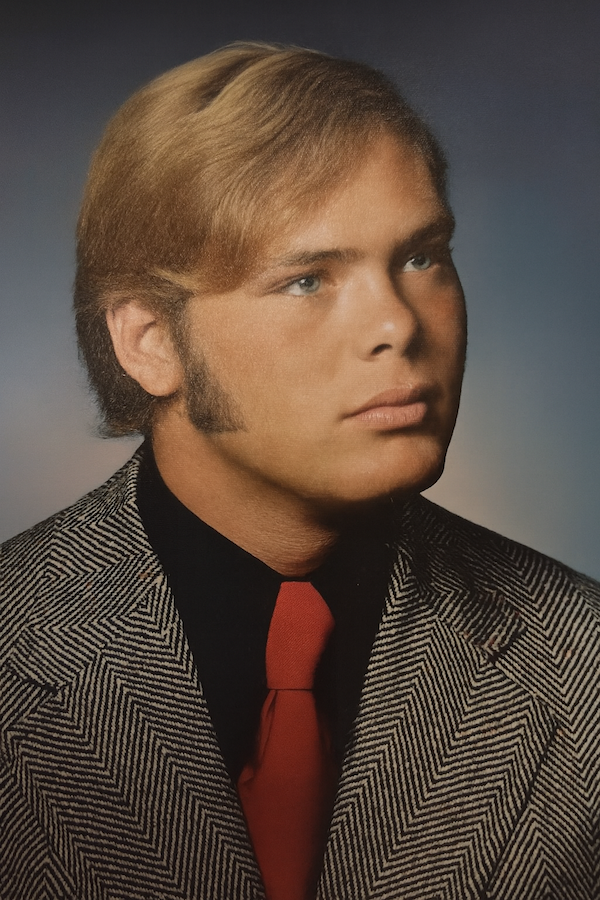
Rapaport graduated high school in 1972 and didn’t seem to be tied to any particular plan or prescription for life. When he didn’t find what he was looking for at the University of Michigan, he returned home and drove a bus for the Michigan School for the Blind in Lansing, also helping to coach the school’s wrestling team. He fell into a relationship with a woman and they, along with her son, moved to Arizona, where Rapaport began working at a small newspaper. When that relationship fizzled, he moved to New York City.
Looking back, Stimson believes Rapaport needed time away from those he knew and his commitments to act on his long-simmering feelings. It’s a period of time that Rapaport described in a letter he wrote to his family for Christmas 1978, a letter that was subsequently published in 1983’s Coming Out to Parents: A Two-way Survival Guide for Lesbians and Gay Men and Their Parents by Mary V. Borhek. Rapaport wrote about the relationship that ended and pieces of himself he kept hidden.
“For some reason, I’d always assumed that the love of the Right Woman would ‘mature’ me out of my ‘aberrent’ feelings and so had never experienced relating to men other than in rather narrowly defined ways — ways acceptable in our homophobic society. When, after a year of various degrees of intimacy with [my ex-girlfriend] — most of it wonderful, all of it satisfactory — I still found my eye wandering and my heart wondering, I could lie to her no longer. Nor could I lie to myself. So I told her then what I am telling you now. After I left her and pursued the only thing I really know: that is, how I feel.”
Rapaport goes on to write that he had felt an attraction to men that he had hidden for 17 years. He wrote about his image and how others might perceive him.
“Whether it be enhanced or diminished in the eyes of any particular person is of less concern to me than this,” he wrote. “I have never felt clearer, more honest, more self-directed, and more confident.”

Rapaport came out to friends around this time, too.
“I didn’t take it very well at first,” Beal said. “He had been super popular and this big man on campus. But again, he was very forgiving.”
Stimson was in graduate school in Wisconsin when Rapaport called her, asking to meet in Chicago. She thinks it was in 1977 or 1978. It was there that he would tell her he was gay.
“It explained everything,” she said. “There had been confusion because we were close, but not romantically. When he told me, it all made sense. In a letter he later wrote, he said my response was as if he’d said, ‘Please pass the mashed potatoes.’ That’s exactly how it felt.”
Rapaport didn’t have any genuine partners, Stimson said. During his time in New York City, he finally had an opportunity to live as an openly gay man. It was several years before anyone knew AIDS existed and would take the lives of more than 100,000 Americans in the 1980s alone.
In the early 1980s, Rapaport moved back to his hometown to enroll at Michigan State University and pursue a journalism degree. He reported for The State News, MSU’s student newspaper, and was pivotal in the creation of Gay Pride Week at MSU. He also produced four one-hour documentaries, Lesbians and Gay Men: The 80s. The episodes dealt with real issues homosexuals were dealing with: coming out, finding community, and acceptance.
During this time, Rapaport worked as a writer and researcher for Robert L. Green, a legendary local figure who desegregated the East Lansing housing market and was an urban planning faculty member at MSU. After completing his degree, he continued working for Green in Washington, D.C.
“I knew Rick was gay, but that was not a big issue with me,” Green said in a phone interview with ELi earlier this year. “The issue with me was fairness and equity. He was a person who was very fair. He was always very generous.
“If you were fair to people and treated them right, that was my concern.”

By all accounts, Rapaport had encyclopedic knowledge and an endless collection of words. His brother remembers a business card he had identifying him as a “wordsmith.”
“Before the internet, access to information was everything,” Beal said. “Rick had this massive collection of magazines and books, and he cross-indexed everything. He really understood the value of information.”
After his work in D.C., Rapaport moved back to Michigan, buying a building on Michigan Avenue with the intention of opening a bookstore and living above it. His brother Ross remembers him coming home for Thanksgiving in 1984 and noticing that he was not well. He experienced headaches and vision issues.
After seeing Dr. Peter Gulick at Sparrow Hospital in Lansing, Gulick sent Rapaport to the Cleveland Clinic for treatment. Gulick had previously worked with HIV/AIDS patients at the Cleveland Clinic.
“I was designated the person to take care of HIV patients because no one else wanted to do it,” Gulick told ELi in a phone interview. “They were afraid. Since I had experience from a center that treated HIV, I became the one doing all the work.
There was little doctors could do for AIDS patients at the time. Gulick explained that he could track the progression from HIV to AIDS, but there was no cure. When patients developed AIDS, their immune systems couldn’t fight off new infections.
Rapaport developed one of those infections, toxoplasmosis, which causes lesions to develop on the brain. At the time, it meant patients had a year — two at most — to survive.
Gulick said it was a time when people, including doctors and nurses, refused to touch patients with AIDS.
“I learned a lot from treating these patients,” he said. “Men who had sex with men would come in and ask me, ‘Are you going to take care of me?’ They were afraid that because they were gay, I wouldn’t want to treat them.
“I’d tell them, ‘Of course I’m going to take care of you.’ The stigma was intense. The same thing happened with Black patients. They would ask me if I was going to give them good care. I couldn’t believe they even had to ask that. They felt dirty. Nobody wanted to touch them or even look at them.”

Gulick said he made a point to start hugging his patients, showing he wasn’t afraid to touch them.
“That became something they looked forward to,” he said. “They wanted that hug because it showed them they weren’t lepers.”
Treating the patients with AIDS took a toll on Gulick who became depressed with no colleagues to confer with who were dealing with the same thing. He told ELi that a particularly difficult part of the experience was informing patients they had HIV/AIDS, knowing there wasn’t a cure.
“It was very difficult,” he said. “Most patients were young men in their 30s. I’m also a board-certified oncologist, so I had experience discussing death and dying. But with HIV, it was different. Cancer patients might go into remission. HIV was a death sentence then. I tried to be realistic but also give hope — talking about future drugs and treatments — so they wouldn’t completely lose hope.”
But he refused to give them timelines.
“I’m not God,” he said. “Sometimes patients surprise you. All we could do was monitor T-cells and use antibiotics to delay infections.”
Forty years later, Gulick easily recalls treating Rapaport, mostly because of the family that surrounded him during his illness and final days. Gulick said many of his patients were abandoned by their families.
“I’ll never forget how good they were to him, especially his mother,” he said. “That’s why I can still see his face so clearly today. She was just so supportive. Honestly, she helped me, too, because I was dealing with a lot of depression at the time. I couldn’t help this young man. Normally, you can treat people and cure them, but here I was completely helpless. She supported me through that. That’s what I remember most about Rick—his family.”
Rapaport died during the annual MSU Pride Week he helped develop years earlier. His brother Ross remembers that he was on a respirator and no longer conscious.
“Mom was there virtually all the time,” he said. “She stepped away from the room for a moment and when she came back, he had passed away.”
“I told him I was there and touched his wrist,” Stimson said. “His skin vibrated — he knew I was there. That was goodbye.
“He never expressed regret,” she continued. “That wasn’t his nature. He was matter-of-fact, lived life fully, had big appetites. I don’t think he would’ve done anything differently.”
Gulick’s work didn’t stop at the hospital door. He saw young men dying without family, support systems or legal protections. He helped develop both the Lansing Area AIDS Network and the Lansing Association for Human Rights. He remains at the forefront of the fight against HIV/AIDS today.
In 1994, Highly Active Antiretroviral Therapy, or HAART, arrived on the scene, a treatment Gulick called “the Lazarus effect” because it “brought people back from the dead.” HAART prevents the virus from progressing as rapidly, turning it into a chronic condition.
And the toxoplasmosis that Rapaport was infected with?
Gulick said it can be treated now and he has patients who survived it years ago and are now living healthy lives.
In 2006, the first single-tablet regiment was introduced, he said, and now simple regular injections keep the disease at bay.
For those with access to the drugs, a long, healthy life with HIV is possible.
Kristina Schmidgal, Executive Director of the Lansing Area AIDS Network, explained the organization has evolved since it was created in the 1980s. Then, it largely supported those destined to die of the disease.
“In the past we focused just on HIV testing,” she said, “but now we’re realizing that people want to know their status for other conditions as well. [We offer] mental health services to individuals living with HIV, as well as to the wider LGBTQIA+ community. We also have medical case management services. That includes a food pantry, help with transportation, insurance, housing, and utility assistance. We don’t provide medical services directly in our office, but we offer wraparound services to help people get what they need so they’re able to go to the doctor, get medication, and take it successfully.”
There were more than 18,000 people in Michigan living with HIV/AIDS as of 2024, Schmidgal said. If afforded the right healthcare and support, they can live long, healthy lives.
It’s an opportunity Rapaport didn’t have in 1985.
The people who knew and loved Rick Rapaport can’t stop talking about him. After an initial interview, Beal called ELi back, excitedly recalling a song Rapaport had written when he was at the University of Michigan, singing it at a performance of Beal’s and “stealing the show.”
“This is another thing about what an amazing person Rick was,” he said. “So multi-talented. I just wanted to share that.”
“He had vision and purpose,” Ross said of his brother. “He wanted to make the world better. He was bright, creative, and committed to justice.”
“He still comes up in conversation,” Stimson said. “He mattered to people.”
Rapaport concluded his 1978 letter to his family with words that could also sum up his brief 31 years.
“My memories of 1978,” he wrote, “…are too many, too complex, too extreme, and too personal to recount here. But I’ll tell anybody anything they’re willing to hear with an open mind. I love you all and would like to know you. I welcome you to know and love me.
“There is much work for me to do, and a changed, freer person goes about the tasks.”