
When East Lansing Was Dry
Eighteen-year-old George Brookover was cruising around town with three friends in the summer of 1968. It was the weekend, it was warm, and they were counting down the days until they could start the next chapter of their lives.
In the Glencairn neighborhood—just a block or two from where his law office would eventually be—a police car clocked them. More than 50 years later, Brookover is the mayor of East Lansing. He doesn’t recall what prompted ELPD to pull him and his friends over, but the officer would discover that the young men were traveling with contraband that was illegal in the city: alcohol.
Prohibited by the original 1908 city charter, alcohol could not be sold, purchased or consumed within city limits.
“He makes all of us get out of the car and pour all of it out onto the street,” the mayor recounted in an interview with ELi.
“He gave [me] a ticket for minor in possession and I immediately headed to a do-it-yourself car wash. The smell was all over.”
“I was leaving for Cornell [University] in six weeks,” he said. “I wasn’t telling my parents. I go in [to the court], plead guilty, and pay a fine. Then, I keep my mouth shut.”
Brookover said that his parents didn’t find out about the infraction until the night before their son departed for college.

“We were sitting around the table,” Brookover said, “and mom and dad start talking about this vote [to allow the sale of alcohol in East Lansing]. Dad started talking about how students still won’t be able to get alcohol [if voters approve the initiative].
“Really dad?” the young Brookover asked before spilling the secret about his own run-in with the law. “Mom started laughing and dad was just silent. The next morning, I got… out of there. The drinking age in New York was 18.”
The United States was experiencing growing pains in 1968 and East Lansing was no different. The question was whether the city would embrace modernity and a growing downtown. Developers from Ann Arbor were proposing a project that would drag the small college town into the future—kicking and screaming, if need be.
Jack Stegeman and Robert Weaver of Ann Arbor (with Roland Ledebuhr of East Lansing representing their local real estate interests) were proposing a behemoth $8 million structure, including a 17-story hotel and a nine story apartment building. They wanted the area bound by Abbot, Albert, Grove, and Linden Road according to reporting by the East Lansing Towne Courier.
There was just one catch: they wanted alcohol sales to be allowed. The city had recently considered such a change twice before.
In 1958, the Marble School District had been annexed by East Lansing. The Lansing State Journal reported that the addition housed a tavern and liquor store. The East Lansing Chamber of Commerce led the campaign to repeal the restrictions on establishment of taverns, liquor stores, and alcohol take out operations. However, the religious community coalesced their support behind the opposition, forming the Better East Lansing Committee.
Voters rejected the proposal by a three to two margin. The tavern and liquor store in annexed Marble closed.
1962 saw the same result, again with religious leaders and their flocks mounting the opposition. Rev. Wilson Tennant of University United Methodist Church chaired the reformed Better East Lansing Committee. 60 years later, his daughter spoke with ELi about this time in his life.
“Our dad got involved in this campaign out of his concern for the young students at MSU,” CarolJean Tennant said. “In 1957, he had founded a Methodist Church on the edge of the campus, now called University United Methodist Church, and students made up a large part of his congregation. He believed that many of them would be influenced negatively by easy access to alcohol when they were away from home for the first time and trying to find their way in life. It is kind of ironic when you consider that MSU has become quite well known as a hard drinking party campus, and that was what my dad was concerned about.”
Again, the 1962 proposal failed by roughly the same margin as in 1958.
Would developer-backed 1968 effort be any different? It would if the City Council and the local Chambers of Commerce had their way.
The bodies took a much more hands-on approach than they had in the previous campaigns. According to reporting at the time by the Lansing State Journal, it originated with the council asking City Attorney Daniel Learned to look into the feasibility of a ballot initiative to allow sale of liquor.
“We’ve been saying we can’t attract top development without liquor,” said City Manager John M. Patriarche at the time according to reporting by the East Lansing Towne Courier. “But it can be controlled in certain zones so it is no detriment to churches or schools.”
City leaders had evolved in perspective, as well. Marc Thomas, grandson of then Mayor Gordon L. Thomas spoke with ELi about this new generation of civil servants.
“Before 1960,” he said, “the council was mostly made up of local business people, the dry cleaners and grocers. It was really insular. They didn’t look outside of East Lansing very much and they [had] a strong connection to what the historians would call temperance. East Lansing was really stuck in a prohibition mentality, really, until the 1960s. The people elected to council were not so much the local business people anymore, but they started [to be] represented more by university and state government leaders like my grandfather.
“My grandfather was probably one of the first people who really started this trend of the city supporting developers.”
In July of 1968, the City Council sent a letter to residents, encouraging them to vote in favor of the amendment. The newly formed East Lansing Chamber of Commerce found a man with new ideas to lead the charge.
Leland Bassett was in his early 20s and had just earned his degree from MSU. He grew up in the world of politics with his father serving in the Michigan House.

“I wound up campaigning door-to-door,” he said in an interview with ELi, “and I noticed that individual people had different responses and meanings for the same message, and I wanted to understand why. I was a little policy wonk.”
This interest led him to stay at MSU and earn a graduate degree exploring “this new field of human communication, behavioral science, data-driven empirical body of knowledge to understand the why in communication.” But it was a relatively new program.
“They didn’t know what the hell to do with me,” he chuckled. But with his desire to know why people made the decisions they did and his early experience in politics, Bassett was hired as the East Lansing Chamber of Commerce’s part time Executive Director.
“It was my first paid political campaign,” he said. “It was the first campaign that actually was based on a strategic communication management approach. And David Berlo, the Chairman of the [MSU] Department of Communication and the father of the field was a mentor, and he was a side consultant for us. We ran an entirely different kind of campaign from the community’s point of view, including research, knocking on every single door.”
To truly overcome the barriers in the city charter, East Lansing needed to permit alcohol to be sold by the glass. Unlike the other question, state law said that this initiative needed to originate with a petition from voters. Led by Bassett’s chamber, 2,900 signatures were needed to place the question on the ballot — 4,200 signatures were collected.
Bassett discovered that the two liquor stores to sell the largest volume in the state of Michigan but outside of Metro Detroit were Oades Party Store to the west of East Lansing and Coral Gables to the east.
“We were dealing with tremendous hypocrisy,” he said. “What we found in our research was that we appealed to the resident’s desire of stopping the hypocrisy and creating the conditions so they could control [alcohol] in the community.
“There was a new way of approaching communication and political campaigns…there was a behavioral science that wasn’t 100% because we’re dealing with humans, but [it] gave us a better ability to understand and better predict and better prescribe communication.
The chamber of commerce’s efforts were supported by a community group that had borrowed its name from the opposition of the earlier two campaigns: the Better East Lansing Committee.
In a tit-for-tat move, the 1968 opposition group dubbed their own efforts as the Best for East Lansing Committee. While their numbers were smaller than previous iterations, residents who wanted East Lansing to remain dry were undeniably just as passionate as their counterparts.
“Why are the mayor and members of the city council falling over themselves to oblige these promoters,” Larry Cushion wrote in a letter to the editor of the East Lansing Towne Courier. “We, as citizens, are being asked to vote in favor of liquor because an $8 million dollar hotel will be built. What assurance do we have that such will be the case. Who is to finance such a building? Who is to operate such a building? We are asked to legalize the sale of liquor in exchange for a pig in the poke.”
Earle D. Harrison was more blunt in his opposition.
“He can look like an angel but he works for the devil,” he wrote in a letter to the editor. “He wants not only our money but our brains and souls, our finest people, young and old. His real name is Ethyl Alcohol.”
And while Bassett and his team were going door-to-door, the “Best” committee held informational sessions with guest speakers from Michigan Department of Corrections and the neighboring university to speak about the dangers of alcohol.
To some, however, their methods came across as more shame-inducing.
“In this respect,” wrote Robert Miller in a letter to the editor, “the opponents of the two liquor propositions are doing their utmost to mislead the people of East Lansing. Raw emotion is their chief weapon, as it was in 1962, when outside liquor interests protected their own economic well-being by suggesting, through well-financed scare tactics, that all our children will be run down by drunk drivers if liquor were approved.”
Bassett didn’t spend time trying to convince those who vehemently disagreed with him. This campaign also taught him not to waste time and money on the “no” voters because there was little chance of convincing them.
“You put your efforts into reinforcing the yes voters and getting them to the polls,” he said. “And then trying to provide informational, educational appeals [to] the middle group and to bring them over. We had a lot of volunteers. We set up a war room with telephones.”
The war room was in a hotel on Saginaw Street. Bassett remembers the walls were adorned with charts and posters from the campaign and that this was where they held a watch party, waiting for results on November 5, 1968.
It was also where they celebrated their win when it became clear that their campaign had succeeded.
The campaign to keep East Lansing dry cost $500, donated entirely by residents Robert Snyder, R.E. Anderson, Ernest L.V. Shelly, and George and Martha Wallace.
The winning side, however, was funded entirely by Stegeman, the developer who wanted to build the grand hotel and spaces that would bring East Lansing into the new era. He spent $23,915.
But Stegeman’s investment would provide a massive return to the city. The East Lansing Chamber of Commerce boasted that the project would bring $216,000 in tax revenue each year. And George Burke Jr. with the Michigan Liquor Control Commission told the East Lansing Towne Courier that the revised city charter meant that East Lansing would be eligible for up to 20 on-premise liquor licenses.
But the magnificent structure was never built. ELi could find no definitive source to explain why, and Stegeman died in 2011 so he couldn’t be reached for comment.
Bassett believes it might have been just bad timing.
“The Lyndon Johnson ‘guns and butter’ budget finally caught up with us,” he said, referencing the difficulty the nation had funding both the war in Vietnam and Johnson’s ‘Great Society’ of social programming.
“The nation went into an economic downturn. That particular hotel never got built. But then you had the ability to have beer, wine, and liquor in East Lansing.”
Twenty years later, the Marriott was built in East Lansing, partially on the spot where Stegeman’s hotel would have occupied. But it wasn’t the grand structure in size or scope of which many had dreamed.
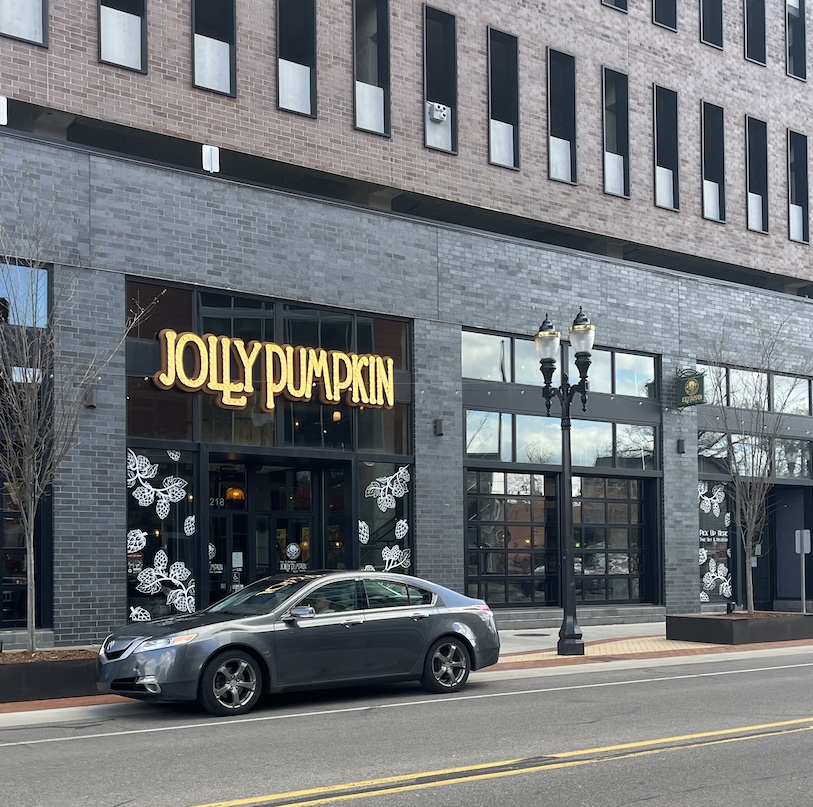
Today, alcohol is a major industry in East Lansing. And more than 55 years after the vote to permit alcohol sales in East Lansing, there is still controversy around just how accessible alcohol should be. In recent months, City Council has had discussions about if there are too many establishments selling alcohol in the city.