
Girls Math and Science Day Inspires Future STEM Leaders in Mid-Michigan
While today Ella Morrow is a Michigan State University PhD student who conducts unique research on electric fish, she remembers being discouraged from pursuing science-related careers growing up, being told those fields aren’t for women.
“It was kind of just that kind of cacophony over and over again, and fortunately, I’m a very spiteful person, and I was like ‘well, just watch me do it,’” Morrow said.
Despite positive momentum in recent decades, research shows that in 2019 women still made up just 27% of those in Science, Technology, Engineering and Mathematics, or STEM, related fields.
Graduate Women In Science, a national nonprofit organization founded in 1921, aims to change that. The organization has three main goals: lead, connect and empower. The organization works to empower women in STEM by providing grants, networking opportunities, professional development and more.
“There’s obviously a lot of folks that have helped us get to where we are today and I think there’s still a lot of work to be done in order to get folks engaged in science,” said Emily Bolger, Graduate Women in Science mid-Michigan president.
Along with helping its members progress in their fields, the local chapter strives to inspire young generations through community outreach and educational events, including the chapter’s annual Girls Math and Science Day.
While the event is focused on girls, anyone who is middle school aged can attend. This year’s event was held March 14, and about 150 students attended, including 43 who traveled roughly six hours round trip from Gaylord. Upon registering for the event, students fill out a form and pick two topics of interest from math, physics, chemistry and biology.
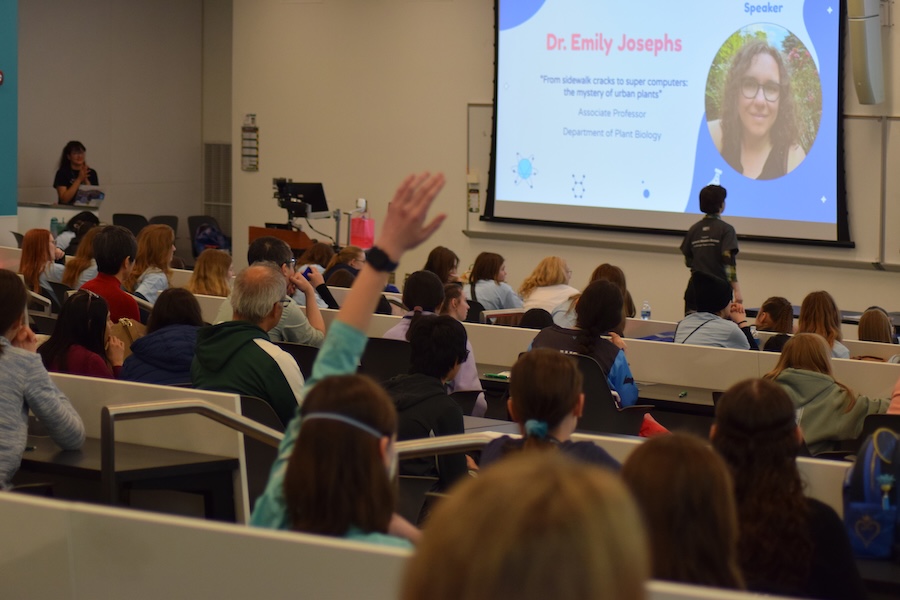
A keynote speaker who talks about their research and career trajectory in STEM kicks off Girls Math and Science Day, followed by a Q&A. Students are then divided; half visit specialized rooms where presenters discuss and demonstrate the subjects the students previously selected on the interest form for 25 to 30 minutes.
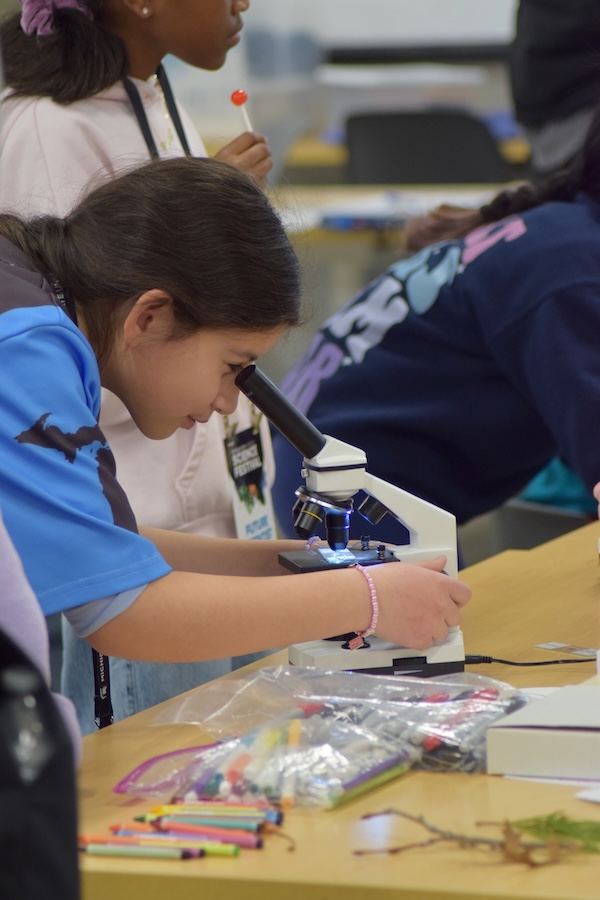
The other group visits two science fair rooms where tables are set up with one to two-minute activities, such as a coding activity, learning how AI works or uncovering fossils buried in sand.
The science fair presenters are encouraged to build an activity based on their research. Brynn Roy, a PhD student studying computational mathematics, science and engineering at MSU, used water and lasers to demonstrate the work she does in medical imaging at the event one year.
The two groups come together afterwards for a snack and hear from a speaker about nutrition before splitting up again to visit the other room. At the end of the day, scavenger hunt prizes, goodie bags with science kits, and an MSU staple Dairy Store ice cream are given out.
The event typically costs between $6,000 and $7,000 to host, and federal funding cuts presented hurdles to raising money for the 2026 Girls Math and Science Day. MSU departments were primary donors to the event in past years, but saw budget cuts and new spending restrictions implemented in 2025.
“This event is extremely expensive … funding has become more and more scarce at MSU to the departments that we solicit for money,” said Roy, who serves as the fundraising and logistics committee chair for the event.
Spending restrictions prevented MSU departments from giving directly to the event as they have in past years. To adapt, event organizers made an Amazon wishlist with items and gift cards to support the event. Departments were allowed to support the event through the Amazon wishlist because it gave clear indication of where money was being spent.
“It’s not anyone’s fault, really, I would say at the MSU level even that these funding restrictions have come through, so when I say that we’ve had to get creative, I’m still even thankful of the fact that we have the ability to do that,” Roy said.
With the changes to spending at MSU, event organizers will begin fundraising earlier for next year’s event, Roy said.
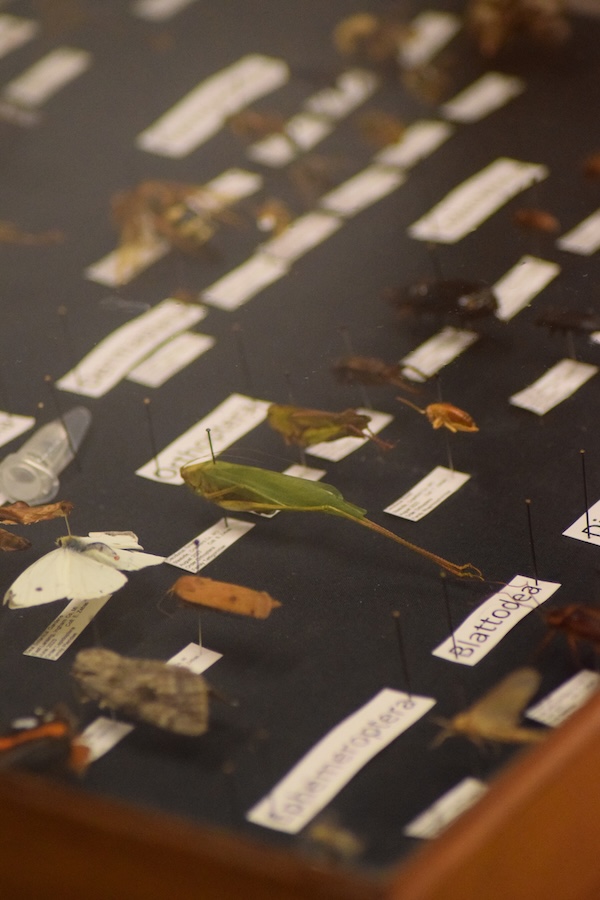
Girls Math and Science Day is a vital event, noted Morrow, who serves as the event’s presenters and volunteers committee chair. It allows middle school aged girls to interact with different types of science and see older women who have found success in their field.
Morrow knows how important representation can be. She initially pursued a career in electrical engineering, but after completing her degree at Ivy Tech Community College in Indiana, she chose not to pursue electrical engineering further after being the only woman in her program.
“It was really isolating and kind of terrifying at times,” Morrow said.
“Part of why I love GMSD [Girls Math and Science Day] so much is because I never had anything like that as a girl, I didn’t have any scientific role models,” Morrow said. “I still have little sisters back in my hometown and I want them to know that … they have the capability to do whatever they want to, and I feel like that starts with seeing people like you in the positions that you dream of.”
This story was updated to correct the number of students who traveled from Gaylord.