
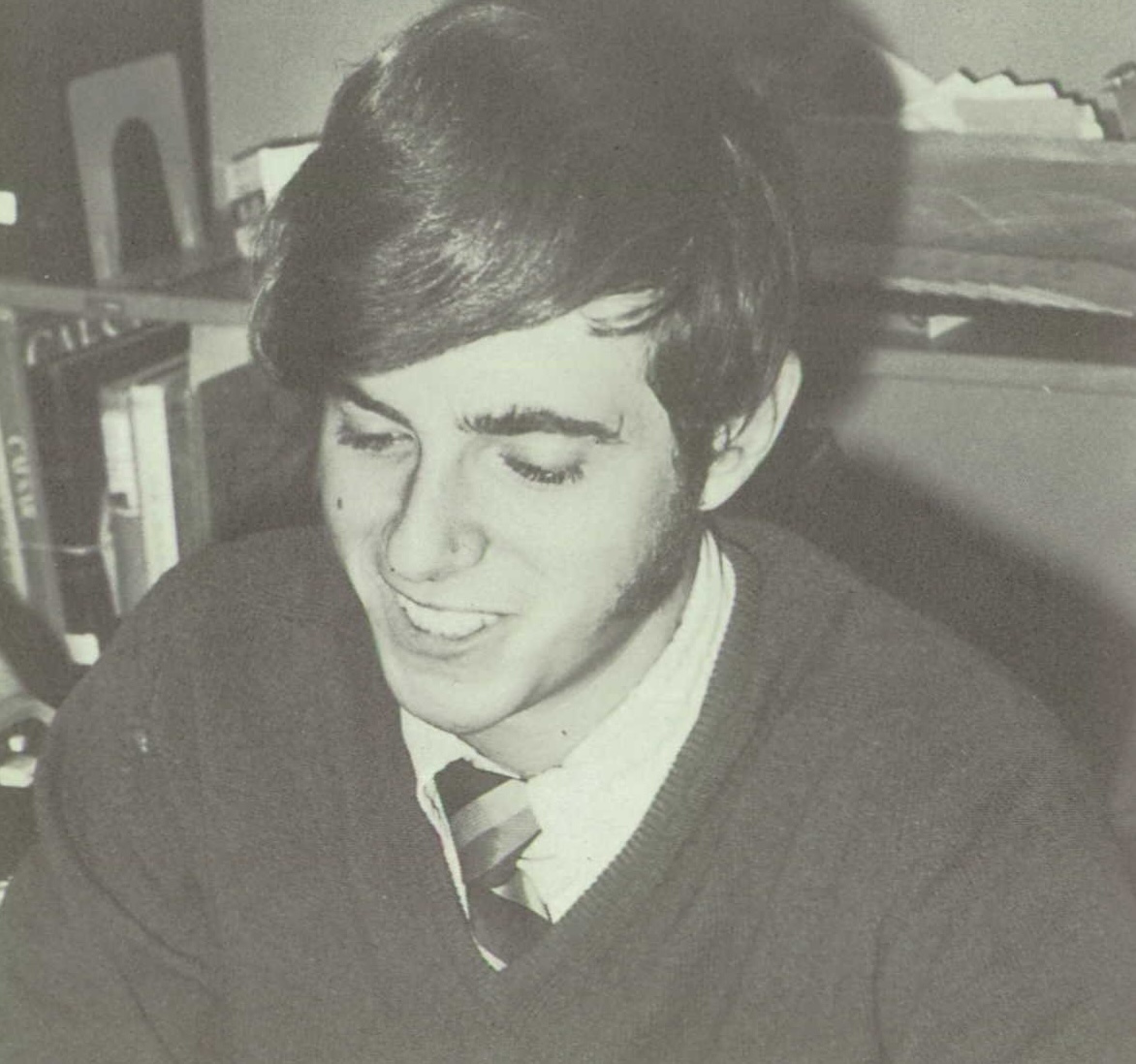
David Balas’ Bold and Understated Leadership
David Balas won election to the East Lansing City Council in 1983.
It had been only five years since Harvey Milk, the pioneering San Francisco politician and gay rights activist, had been assassinated in city hall. Just two years earlier, The New York Times first reported on a “rare cancer” affecting gay men. Another two years would pass before middle America would be shocked to learn that legendary Hollywood leading man Rock Hudson was gay and dying of AIDS.
This was the backdrop against which Balas became East Lansing’s first openly gay city council member. He served in this capacity from 1983 to 1995, never trying to mask who he was to win favor with his constituents.
“He never ran as a gay candidate [but] he never hid anything either,” his husband Jim Sellman recalled in a phone interview with ELi. “If someone asked [about his sexuality], he would not deny it.”
Sellman said that Balas included him in all the city functions, fundraisers and benefits that politicians attend, leaving no doubt that he was Balas’ partner.
“We were always there together,” Sellman said. “I knew how important it was to him because I felt that he truly did make a difference in what he did, and I was very proud of that.”
The two met in 1982 and would remain together for 37 and a half years until Balas’ death in 2019. They married in 2015 shortly after marriage equality was affirmed by the U.S. Supreme Court.
“He was open-minded, generous and very ambitious,” Sellman said.

Mark Meadows met Balas in 1979 when they both worked in the state attorney general’s office.
“David was a really personable guy and he was an excellent attorney,” Meadows recalled 47 years later. He said he campaigned door-to-door for Balas during his initial 1983 campaign.
Balas was born and raised in southeast Michigan and had attended law school in Ohio. Meadows believes he was drawn to East Lansing because of its progressive politics.
“The movement toward acceptance of [gay rights] began with the Stonewall riots [in 1969],” he said. “Then East Lansing was the first in the nation to provide civil rights guarantees for people based on sexual orientation, and that was in 1972, before David was hired by the [attorney general’s] office and presumably moved to East Lansing.”
With a community that accepted him and a partner by his side, Balas ran for and won a seat on the City Council. Sellman said that he took his responsibility as a representative of the people seriously, making every effort to connect with voters.
“If someone came to a council meeting and stood up and voiced opposition to something, an issue that the council was discussing,” he said, “probably the next day after the meeting, David would phone that person and set up a meeting. And he would go to their house and he would talk to that person. He wanted to hear their whole side of the story of why they had a dissenting view. And then he would explain his view. And probably more times than not, that person’s mind was changed because he would remain calm and he would listen and he would offer up facts and make people feel comfortable with their opinions, but also feel comfortable with his.”
Meadows said that Balas had three main objectives for his time in service: a no-smoking ordinance, a handgun ordinance and benefits for domestic partners.
Balas introduced the idea of a smoking ban in public spaces early in his career. Ralph Monsma served on City Council from 1979 to 1991 and remembered the fight Balas put up to defend the ban.
“He was a person who was very conscious of doing the right thing,” Monsma said in a phone interview with ELi. “He wasn’t going to get all excited and mean or anything like that about it, but he definitely was looking after the best interests of the community.”
Balas faced organized opposition from the now-defunct National Tobacco Institute and from restaurant and bar owners who feared that patrons would choose establishments in neighboring communities that didn’t have restrictions.
Karen Krzanowski was the program director of the American Lung Association of Michigan at the time and became friends with Balas while working with him to pass the ordinance.
She said these bans were a new public policy being pursued in the 1980s and had been successful in California and Minnesota. East Lansing was the second city to attempt a ban, coming on the heels of Marquette.
“We were having trouble because the Tobacco Institute had a very powerful lobbying force and influence,” Krzanowski told ELi. “While we continued to try and pass [something] at the state level, we saw that there were cities in other states having success. We approached several municipalities and counties too here in Michigan to try and get such ordinances passed.”
She said that Balas was a gentleman, a kind person and service-oriented.
“He really was trying to work for the good of the city of East Lansing,” she said. “With all we have going on in our politics these days and politicians, David was the opposite of that. David was not at all interested in his own needs. He was there for people, for the community, for public health.
“I remember him as just a very, very kind man and the kind of politician that I wish we had more of.”
The council unanimously approved Balas’ ordinance, declaring “smoking a nuisance” and prohibiting “any person from smoking in a public place or in an office workplace.”
Another success Balas saw was the passage of an ordinance requiring new residents applying for a handgun permit to take a safety course.
But something East Lansing wasn’t quite ready for was an ordinance that would have provided domestic partnership benefits to city employees. The council spent at least two years debating the concept, but the body never crossed the finish line and enacted anything during Balas’ time in service.
Sellman said it was just another example of Balas being ahead of his time.
“It wasn’t just gay people that had domestic partners,” he said. “Straight people could have domestic partners. It’s just people that choose to live together and not be married. And at the time, the gay population were domestic partners because marriage wasn’t recognized. And so he explained it that way to people.”
Sellman remembers one particular City Council meeting at which a woman with a male domestic partner spoke. She worked for the city and had experienced a physically abusive relationship in her past.
“She said, ‘I’ll never marry a man again because of that,’” he remembered. “But that still didn’t help people because this was at the tail end of the [initial] AIDS crisis. People were saying that every person with AIDS across the country is going to come and work in East Lansing so they can get health insurance. I mean, people were just being pretty ridiculous.”
But Balas achieved more successes than setbacks during his time on council. Monsma remembered that it was a state grant that Balas applied for that provided an early recycling program for the city. Meadows said that he was instrumental in creating the city’s Crystal Awards and in bringing longtime City Manager Ted Stanton to East Lansing.
“I always think of the period 1980 to 1989 or so as the best years of East Lansing governance,” said Mark Grebner, legendary political consultant and statistician. “Dave was a steady if understated cog in that machine.
“I can’t remember a single issue or event where he disappointed me.”
At the end of three terms, the last of which he served as mayor pro tem, Sellman said that his husband was ready to pass the mantle on to someone else. The two moved to Saugatuck on the west side of the state, built a home and lived the next 24 years together. When Balas received his cancer diagnosis, Sellman cared for him. He was by his side when he died in 2019.
“There was a time I could hardly even say his name without having a meltdown,” Sellman said. “And now I’m to the point where anytime anybody wants to talk about him, I feel honored. I’ll even hear in Saugatuck, where he was very, very well liked, people will say, ‘What would David do?’”
Monsma said that residents can still walk around the city and see the results of Balas’ work, including strategies to keep downtown safe and welcoming.
When asked how Balas should be remembered, Meadows answered easily.
“I think they should remember him as a person who was committed to his community and put his time and his energy toward making it better here,” he said, “particularly in those things that the community identified with: civil rights, the arts, and making this community welcome to anybody who wanted to live here.”