
Commissions Challenge City Attorneys’ Influence on Policymaking, Transparency
More than a year ago, an East Lansing Police Department officer pepper-sprayed two Black men in downtown East Lansing, igniting a still-burning chain of events that has brought broad public backlash.
After Lonnie Smith and Mason Woods were pepper sprayed, the ELPD issued a press release about downtown violence that named both men and said they were charged with crimes related to fighting. The release was extremely unusual, as the men were accused of common misdemeanors and were the only individuals singled out by name. The inclusion became even more eye-raising when the men’s attorney released footage of the incident, which appears to show Smith come from the curb to break up an altercation between Woods and other men in line outside of a restaurant, before the pair were pepper sprayed. Charges against both men were later dropped.
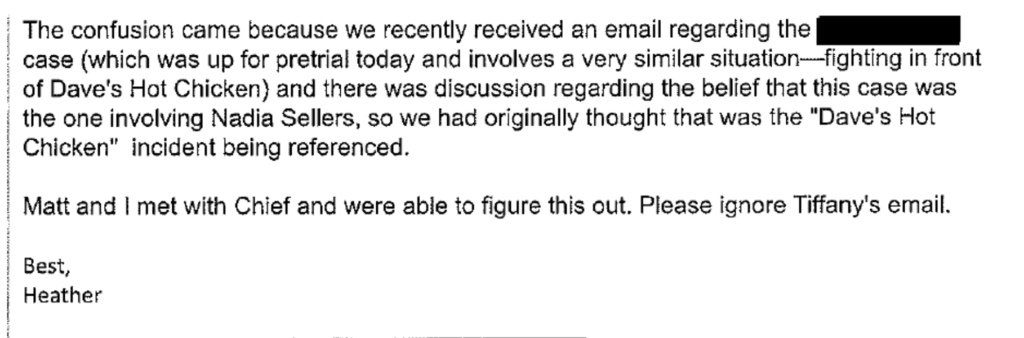
A subsequent series of records requests by East Lansing Info showed that ELPD Chief Jennifer Brown supplied Woods and Smith’s names to be included in the press release and that at one point, the city’s communications consultants believed they were to include another individual arrested for unrelated reasons because he shared a last name with Smith’s mother, Nadia Sellers. For weeks prior to the press release’s publication, Sellers had been speaking critically about the police department at city meetings.
Despite the unusual series of events and substantial public concern generated, the city has communicated very little about the incident or press release. The men filed lawsuits last November, and city officials have declined to comment due to pending litigation. In February, former City Manager Robert Belleman said that because the firm handling the litigation was hired by the city’s insurance company, talking about the matter could jeopardize coverage.
However, this is not the only topic officials have been reluctant to address in public due to litigation, as the city’s volunteer commissions have become increasingly frustrated with city attorneys wanting to communicate during closed-door meetings or in confidential memos.
In 2025, the city switched to Rosati, Schultz, Joppich and Amtsbuechler for most legal services and for the last several months, Carlito Young has served as the primary city attorney.
Tensions between city attorneys and members of city commissions were on full display during meetings for the Human Rights Commission and Police Oversight Commission in October. The commissions are looking to address issues like a surge in police use of force and civil rights protections for residents. However, concerns from city attorneys about legal risks have sparked debates about what conversations should be held in public and how much sway attorneys should have over decisions from elected officials.
East Lansing’s Human Rights Commission thinks stripping investigative powers went beyond legal requirements.
The East Lansing Human Rights Commission, or HRC, investigated complaints Woods and Smith filed, despite city attorneys urging them not to. The body eventually found the men had their civil rights violated and ordered the city to pay each $50,000, retract the press release and apologize, among other things.
The City Council responded by saying the HRC, made up of appointed volunteers, does not have the authority to order restitution, as that is exercising judicial authority. In June, the council moved to amend the ordinance governing the HRC to remove the commission’s ability to review complaints against city employees and complaints that were filed with another investigatory body.
Members openly questioned the city attorney’s office’s involvement in drafting the new rules and the council’s reliance on legal counsel’s opinion. This tension is compounded by city attorneys offering to address concerns only in closed-door meetings or through confidential memos, both of which are protected by attorney-client privilege.
“If any person is overly reliant on what a certain lawyer says without considering what those lawyers’ biases may be, what those lawyers’ incentives may be, and especially if this is happening behind closed doors where the words of those lawyers can’t be vetted publicly, it doesn’t really do us any good,” said commissioner Jonathan Forman, who works as a public defender.
Previously, if a complaint was filed concurrently with an external agency like the MDCR, the commission still maintained its authority to investigate the matter. But now, the commission automatically loses its ability to carry out an investigation if it is filed with another agency, a restriction commissioners took major issue with.
“The city loses its authority to investigate a claim like that, and that seems to me to be swept up in all the changes in a way that wasn’t necessarily the reasons being publicly stated of why this had to be done,” Forman said. “That has nothing to do with a delegation of powers issue.”
Because every agency operates on its own timeframe, commissioners warned that respondents could exploit the new rules, asserting that accused individuals could cooperate just long enough to run out any clocks on alternative local options.
“The City Council has created a very perverse incentive for people who come to our body for help,” Forman said.
With Mayor Pro Tem Chuck Grigsby present at the Oct. 5 HRC meeting as the council’s liaison, Forman asked if the ban on concurrent investigations with MDCR was truly a legal requirement. Grigsby replied that the decision ultimately boiled down to how East Lansing defines commission roles under the city charter.
“This really came down to … do we have [an] investigatory commission dynamic or do we have an advisory one,” Grigsby said.
Forman pushed back, specifically questioning why the HRC must dismiss a complaint if an outside investigation is going on. Grigsby clarified that the choice was made because the MDCR employs professional investigators and experts.
Forman responded, “So that wasn’t a legal issue, it was a policy determination,” explaining that he was trying to understand if the council was advised that they legally needed to make these sweeping changes.
While Forman noted he could see a plausible argument for the city protecting itself against the unlawful delegation of powers, he added, “That doesn’t justify all the changes that were made.”
He, along with other commissioners, sharply questioned the decision to exempt city employees and city contractors from HRC investigations.
During initial May and June City Council meetings, the city attorney stated that exempting city employees was required to comply with the city charter, which mandated that personnel matters are handled internally by the city manager. However, the attorney did not identify why city contractors are included in the exemptions. According to the amended ordinance, complaints involving contractors must now be reviewed by the City Council.
Forman highlighted that while he served on a city committee that conducted a thorough review of the city charter in 2024 and 2025, former City Attorney Tony Chubb never mentioned any concerns regarding conflicts between the charter and the HRC’s powers.
The HRC has spent months trying to get clear answers regarding the amendments, with little success. Chair Tina Farhat said at the meeting that the city attorneys have refused to speak unless the commission entered a closed-session, citing the active litigation.
“They won’t even talk about that in public,” Farhat said. “It becomes a very circular problem because we need some legitimate feedback and advice.”
Commissioner Matthew Boughton highlighted a deeper structural concern regarding the closed sessions. Because city attorneys represent the municipality as a whole, only the City Council has the legal authority to waive attorney-client privilege. In spite of Young previously telling the HRC that the city attorneys represent the commission because it is an extension of Council.
“Anything they tell us we can’t talk about publicly because we are not the client, City Council is,” Boughton said.
Members also pointed out how the proposed amendments were introduced and adopted within a span of just three weeks, despite the commission urging the council to delay the vote until they could provide thoughtful, structured input.
At the Oct. 5 meeting, Grigsby suggested that the HRC extend a formal inquiry to the city attorney regarding the amendments and the exact scope of what the commission can or cannot do.
The recommendation immediately stirred contention.
“The relationship is completely broken with the city attorney,” Commissioner Rebecca Kasen said. “If they tell me the sky is blue I’m going to need 10 articles to prove it … I don’t trust what they have to say.”
Kasen added that State Reps. Penelope Tsernoglou and Julie Brixie recently sent a formal letter to the City Council also urging them to reconsider the restrictive new ordinance.
“Why are we so heavily relying on one law firm … to make all these decisions when we have other attorneys saying basically that they’re wrong,” Kasen said. “She [Tsernoglou] is an elected official as well as an attorney, and if she’s saying that this whole thing should not have happened, I’m more inclined to agree with her than attorneys who are costing the city millions of dollars.”
When Forman asked Grigsby if he believes the City Council would be open to restoring parts of the old ordinance, Grigsby responded, “I think so.”
Boughton questioned who truly has control in the city.
“I also find it very concerning … that your impulse is to defer our conversation to a lawyer instead of having a politically elected representative make policy,” Boughton told Grigsby. “It sounds like you want us to discuss [policy] with your lawyer, but the thing is, lawyers shouldn’t make policy, elected representatives make policies. That does not seem to be what’s happening in the city.”
The Police Oversight Commission wants to have public discussions about a surge in police use of force. Attorneys have concerns.
Just two days after the HRC meeting, the East Lansing Independent Police Oversight Commission, or ELIPOC, expressed similar concerns about the city’s legal counsel.
At its Oct. 7 meeting, the commission formally accepted a use of force report produced by Cedrick Heraux, a sociology and criminal justice professor at Adrian College. Heraux analyzed data provided by the ELPD to review incidents in which force was used in 2025. There were two points from the report the commission focused its discussion on: a more than 50% spike in the number of incidents force was used and that most of the incidents occurred in the downtown area.
In an effort to use the data to spark conversations about potential solutions, ELIPOC Chair Ernest Conerly proposed inviting community stakeholders – including Council Liaison Mark Meadows, Interim City Manager Annette Irwin, DEI Director Elaine Hardy, a representative from the Downtown Development Authority, Brown and a city attorney – to have an open discussion at the Nov. 4 ELIPOC meeting to address the increase in force used downtown.
Young immediately pushed back, advising against a broad public discussion due to legal liabilities.
“You know where my advice is going to lead in a public setting about issues that can affect the city,” Young said. “If we started in a private meeting setting and then … create a plan moving forward, that’s an option … if we do it as an open [meeting] … all it’s going to be is me talking, advising people that we have concerns.”
After commissioners pushed back against holding discussions in closed meetings, Young suggested holding sub-committee meetings to talk about the increase of use of force downtown.
Conerly countered, “I get that there will be things they might not [or] cannot say but it is ludicrous for you to ask us to … hash things behind closed doors. We need to heal, we are a city that is broken, we cannot heal with a subcommittee in closed doors,” adding that a subcommittee framework would not work because all commissioners would likely want to participate.
Young responded, “You saw a study, you don’t like the numbers, you want to discuss it, fine. I have to advise you there are consequences and … if we do it in a certain setting, it’s hard to do because I got two lawsuits pending. I got matters pending, I got issues out there, I can’t ignore my job no matter how much you want to do yours.”
“If that’s the route you want to go, we have heard your opinion, we appreciate it,” Conerly told Young. “But I’m going to respectfully reject it because it’s not okay.”
An ELIPOC subcommittee recently worked with attorneys and ELPD leadership on police use of force policy revisions. These subcommittee meetings were open and noticed.