
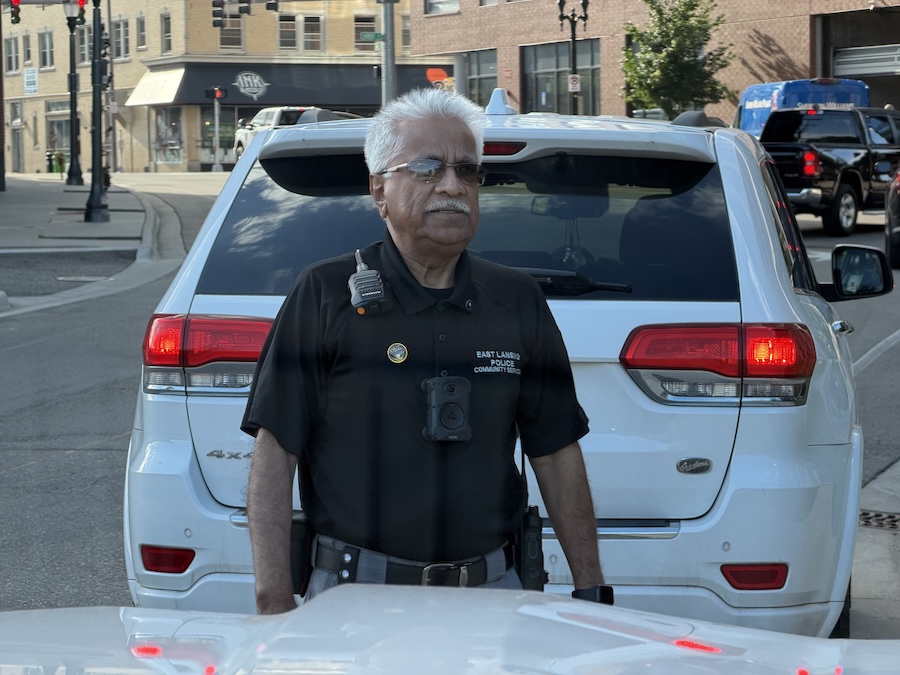
On Patrol With East Lansing’s Parking Enforcers
Parking and Code Enforcement Officer Sharif Tauqi spends much of our four hours together in conversation, laughing easily and often. The stream of chatter is broken only when he spots a car parked where it shouldn’t be.
Earlier this summer, East Lansing Info rode along with PACE Officer Tauqi and his trainee, Alexandra Grabowski, to learn about the department’s efforts to enforce parking rules and other regulations of the city.
Tauqi started his part-time work with PACE two years ago after a 24-year career with East Lansing’s Student Book Store. He is one of eight PACE officers, seven of whom are part-time and one of whom is full-time, according to Supervisor Paul Weidner.
During this particular period, however, Tauqi said only two were working each day.
“Students are gone,” he said. “[But] normally we have two to three.”
Like East Lansing Police Department officers, he is connected with dispatch to field calls from residents who complain about code violations — most often, someone parked where they shouldn’t be.
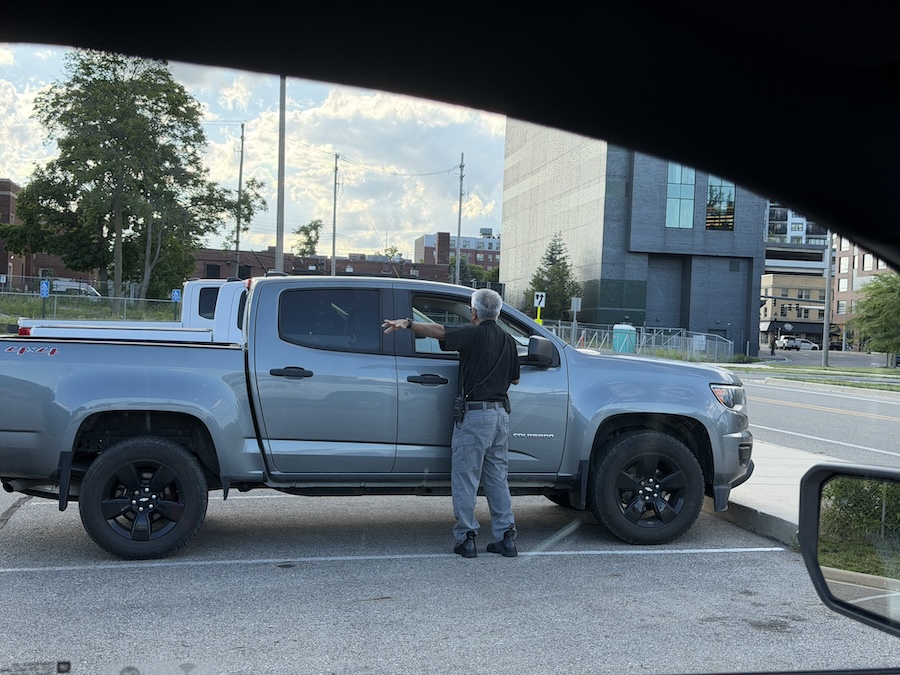
On this particular day, vehicles are illegally parked in two city parking garages. In the Grove Street garage, a large black truck is parked in a compact spot, and Tauqi navigates the narrow path up to the top level. On the way back down, he sees the offending vehicle, and Grabowski hops out to take photos of the oversized vehicle’s license plate and wheels extending far beyond the lines. She prints the ticket from a handheld device and leaves it in an envelope under the windshield wiper.
“Oh, they don’t like us,” he said about the drivers who find tickets on their windshields.
But does anyone ever get combative with the PACE officers?
“Oh yeah,” Tauqi responds while driving behind the East Lansing Target store on Grand River Avenue. “In this alley. That’s why we carry pepper spray.”
He shares a story about a man who parked in the middle of the alley so no other vehicles could get through. While Tauqi was preparing the man’s citation, the man came to his car and started taunting the PACE officer and cursing at him.
“He was trying to be something,” he said. “I called for help and asked for a [police] officer. As soon as he heard the siren, he started running super fast [down] the alley. I thought he was going to hit somebody.”
Tauqi remembered another time when he typed someone’s license plate into the system and saw that the owner was a repeat offender. Legally, he would have had every right to have the vehicle towed. But when the man approached him, Tauqi told him that if he went to City Hall, immediately paid his back tickets and returned with his receipt, he would let him go. Tauqi said the man returned 15 minutes later with a receipt for approximately $1,100 in unpaid citations.
“I’m not heartless,” Tauqi said.
During the ride, he points out a new piece of technology just north of the Grand River Avenue intersection on Abbot Road: a simple metal fixture jutting out of the sidewalk. He explains that it’s a camera that will automatically take photos of parking offenses so violators can be ticketed. In the downtown, the most frequent offenders are delivery trucks and individuals picking up meals and groceries to be delivered.
The new cameras were tested in a pilot program during the spring where tickets were not issued, but could be activated this fall if the state grants approval. Seven cameras found more than 1,300 violation during the April pilot program.
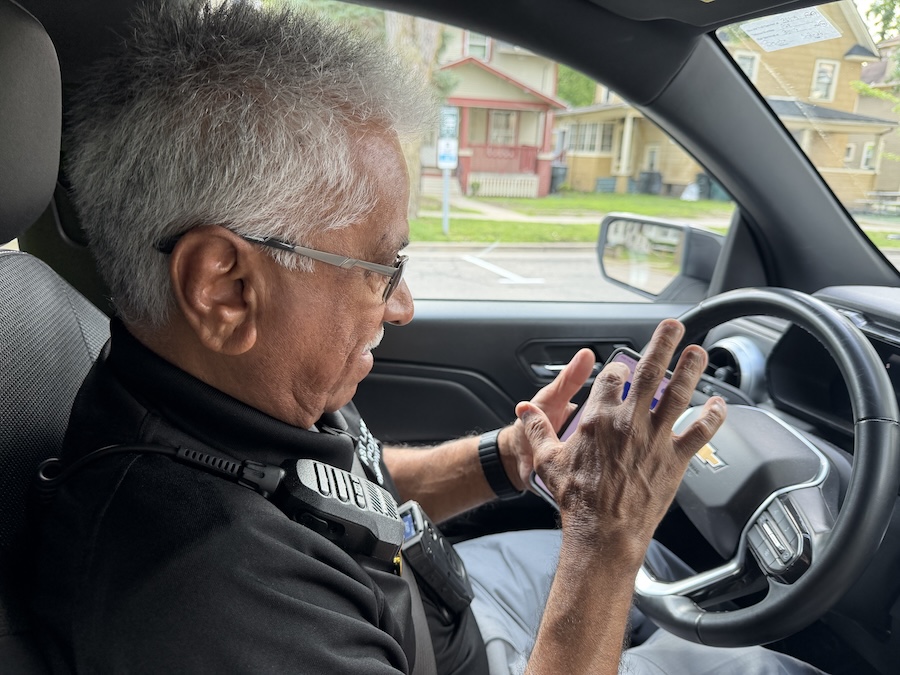
The world has entered a digital age that the “meter maids” of yesteryear would not recognize. Instead of checking each parking meter individually, Tauqi can simply pull out his phone and see in an app the meters that have expired and those that should be empty.
Tauqi is gentler about his job than some might assume. He said if he sees someone sitting in a car in a spot where they aren’t sanctioned to be, he will either ask them to move or simply ignore them. He knows some people like to sit in their cars to eat lunch and will move on once they’re done. He doesn’t waste time with these drivers because he knows that when he returns to the lot on his next sweep in 15 minutes, they will be gone.
Both he and Weidner emphasized that there are no quotas PACE officers must meet in doling out citations.
“Before I issue a ticket, I just look around to see if somebody’s running [and says], ‘Hey, this is my car,’” Tauqi said. “I wait a couple minutes before I ticket.”
In the Evergreen parking lot near Peoples Church, Tauqi and Grabowski write tickets to two vehicles. Tauqi tells me that he drives through this lot so often that he knows which vehicles are permitted to park there — those owned by city employees — and which are the violators. He said parents of Peoples Church Preschool students will often park there to drop off their children, but he typically overlooks these temporary interlopers.
At The Graduate Hotel downtown, there is a line of vehicles waiting outside the valet parking stand on Evergreen Avenue and wrapping around Albert Avenue. Tauqi puts the PACE truck in park, and one of the valets jogs over to his window. Tauqi says the approaching man is a former PACE officer.
Tauqi tells the young man at his window that they need to get the traffic jam under control. The valets drive the cars to spaces the hotel leases several blocks away and then jog back to park another car.
As the valet departs, Tauqi notices a truck that has been left idling in the procession near Peoples Church with no one in the cab. He waits several minutes before running across the street to issue a citation to the vehicle for illegal parking. When he returns, he tells me that The Graduate has been the cause of several citations and traffic headaches since it opened without on-site parking.
PACE doesn’t deal only with errant downtown parkers. As we ride through the Red Cedar neighborhood, Tauqi points out a car on Daisy Lane parked on the grass next to the driveway.
This is illegal according to city code.
“I remember that car,” he said. “I’ve ticketed it three times.”
Today will be the fourth. He sends Grabowski to issue the citation, reminding her to take photos of where the car is parked and its license plate.
Two more vehicles parked on lawns in the Marble neighborhood earn tickets. While making the rounds, Tauqi mentions that some of the lawns are looking overgrown, but not yet to the point where he will issue a warning. PACE gives warnings to homeowners with unkempt lawns or unshoveled sidewalks.
“Mostly, it’s the neighbors who complain,” Tauqi said. “Each neighborhood seems to have one person who watches for these things. I like to give them a warning before the weekend so they have until Monday to take care of it.”